Who’s the Boss?

We were supposed to meet in the hotel lobby at ten after six. “Ladies, I’ll see you in the lobby at six ten,” instructed Ami, (pronounced Aimee). Ami is our coordinator for the Women’s Economic Security Campaign (WESC) and she is always telling us what to do. Ami should not be confused with my mother who we also called Ami (pronounced Ummi). Come to think of it Ami, my mother, was also often telling people what to do. And Ami, our coordinator, was herding us around like a bunch of kids. So much so that I noticed some of the ladies in our group started calling her Mom. “Okay, Mom. We’ll be there at ten after six.”

WESC is a collaborative of four women’s funds. My colleagues from Chicago, Memphis and DC and I are working together in collaboration with the Women’s Funding Network to improve economic security for women and girls. Earlier this month, WESC released the second in a series of policy reports, Aiming Higher: Removing Barriers to Education, Training and Jobs for Low-Income Women, which focuses on job creation, training and supports for low-income women. We were in DC to release the report and meet with national advisors and policymakers. Ami had arranged everything for the trip. And if it weren’t for her we would never have gotten our act together to actually complete the report.

We all have big important jobs and we work hard, but left to our own devices we could never accomplish all the things we want to do with this campaign, so we hired Ami. Through our work together, we’ve also really come to enjoy each other.

“Let’s go to the bar and get a drink,” Shelley said. Shelley is from the Chicago Foundation for Women and like me, she loves red wine, preferably a full-bodied red like a Cabernet or Zinfandel. “I need to go up to my room and change really quickly. I’ll meet you there,” Shelley said.

“Sounds good,” the rest of us said in unison. We’re a very agreeable group which is an essential quality for a collaborative.

“I’ll have a Pinot Grigio,” Jennifer said when we got to the bar. Jennifer is the Interim Co-President and Vice President of Programs for the Washington Area Women’s Fund. She has two jobs so she really needed that glass of wine.

“Make that two,” said Shante, our colleague from the Women’s Foundation for a Greater Memphis. When Shelley came down, she ordered a Cabernet.

My boss, the President of the Women’s Foundation of California joined us a few minutes later. “Can I get you anything?” the waiter asked.

“No,” Judy replied. “I’m just going to sit here and watch them drink.” Judy enjoys a glass or two of wine from time to time, but she was getting ready to head to the airport. She had to leave us early.

“Too bad you can’t join us at the White House,” we said to Judy. Ami and Shelley had worked together to get us a meeting with Tina Tchen, the Executive Director of the White House Council on Women and Girls. We were talking with excitement about this meeting when Ami found us in the bar.

“I knew I’d find you ladies in here,” Ami said appearing at our table and tapping her watch with her index finger.

“Is it ten after six already?” we said earnestly. “Time flies.”

“Let’s go, ladies. We don’t want to be late.” We had been invited by a well-connected DC colleague, Kathy, to her apartment at the Watergate. Kathy, who has done some communications work with some of our funds, was kind enough to invite some DC-based feminist leaders to have dinner with us. Everything was lovely, including her apartment and the dinner she had arranged. “Ruth Bader Ginsburg used to live just a few doors down,” Kathy told us. “And Condie Rice. She lived down there.”

My WESC colleagues and I put on our networking faces and charmed the elder feminists. Marcia Greenberger, the executive director of the National Women’s Law Center was there. And Ellie Smeal from the Feminist Majority was there with her colleague Kathy Spillar, the executive editor of Ms. Magazine.

We all nibbled on salmon, and chicken, and salads as we continued drinking wine.

“Ladies, we’ve got an early morning tomorrow,” Ami was trying to get us out the door after the chocolate cake had been served. Kathy told us we could get a cab at the Kennedy Center across the street.

It was spitting rain and slightly chilly and we were not happy with having to walk the short block. “Where’s the taxi stand?” we asked Ami expecting her to know the details of the Kennedy Center taxi stand.

“Maybe it’s up those stairs,” she said.

“Up the stairs?” Ruby, the executive director of the Women’s Fund for a Greater Memphis moaned. She had heels on and was not having it. And the rain was really complicating things. I’m surprised Ami didn’t remind everyone to bring an umbrella. I had my umbrella which was good because Shante kept sidling up to me trying to get cover from the rain. She forgot her umbrella. Jennifer and Ruby also forgot their umbrellas so they wrapped their shawls around their heads which made them look like they were good Muslim ladies wearing hijab.

“There’s the taxi stand,” Ami said pointing to a sign.

“But there are no taxis,” we noted as if Ami was not smart enough to notice the absence of any cabs. I think we were getting a bit too reliant on Ami’s coordinating skills. Surely the rest of us knew how to look up a cab company on our fancy iPhones and Blackberries. But instead we looked at Ami, like a bunch of kids. “What are we supposed to do now?” we asked Ami.

Ami called us a couple of cabs, and we waited. And waited. For forty minutes. In the drizzle.
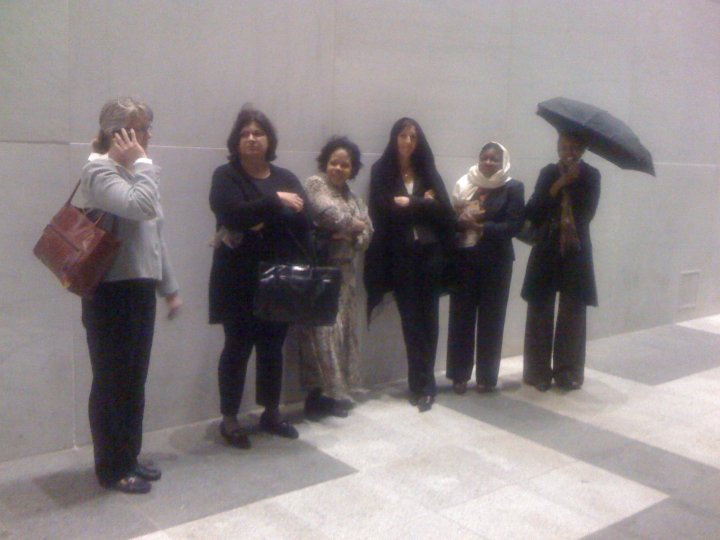
Ami is the one on the left on the phone trying to get us a cab as the rest of us look on while we wait in the rain at Kennedy Center.

“I want to see you at 8 am,” Ami said to me when we got back to the hotel. “And I want to see you at 8 am,” she instructed Ruby. She said the same thing to each of us. I was expecting the next words out of her mouth to be “and not a minute later,” but she was gentle with us. Ami has two young boys, and I could tell she had good, caring parenting skills. “Get a good night’s sleep,” she added.

The next day we had a series of meetings with our national advisors, and had to tape a segment for a webcast for the Spotlight on Poverty and Opportunity. Ami had us do a run through of the webcast earlier in the morning, reminding us each of our roles. “You’ll all be great,” she cheered.

When we got to the studio for the taping, the news anchor who was going to interview us was late, and Ami was not happy. “We need to get back to the hotel for the meeting with our national advisors by 11:30,” she said. Too bad Ami, wasn’t coordinating the anchor’s schedule. If she had, we would not be running late.

“Can we bring our notes on to the set?” we asked.

“No,” replied Ami. “But you guys know all this stuff. You’ll do great.” We couldn’t help but notice that the news anchor, when she finally arrived, not only got to bring her notes on the set, but she also had an ear piece into which the producer would speak to her giving her guidance.

“Why can’t we have Ami talking to us through an ear piece in case we forget anything?” we wanted to know. No one even bothered answering that question.

After the webcast taping we rushed back to the hotel for our lunch meeting. And then like clockwork, at 1pm we left for the White House, where we arrived in two cabs.

“Is this the right entrance?” we asked from the backseat of the cab. Ami was sitting up front with the cab driver and decided to go out and check. “You stay in the cab,” she told us.

When a police car pulled up to the cab, we knew we were at the wrong entrance. “You know you’re not supposed to be here, right?” the officer said over his speaker.

The cab began to pull away just as Ami was running back, and she jumped back in just before it took off. “We need to go to the Pennsylvania Avenue and 14th Street entrance,” Ami instructed the cab driver.

We arrived at the Northwest gate and waited for the rest of our colleagues who were in another cab. Ami got out her cell phone and guided them to the right entrance. “Walk faster,” she said.

When we were all assembled, Ami looked us over. I almost expected her to start fixing our hair, or straightening our collars. “Let’s go ladies,” she said as she rang the buzzer. After making sure our names were on the security list, the guard buzzed us in. We had to put our bags through an x-ray machine and we walked through a scanner, each one of us causing it to beep. Each of us was then scanned with a wand and passed through to the other side. We walked to the West Wing where we were greeted in the lobby by a young receptionist sitting at the cleanest desk I have ever seen. There was not a thing on it. I later noticed that she had a computer, but it was embedded in the desk.

“Remember our pact,” Shelley said. “No acting cool as a cucumber. We need to get some photos while we’re here.”
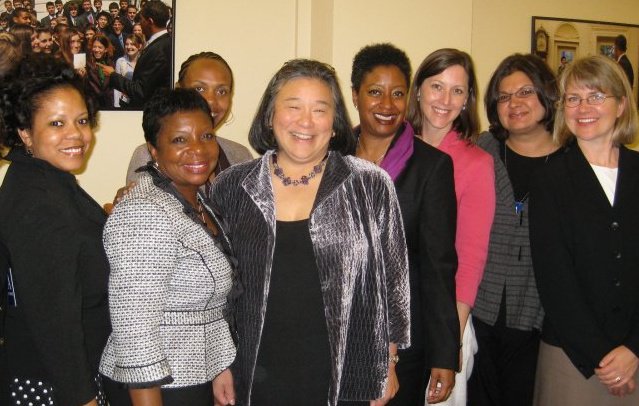
With Tina Tchen at the White House Council on Women and Girls. From left, Shante, Ruby, Shaune, Tina Tchen, Shelley, Jennifer, me, and Ami.

As we walked out of the West Wing, we passed by Valerie Jarrett’s office. “Someone told me that used to be Karl Rove’s office,” one of us whispered.

Back outside, we wanted to take a photo in front of the West Wing entrance. We were instructed by White house staff and security not to take any photos but Ami gave us permission, so we stopped and everyone got their cameras out. Ami even got in the photo with us.
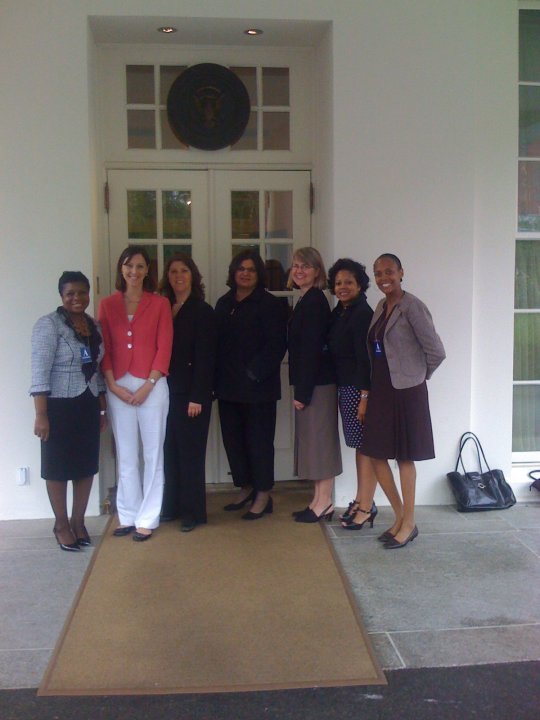
At the entrance to the West Wing: Ruby, Jennifer, Shara, me, Ami, Shante, and Shaune. Shelley is not pictured since she took this photo.

Cattle Call

One of my uncles writes regular commentary for the Pakistani newspapers. Once in a while he will forward his articles and other noteworthy pieces to family and friends. For some reason, I am not on his email list, but Jenny is.

She showed me an email he sent the other day. Apparently it is an actual essay written by a candidate applying to the Pakistani Civil Service (CSS). Although upon further internet research, I noticed that a Bihari candidate applying to the Indian Civil Service supposedly wrote the same essay for his exam. And they say Indians and Pakistanis can’t agree. Or maybe it is a case of plagiarism. Who knows? Maybe it isn’t even real, but it is entertaining. Apparently the Pakistani and Indian candidates, if this is to be believed, wrote their civil service essay exams on the Cow.

Titled simply, “Cow,” it begins, “He is the cow. The cow is a successful animal. Also he is 4 footed. And because he is female, he gives milks, [but will do so when he is got child.].” After reading this first part of the essay, I started giggling. I wonder if the writer meant to make the Cow transgender.

“He is same like-God, sacred to Hindus and useful to man. But he has got four legs together. Two are forward and two are afterwards.” Afterwards?

“His whole body can be utilized for use. More so the milk. Milk comes from 4 taps attached to his basement. [horses don’t have any such attachment].” The taps are attached to his basement? This made me think how my taps are not attached to my basement.

“What can it do? Various ghee, butter, cream, curd, why and the condensed milk and so forth.” I think he meant to write whey, not why.

“Also he is useful to cobbler, water mans and mankind generally. His motion is slow only because he is of lazy species. Also his other motion. {gober} is much useful to trees, plants as well as for making flat cakes [like Pizza], in hand, and drying in the sun.” The flatcakes he refers to are dung patties, which are used for fuel for heating and cooking.

“Cow is the only animal that extricates his feeding after eating,” Really? What do the other animals do after they eat?

“Then afterwards he chews with his teeth that are situated in the inside of the mouth.” Good to know. What else would the Cow chew with? The writer may be interested to know that I also chew with the teeth inside my mouth.

“He is incessantly in the meadows in the grass,” True enough. The Cows are always in the meadows and the grass.

“His only attacking and defending organ is the horns, specially so when he is got child.” Is he referring to the transgender Cow again? “This is done by knowing his head whereby he causes the weapons to be paralleled to the ground of the earth and instantly proceed with great velocity forwards,” if I were an editor, I might suggest he rewrite that last sentence.

“He has got tails also, situated in the backyard, but not like similar animals. It has hairs on the other end of the other side. This is done to frighten away the flies which alight on his cohesive body here upon he gives hit with it.” Okay seriously. Is this for real?

“The palms of his feet are soft unto the touch. So the grasses head is not crushed. At night time have poses by looking down on the ground and he shouts. His eyes and nose are like his other relatives. This is the cow.”

The cow. His four taps in his basement are showing.

Clearly, I need to get on my uncle’s mailing list. In the meantime, I decided to check out the CSS website as well as the Indian Civil Services exam requirements.

The Indian essay exam has five general topics that applicants are required to choose from including, “Good fences make good neighbors,” and “Are our traditional handicrafts doomed to a slow death?” Applicants can also choose to write about “Globalism vs. Nationalism,” or “Are we a ‘soft’ state?”

The Pakistani CSS exam offers many more options for essay topics, which include, “Man is Condemned to be Free,” or “Spare the Rod and Spoil the Child,” or “Not Everyone in Chains is Subdued.” Here’s one the makes no sense, “One Today is Worth Two Tomorrows.” The options also include an essay on, “A Living Dog is Better Than a Dead Lion.” My personal favorite topic might be, “All that Glitters is not Gold.” But then I saw an option to write about “Frailty thy Name is Woman.”

This one threw me for a bit of a loop, “There is a tide in the affairs of men. Which, taken at the flood, leads on to fortune.” I have no idea what this means.

One can also write about “Weather Forecasting,” or “Table Manners,” or ‘Sports for Women–Suitable and Unsuitable.” And here’s a particularly appropriate one for many a nation state, “Is Democracy Out of Date?”

Another option is to write about the “Theater of the Absurd,” which is what I feel like I am doing right now.

Working for the (Wo)man

I am having a lot of fun with this blog. I’ve been wanting to write some of these stories for years, especially the ones about my family. I hadn’t planned on starting a blog. It was not one of my new year’s resolutions. It was not on my list of things to do, but earlier this month, somewhat on a whim, I entered my first post.

I’ve always had a love-hate relationship with writing. Kind of like going to the gym. I feel good and accomplished afterward, but I don’t much care for the actual activity while I’m doing it. Not so with this blog. I am really enjoying the act of writing and wish I could spend even more time with it everyday. But alas, I have a job. A demanding one. That keeps me really busy. And even though today is technically a holiday (happy birthday, Dr. King) I need to get back to work since the Women’s Foundation of California, where I am happily employed, is holding a big statewide conference for community leaders and donors later this week. It’s called Connecting California 2010 and I’m excited about it, if not a bit focused on the multiple details that come with hosting 200 people–but I’ve had good training in all things related to entertaining and I love a good party. Thanks to my mother (and my sisters). So the blogging will have to happen at odd hours of the morning and night, and on weekends.

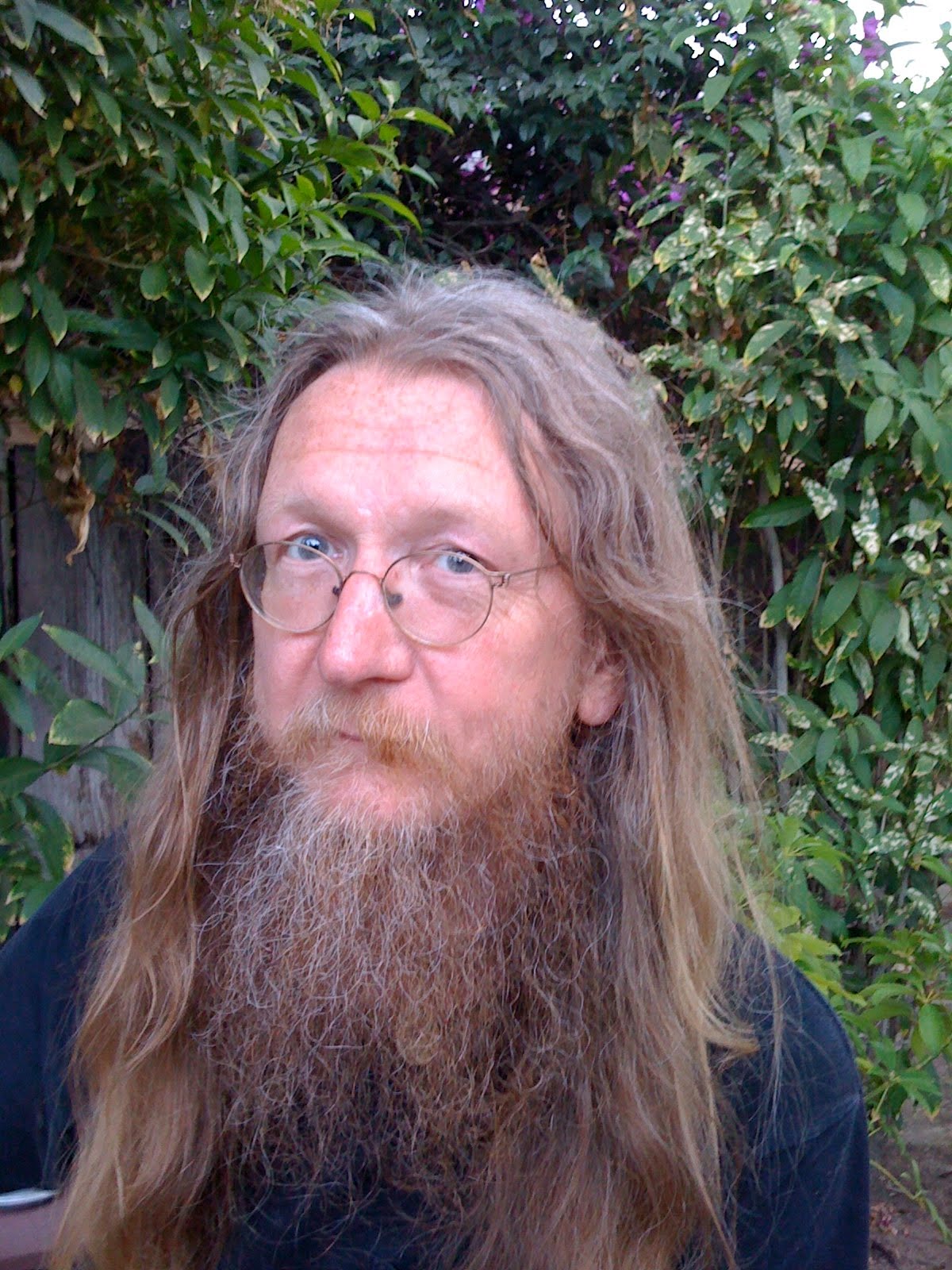
So off to work I go. Which reminds me of Jenny’s brother, Dane. My brother-not-in-law. He’s the oldest sibling of three. A really smart guy, with long hair, beard and mustache. Yes, that’s right, he’s a hippie. Dane has many talents, but he does not like working for “the man.” So I said to him, “Don’t. I work for the woman. You can too.”

Here’s Dane. He’s considering working for the (Wo)man.

Chicks is Our Business

My father came from a long lineage of military men. They held distinguished titles like Air Marshall and Brigadier General. In the early 1960s, before I was born, my father retired from the Pakistani Navy and went into the chicken business. After that he was still known as Commander Afzal Khan or Commander Saab.

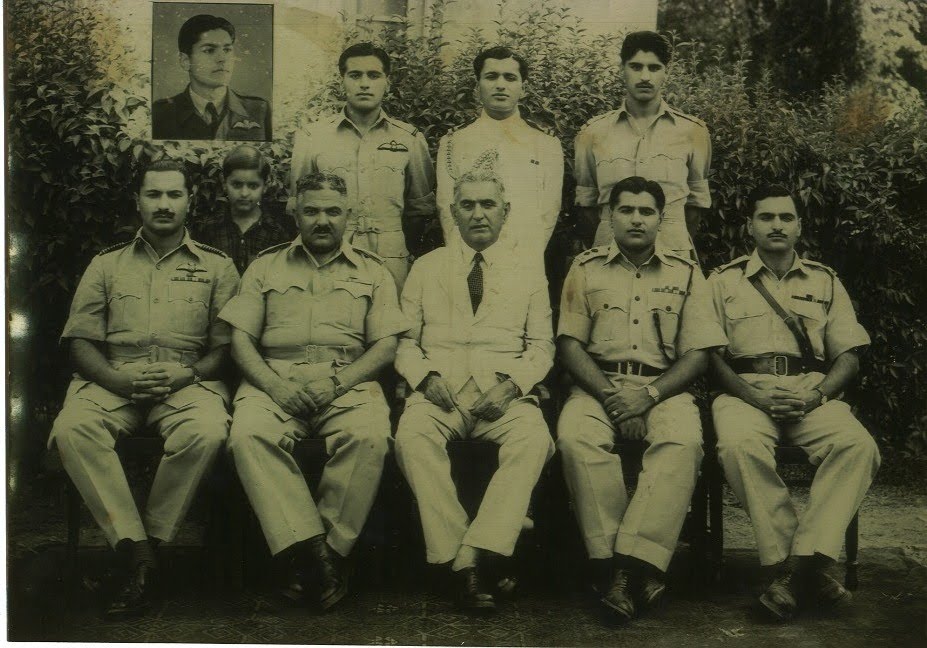
My father with his brothers and my grandfather. 
My grandfather is seated in the middle, the only one of the grown men not dressed in military attire and my father is standing directly behind him. The super-imposed photo on the upper left is another brother, Asif, who died in a plane crash while serving in the Air Force, before this photo was taken.

My parents were married in 1954. My mother, Sunnaiya, or Sunny as she was called affectionately by family and friends, was just eighteen years old, my father about nine years older. Shortly after their wedding, my father was posted to the UK. And my mother, who came from a wealthy family, had to adjust to living on a military salary. She wrote in a letter to a friend in November 1954, “Can you imagine I do all the sheets and towels by hand? I cook, clean, wash, iron, and in short am a drudge of all work and yet don’t seem to mind in the least as Afzal’s image is always in my mind and his love in my thoughts.”

The love between Sunny and Afzal was strong, but I’m sure living on a tight budget had its challenges,  especially for a woman who was used to every luxury. At one point while they were living in England, as my mother once recounted to me, she said to my father, “I wish we could have chicken for dinner just one night.” And he replied, “If you wanted chicken for dinner, you should have married someone else.”

Hearing this story growing up, I always thought it was romantic that my father chose to go into the chicken business. His business choice probably had more to do with the fact that Pakistan was a new nation, not even twenty years old, and there were many opportunities in building the agricultural infrastructure of the country, but I think it’s romantic that he chose chickens.

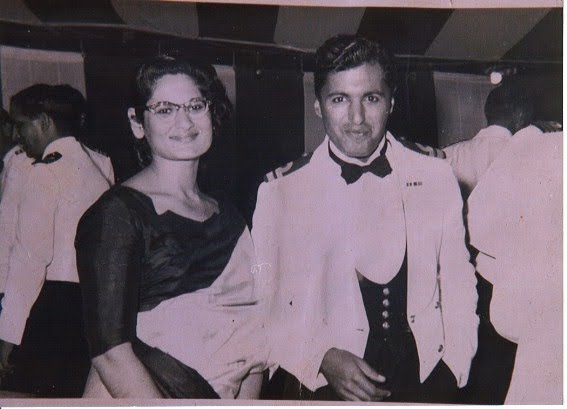
Here’s a photo of my parents as a young married couple. 
I think it was taken when they were living in the UK.

In any case, he purchased a subsidiary of Arbor Acres Inc., which was headquartered in Glastonbury, Connecticut and went on to become a very successful businessman until he became ill and passed away in the late 1980s. Now the family company is basically defunct, although  my eldest brother continues to benefit financially from my parents estate. He’s the only one among us who got anything from their estate, refusing to share it with his siblings, but that’s another story.

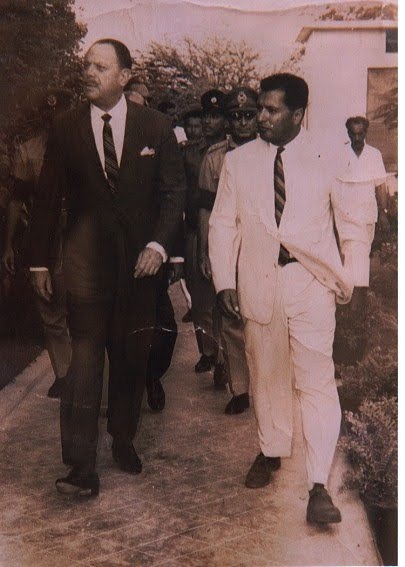
Here’s my father with Pakistani President Ayub Khan, touring the Arbor Acres farms. Ayub Khan was the first military ruler of Pakistan, from 1958-1969. 

In its heyday, the motto for Arbor Acres  was “Chicks is Our Business.” I wonder if I took this very literally on  some kind of subconsious level. For one thing  there is this issue that I am a lesbian, and now I work in women’s philanthropy. Chicks is my business too.

Christian Reconstructionism is Hard

I get a perverse sense of satisfaction when the right wing writes about me.

Have you ever heard of Paliban Daily? Me either. It’s a website dedicated to “what Christians (and other fundamentalists) are up to in the world.” I came across it today because it popped up when I was searching my name on Google. Right, like you’ve never searched for yourself on Google.

Anyway, they think I have grasped the concept of Christian Reconstructionism. I take this as a big compliment given that I studied the Christian Right for many years when I was a researcher at Political Research Associates. It took me a good while to grasp Christian Recontructionism.

As they say on Paliban Daily, the goal of Christian Reconstructionism  “is to replace the secular Constitution with God’s Law.” This may seem like a simple concept but there’s a lot more to it. I read books, attended right wing conferences, poured over direct mail from organizations like the Family Research Council, Concerned Women for America, and the Chalcedon Foundation (the go-to place for all things Christian Reconstructionist).  I even took a guided tour of Focus on the Family for God’s sake. I mean that very literally. So when a self-declared Christian Rightist says I’ve grasped the concept of Christian Reconstructionism, it makes me happy.

The title of the post is “Liberal Grasps Reconstruction,” and it is in response to an article I authored last year, titled, Tying the Not: How the Right Succeeded in Passing Proposition 8. In the article I note that “the broader agenda that the Christian Right will continue to pursue will promote Christian nationalism, an ideology that seeks to use laws and regulations to promote fundamentalist Christian values on the nation.” This is the basis of Christian Reconstructionism.  Glad to know the folks at Paliban Daily think I got it right. They did say my article is “rather wordsome,” but whatever. Christian Reconstructionism is hard.

They go on to say that I work for a “sexist and ungodly group that supports and promotes women–only women–seeking leadership positions.” This is in reference to my current place of employment, the Women’s Foundation of California.

Egads! Supporting and promoting women. Shame on me.