We were supposed to meet in the hotel lobby at ten after six. “Ladies, I’ll see you in the lobby at six ten,” instructed Ami, (pronounced Aimee). Ami is our coordinator for the Women’s Economic Security Campaign (WESC) and she is always telling us what to do. Ami should not be confused with my mother who we also called Ami (pronounced Ummi). Come to think of it Ami, my mother, was also often telling people what to do. And Ami, our coordinator, was herding us around like a bunch of kids. So much so that I noticed some of the ladies in our group started calling her Mom. “Okay, Mom. We’ll be there at ten after six.”
WESC is a collaborative of four women’s funds. My colleagues from Chicago, Memphis and DC and I are working together in collaboration with the Women’s Funding Network to improve economic security for women and girls. Earlier this month, WESC released the second in a series of policy reports, Aiming Higher: Removing Barriers to Education, Training and Jobs for Low-Income Women, which focuses on job creation, training and supports for low-income women. We were in DC to release the report and meet with national advisors and policymakers. Ami had arranged everything for the trip. And if it weren’t for her we would never have gotten our act together to actually complete the report.
We all have big important jobs and we work hard, but left to our own devices we could never accomplish all the things we want to do with this campaign, so we hired Ami. Through our work together, we’ve also really come to enjoy each other.
“Let’s go to the bar and get a drink,” Shelley said. Shelley is from the Chicago Foundation for Women and like me, she loves red wine, preferably a full-bodied red like a Cabernet or Zinfandel. “I need to go up to my room and change really quickly. I’ll meet you there,” Shelley said.
“Sounds good,” the rest of us said in unison. We’re a very agreeable group which is an essential quality for a collaborative.
“I’ll have a Pinot Grigio,” Jennifer said when we got to the bar. Jennifer is the Interim Co-President and Vice President of Programs for the Washington Area Women’s Fund. She has two jobs so she really needed that glass of wine.
“Make that two,” said Shante, our colleague from the Women’s Foundation for a Greater Memphis. When Shelley came down, she ordered a Cabernet.
My boss, the President of the Women’s Foundation of California joined us a few minutes later. “Can I get you anything?” the waiter asked.
“No,” Judy replied. “I’m just going to sit here and watch them drink.” Judy enjoys a glass or two of wine from time to time, but she was getting ready to head to the airport. She had to leave us early.
“Too bad you can’t join us at the White House,” we said to Judy. Ami and Shelley had worked together to get us a meeting with Tina Tchen, the Executive Director of the White House Council on Women and Girls. We were talking with excitement about this meeting when Ami found us in the bar.
“I knew I’d find you ladies in here,” Ami said appearing at our table and tapping her watch with her index finger.
“Is it ten after six already?” we said earnestly. “Time flies.”
“Let’s go, ladies. We don’t want to be late.” We had been invited by a well-connected DC colleague, Kathy, to her apartment at the Watergate. Kathy, who has done some communications work with some of our funds, was kind enough to invite some DC-based feminist leaders to have dinner with us. Everything was lovely, including her apartment and the dinner she had arranged. “Ruth Bader Ginsburg used to live just a few doors down,” Kathy told us. “And Condie Rice. She lived down there.”
My WESC colleagues and I put on our networking faces and charmed the elder feminists. Marcia Greenberger, the executive director of the National Women’s Law Center was there. And Ellie Smeal from the Feminist Majority was there with her colleague Kathy Spillar, the executive editor of Ms. Magazine.
We all nibbled on salmon, and chicken, and salads as we continued drinking wine.
“Ladies, we’ve got an early morning tomorrow,” Ami was trying to get us out the door after the chocolate cake had been served. Kathy told us we could get a cab at the Kennedy Center across the street.
It was spitting rain and slightly chilly and we were not happy with having to walk the short block. “Where’s the taxi stand?” we asked Ami expecting her to know the details of the Kennedy Center taxi stand.
“Maybe it’s up those stairs,” she said.
“Up the stairs?” Ruby, the executive director of the Women’s Fund for a Greater Memphis moaned. She had heels on and was not having it. And the rain was really complicating things. I’m surprised Ami didn’t remind everyone to bring an umbrella. I had my umbrella which was good because Shante kept sidling up to me trying to get cover from the rain. She forgot her umbrella. Jennifer and Ruby also forgot their umbrellas so they wrapped their shawls around their heads which made them look like they were good Muslim ladies wearing hijab.
“There’s the taxi stand,” Ami said pointing to a sign.
“But there are no taxis,” we noted as if Ami was not smart enough to notice the absence of any cabs. I think we were getting a bit too reliant on Ami’s coordinating skills. Surely the rest of us knew how to look up a cab company on our fancy iPhones and Blackberries. But instead we looked at Ami, like a bunch of kids. “What are we supposed to do now?” we asked Ami.
Ami called us a couple of cabs, and we waited. And waited. For forty minutes. In the drizzle.
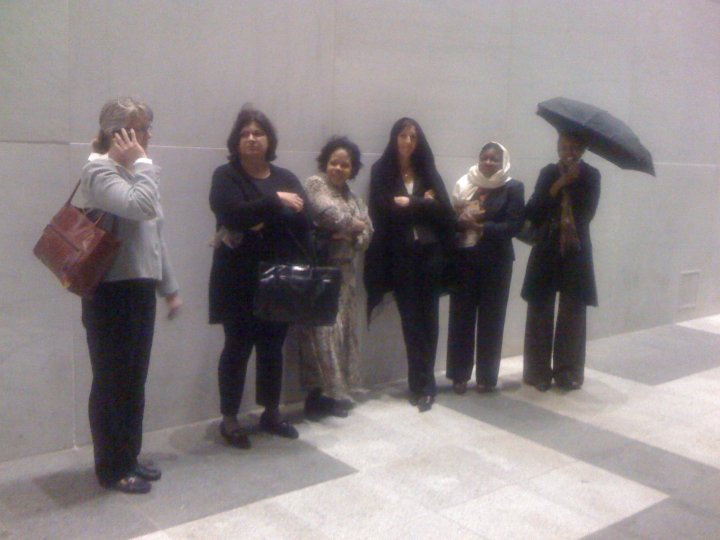
Ami is the one on the left on the phone trying to get us a cab as the rest of us look on while we wait in the rain at Kennedy Center.
“I want to see you at 8 am,” Ami said to me when we got back to the hotel. “And I want to see you at 8 am,” she instructed Ruby. She said the same thing to each of us. I was expecting the next words out of her mouth to be “and not a minute later,” but she was gentle with us. Ami has two young boys, and I could tell she had good, caring parenting skills. “Get a good night’s sleep,” she added.
The next day we had a series of meetings with our national advisors, and had to tape a segment for a webcast for the Spotlight on Poverty and Opportunity. Ami had us do a run through of the webcast earlier in the morning, reminding us each of our roles. “You’ll all be great,” she cheered.
When we got to the studio for the taping, the news anchor who was going to interview us was late, and Ami was not happy. “We need to get back to the hotel for the meeting with our national advisors by 11:30,” she said. Too bad Ami, wasn’t coordinating the anchor’s schedule. If she had, we would not be running late.
“Can we bring our notes on to the set?” we asked.
“No,” replied Ami. “But you guys know all this stuff. You’ll do great.” We couldn’t help but notice that the news anchor, when she finally arrived, not only got to bring her notes on the set, but she also had an ear piece into which the producer would speak to her giving her guidance.
“Why can’t we have Ami talking to us through an ear piece in case we forget anything?” we wanted to know. No one even bothered answering that question.
After the webcast taping we rushed back to the hotel for our lunch meeting. And then like clockwork, at 1pm we left for the White House, where we arrived in two cabs.
“Is this the right entrance?” we asked from the backseat of the cab. Ami was sitting up front with the cab driver and decided to go out and check. “You stay in the cab,” she told us.
When a police car pulled up to the cab, we knew we were at the wrong entrance. “You know you’re not supposed to be here, right?” the officer said over his speaker.
The cab began to pull away just as Ami was running back, and she jumped back in just before it took off. “We need to go to the Pennsylvania Avenue and 14th Street entrance,” Ami instructed the cab driver.
We arrived at the Northwest gate and waited for the rest of our colleagues who were in another cab. Ami got out her cell phone and guided them to the right entrance. “Walk faster,” she said.
When we were all assembled, Ami looked us over. I almost expected her to start fixing our hair, or straightening our collars. “Let’s go ladies,” she said as she rang the buzzer. After making sure our names were on the security list, the guard buzzed us in. We had to put our bags through an x-ray machine and we walked through a scanner, each one of us causing it to beep. Each of us was then scanned with a wand and passed through to the other side. We walked to the West Wing where we were greeted in the lobby by a young receptionist sitting at the cleanest desk I have ever seen. There was not a thing on it. I later noticed that she had a computer, but it was embedded in the desk.
“Remember our pact,” Shelley said. “No acting cool as a cucumber. We need to get some photos while we’re here.”
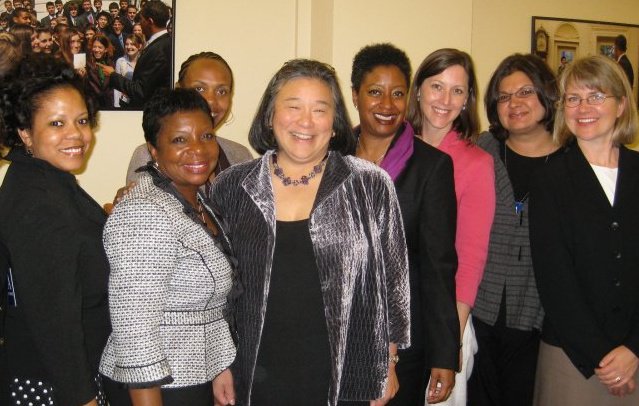
With Tina Tchen at the White House Council on Women and Girls. From left, Shante, Ruby, Shaune, Tina Tchen, Shelley, Jennifer, me, and Ami.
As we walked out of the West Wing, we passed by Valerie Jarrett’s office. “Someone told me that used to be Karl Rove’s office,” one of us whispered.
Back outside, we wanted to take a photo in front of the West Wing entrance. We were instructed by White house staff and security not to take any photos but Ami gave us permission, so we stopped and everyone got their cameras out. Ami even got in the photo with us.
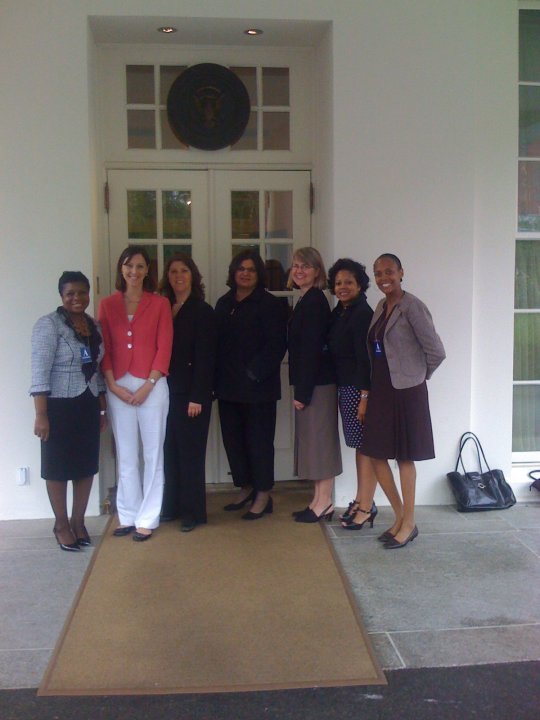
At the entrance to the West Wing: Ruby, Jennifer, Shara, me, Ami, Shante, and Shaune. Shelley is not pictured since she took this photo.


 Leaving Pakistan