My Big Gay Funeral

We invited Jenny’s mom, Pat, to move to Long Beach the same year we moved here, in 2003. After many years of teaching elementary and middle school, she had retired and was living in Newburyport, Massachusetts and was starting to have a little trouble. Mostly small stuff, like opening a jar or making sense of her landlord’s puzzling demands. And since we had just moved to southern California we thought it would be a good idea for her to join us, especially since one of Jenny’s brothers, Neal lived nearby. “She’s getting old,” I said to Jenny. “She’s going to need help doing things.”

Pat, after she moved to Long Beach

Pat was happy when we suggested she move here. “My children have invited me to live closer to them,” she would say proudly.

Pat adored her kids, Dane, Neal, and Jenny. Sometimes I would poke fun, “Pat, I don’t know how you did it, but you managed to raise two gays and a hippie.”

Before the hippie grew his hair long and the two gays came out.

The gay stuff didn’t seem to bother her, at least by the time I came on to the scene. She welcomed me into her family when Jenny and I got together. “It’s been a happy time for me this past week to have you visit with Jennifer,” she wrote to me in 2002. “I enjoyed seeing you and Jennifer giving so much of your caring support to each other in your work and daily life.” Later that year, I started calling her my mother-not-in-law.

When we first met.

Jenny’s brother Neal is a big gay too, but he didn’t come out to Pat until after she moved to Long Beach. When she was well into her 70s and he was well into his 40s.

Before we moved to Long Beach, Jenny and I were living in San Francisco, and we invited Pat to visit us over her birthday. Neal decided he would fly up from Orange County to surprise Pat. So he flew up and let himself into to our apartment while the three of us were out to lunch. When we came back, Neal hid in the closet of the guest bedroom. And when Pat went into the bedroom, Neal jumped out of the closet.

“Oh my goodness!” Pat shrieked in surprise. “Neal, how long have you been in there?”

“Oh about 45 years,” Neal responded. Perhaps, subtly, or maybe not so subtly, trying to come out to her.

Later that evening, as we recounted the story to our friends Jim and Matthew, Pat said gently, “Neal, are you trying to tell me something?”

Neal is a big gay.

Neal and Pat had a special relationship. He was her second child and they always had a strong bond. She visited him every winter and would stay three or four months. The two of them were inseparable. “Meet my significant mother,” Neal started saying.

After she moved to Long Beach, Pat did her best to be helpful. She called often.

“Girls,” she said once on the answering machine. “I just saw on the news that there’s a virus and it’s coming to California. On the computers. You know like the ones you two use? Well, they say the virus should be here by noon, so make sure you turn your computers off.”

She did the same thing to Neal. “Oh Neal,” she said leaving a message on his answering machine. “I just read an article in the Boston Globe, and it said men who tie their ties too tight get glaucoma, so don’t tie your tie too tight, okay?”

Sometimes when she’d get overly anxious, I’d say, “Pat, your having a patty meltdown.”

Even in these last years of her life, she kept making us laugh. A year or two ago, she was taken to the hospital and they had her all rigged up with wires and patches, probably monitoring her heart beat or some such thing.

We rushed to the hospital and when we got to her bedside, she looked at us, deadpan. “I’m wired.”

Sometimes her sense of humor was a little racy. “When they’re toes to toes his nose is in it, and when they’re nose to nose, his toes are in it.” I’m still figuring that one out. But it sounds inappropriate.

A few years ago, we were getting in our car. Pat was buckling herself up in the back seat and I turned to her wanting to know if she had enough room. “Are you good back there?” I asked.

“I’m trying to be,” Pat said. And she was good. For all of her 82 years.

Pat passed away peacefully on December 10 with Neal at her side holding her hand and playing music. Silent Night was on the iPod and the words “sleep in heavenly peace” had just played when she took her last breath.

Now we’re planning her memorial service and I’m beginning to think it’s pretty gay. We asked her former neighbor and good friend, Bill Benson, to officiate the service. “I think you’re really going to like my neighbor,” Pat said when she met Bill. “He’s gay.”

And the funeral director is gay too. Even the priest who is going to say a prayer for Pat is a gay.

I’m beginning to think we should call Pat’s memorial service, “My Big Gay Funeral.” I’m sure the hippie will not be offended.

Read more about Pat on her Memorial website.
Bed Rest

I was feeling feverish. “I think I’m dying,” I told my mother. She held the back of her hand up to my forehead. “You do feel a bit warm,” she said.

We were in a taxi, on our way to the Golden Temple in Amritsar, the last of our stops on our summer holiday in India. “When we get back to the hotel, we’ll get you some aspirin.”

Aspirin? “No, really. I think I’m dying,” I repeated. But we continued on to the Golden Temple and took our tour as I sighed audibly the entire time.

“I might faint,” I complained.

“You’ll be fine,” Ami responded. “Just a slight fever.” Ami was not into organized medicine. And after six children, she knew the symptoms for most illnesses. She had been through the chicken pox, the measles, the mumps, pneumonia, and general malaise, multiple times. She knew how to treat a sick kid.

As a result, I don’t like going to the doctor. When I do go, which was erratic until recent years, they were always poking and prodding me, sometimes in unusual places. And they always need to weigh you, after which the nurse might say the dreaded words, “You’ve gained a few pounds since your last visit.”

I hardly ever get sick so for years I just avoided the doctor altogether, often with a little help from my mother.

“This form needs to be signed by a doctor,” I said on pretty much an annual basis before the school year started. “It says I need a physical.”

“Call Doctor Malik and invite him to dinner,” Ami would respond. Dr Malik was a friend of the family. I think he had a general medical practice, which you’d think would prevent him from signing a medical form without giving me a physical. But my mother was a persuasive woman.

“She’s a healthy girl,” Dr. Saab,” Ami would say after an elaborate dinner. “No need to examine her. You can sign the form here.”

The only time a Doctor was called in for actual medical treatment, was if my mother thought the illness might be serious. That summer in Amritsar, it seemed my mother was prepared to treat me herself. When we got back to the hotel, Ami gave me two aspirin, and put her hand on my forehead. “I think you may have Malaria,” she said as I groaned in pain, starting to sweat and shake with chills. “We’ll go to the Doctor when we get back to Abbottabad tomorrow.”

“Tomorrow? I might die before then,” I moaned dramatically. The next day, after crossing the border on foot and a long drive to Abbottabad, the Malaria was confirmed by the Doctor at the Missionary hospital nearby our house.

“Good. That’s settled.” Ami said as if she had just completed an errand. “You’ll start feeling better when you take the medication. And make sure to drink lots of fluids so you don’t get dehydrated,” she said matter-of-factly. “Now go pack your clothes for Nathiagali.” The thought of the drive up the winding mountain roads to our house in the foothills of the Himalayas was making me nauseous. But apparently a Malaria diagnosis was not enough to interrupt our summer plans.

“Shouldn’t I stay in bed?” I asked. “I have Malaria.”

“You can stay in bed in Nathiagali,” Ami said.

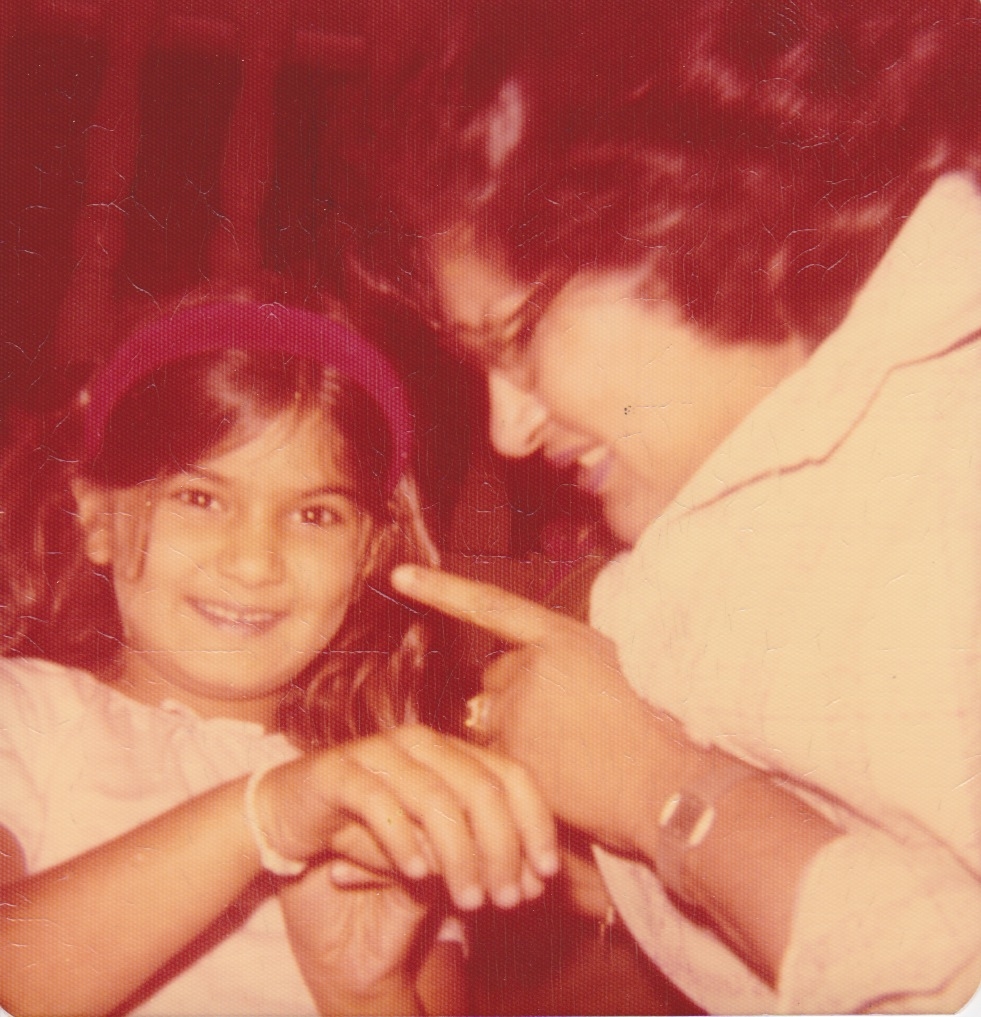
Me with my mother. Another diagnosis?

Masala Madness

When I was helping Ami take care of Aba in London, I asked her to teach me how to cook Pakistani food.

She showed me a basic recipe for chicken masala. “You have to make sure to bhoono the spices,” she instructed. This technique, done on high heat with constant stirring, cooks the spices and prevents them from tasting raw.

“When the oil separates from the water, you know you’ve bhoonoed it enough.”

I used this technique over the years for all kinds of dishes. Chicken masala, vegetable masala, ande (egg) ka masala. And then an aunt told me about Shan Masala. “Have you tired Shan Masala?” she asked.

“No, what is that?”

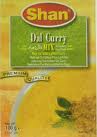
Shan Masala is “premium quality” pre-mixed spices for a variety of South Asian dishes. Everything from Dal to Chappli Kababs and Biryani. I found Shan Masalas at my local Indian grocery store. First I tried the Chappli Kababs. They were delicious. Every Shan Masala I tried, tasted authentic. Never mind the high sodium content.

The instructions, however, can be confusing.

“How many grams in a pound?” I asked Jenny. The Chappli Kabab recipe called for 500-600 grams of minced beef.

I like Dal with my Chappli Kababs so I got out the Shan Dal Curry box. “Let’s make Dal, Doll,” I said to Jenny. I carefully measured a cup of lentils or 175 grams plus three tablespoons.

The recipe instructed me to add six glasses of water to the lentils. “Six glasses? What do they mean six glasses?” I blurted. “What size glasses? Tall glasses, or small glasses?”

Before that I was instructed to fry some onions “for few minutes.” That’s straight forward enough, but how many minutes equals “few minutes?” Three to five? Or more like ten? And a few minutes until what? Until they turn golden brown? Or just translucent? On high heat or medium high? Fortunately, I had my mother’s cooking training to fall back on. I decided one glass is the equivalent to one cup and cook for “few minutes,” means until they are golden brown. Which takes close to ten minutes.

I still don’t know how many grams are in a pound.

Escape to Wisconsin

I wasn’t keen on going back to Tulane after a short spring break at home in Connecticut. “I’m going to Beloit to visit Sly for a few days before I go back to school,” I told Mimo and Puchi who were managing the Connecticut house while my parents were in Pakistan.

I had only planned to stay in Wisconsin to visit my high school friend for a few days. But then I extended the visit one day at a time without really notifying anyone.

I called my roommate at school and told her I would be back soon. “In the meantime, if anyone calls for me, like my sisters, just tell them I’m in the library.” One day turned into the next, and into another, until a month had passed.

My friend Sly and his girlfriend Ellen, had gone out to get some lunch when there was a knock on the door of their apartment where I had been staying.

I opened the door and saw a police officer. “Are you Surina Khan?” he asked.

How did a police officer in Beloit know my name?
“Why do you want to know?” I responded.

“How old are you?” he said, asking for my identification.

I had recently turned eighteen. “Eighteen,” I responded nervously as I handed him my license.

“The New Orleans Police Department has an APB out on you,” he said looking over my driver’s license and confirming my date of birth. “Who do you think is looking for you? Your parents?” he asked, returning the license to me. I didn’t know what an APB was, but it did not sound good. I later learned it stands for an All Points Bulletin.

“No,” I said. “I don’t think it’s my parents. They’re out of the country. Maybe my sisters?”

“Can you give them a call?” he asked. “They’re probably worried about you. And since you’re eighteen, there’s nothing I can do.”

When I called Mimo and Puchi, they were not happy. “Where the hell are you?” Mimo berated me.

“I’m still in Wisconsin,” I said sheepishly.

“What are you still doing in Wisconsin? We thought you went back to school weeks ago.”

“I don’t know,” I said.

“Well the school is looking for you. They called us asking where you were and we said you were back at school. Your roommate said you were in the library every time we called. Your professors thought you were dead in a gutter somewhere when you didn’t show up to your classes,” Mimo continued.

“I’m sorry,” I offered.

“Ami and Aba are going to be really upset,” she said.

“Maybe we don’t need to tell them,” I said. “No need to worry them,” I suggested.

Mimo did not agree. “They need to know what you’ve done,” she said. “And you should be the one to tell them. If you don’t, I will.”

“Okay,” I groaned. ‘You’re right.”

When I got back to school, I had to go see the Dean. “Do you have any idea what is going to happen to you?” he said.

“Actually, I was hoping you could tell me,” I replied.

“If you’re lucky you’ll get incompletes, but you’re likely to fail all your classes and will have to make-up your coursework in summer school.”

The thought of staying in New Orleans over the summer was unbearable. The heat and humidity in the spring was bad enough. It was ten days before final exams, but I decided to try and make-up the work.

I went to each of my professors and explained my situation. “I don’t feel comfortable talking to you about where I was or the reasons for my absence,” I said. “It’s personal. But before you make a decision about what to do with me, let me make-up the work and take the final, and then decide if you want to give me an incomplete, fail me or give me a grade,” I suggested. They each decided this was a fair request. And then I really did spend every waking hour in the library doing my best to make-up the work I had missed. In the end I did well, getting mostly A’s and B’s. My professors all decided to give me grades, and I successfully avoided summer school.

When my mother called I told her I needed to tell her something. “I went to visit Sly in Wisconsin and stayed longer than I planned,” I explained. “I missed almost a month of school, but I’ve made up the work and my grades are good. I’m not sure why I stayed away so long, but I think I was just trying to work some things out,” I said.

“Well good for you,” my mother responded.

“Good for me?” I asked. “What do you mean?”

“You recognized you needed to take some time for yourself and you had the courage to do it. Good for you.”

My mother never ceased to surprise me. I called Mimo and Puchi. “Ami thinks I did the right thing by taking some time for myself,” I said feeling vindicated. “She wasn’t upset at all,” I added.

“Time for yourself?” Mimo said. “That’s really rich. I’m sure she doesn’t know the half of it.”

Anger Management

I needed more Valium. “Three boxes of Valium, please,” I said to the clerk behind the counter.

“5 or 10 milligrams?” he asked.

“10 please,” I responded.

After my back injury, the doctor said I should take Valium “as needed.” In Pakistan you didn’t need a prescription for most drugs so I purchased the Valium over the counter at the local drug store. More than anything, it was a muscle relaxer which helped with the back pain I was experiencing after my cast came off. The three vertebrae I had fractured had healed well, but the doctor said I might experience muscle spasms which the Valium would help with. I noticed the Valium was also good for my mood. Things just didn’t seem to bother me as much. I was calm, and generally content.

My mother, on the other hand seemed to be easily agitated. “Why don’t they listen?” she said upset with the house servants. “I told the bloody fools to set the table for the food on that end of the garden,” she hissed. Muna was hosting an afternoon luncheon and fashion show at the Islamabad house for the high school students from the school where she was teaching.

The house servant walked onto the veranda where we were sitting and offered my mother the fresh lime and water she had asked for. She took one sip and slammed it back down on the silver tray, spitting it out. “Saccharin, not sugar.”

“I’ll fix it,” I said, taking the tray and the fresh lime and water into the kitchen. I’m not sure whose idea it was, maybe Puchi and I thought about it at the same time.

“Let’s put half a Valium in her fresh lime,” one of us said. The label inside the box noted that Valium can also be used for the “treatment of anxiety, panic attacks, and states of agitation.”

“She seems really agitated,” I said. “Maybe this will help her relax,” I said, crushing half the blue pill along with the saccharin tablet and putting it into the fresh lime and water.

I walked back out to the veranda with the new fresh lime and water on a clean tray. “Here we are,” I said to my mother. “Just the way you like it.”

She sipped it slowly. By the time the party started, she was calm and relaxed.

The following week, when we noticed the rage coming on again, I asked my mother, “Can I get you a fresh lime and water?”

Where’s the Beef?

When my father was home we usually ate dinner in the dining room. Puchi and I would set the table, with a table cloth, linen napkins, china and silverware.

My parents were not deeply religious, but we observed general Muslim practices. No pork products were allowed in the house, though liquor was admissible for guests, and occasionally my parents might have one drink or, in my mother’s case, one glass of wine.

When my father was not around, the dinner hour was more casual. Sometimes we’d eat at the kitchen table, laying out the food on the counters, buffet style, and grazing as we chatted with our mother about this or that.

Sometimes we ordered pizza. “What do you want on your pizza?” my mother would ask.

“Pepperoni,” I replied.

“We can’t have pepperoni,” my mother said. “It’s made with pork.”

“No it isn’t,” I lied. “They make it with beef.”

“Oh is that right? Well go ahead and order it then,” she said trusting me.

We ordered the pepperoni pizza and a mushroom pizza and maybe some other kind of pizza. Enough to feed all the people who were invariably around for the dinner hour– my sisters and brothers and any number of our friends. I don’t think my mother ever questioned my deceitful declaration that pepperoni was made with beef.

 I like pepperoni pizza.

I never really understood the no pork or alcohol rule. Or the no shellfish rule for that matter. Many of the Pakistani Muslims I encountered drank alcohol. I thought it was hypocritical. Alcohol was permissible but pork was not. So, I quietly started consuming pork products as a child, mostly pepperoni and sometimes bacon. As I got older I introduced alcohol to my diet as well. Many people would say I am not a good Muslim. And I would agree with them. In addition to the pork, shellfish, and alcohol consumption there’s the issue of my lesbianism which is also frowned upon in Islam.

When I’m not lying about how pepperoni is made, I keep my pork consumption on the down low. I make bolognese with mild Italian sausage, or I might order a side of bacon or chorizo with my eggs from time to time, but I don’t make a big deal about it.

My friend Jim introduced me to grilled figs wrapped in prosciutto. Jenny and I made them for a dinner party once, and knowing that one of our guests was a devout Muslim, we made sure to grill some figs without the prosciutto. I made the mistake of putting both on the same plate, which I should have known is also frowned upon in Muslim circles. You don’t want pork products touching non-pork products.

“What are these?” our Muslim guest asked.

“They’re figs wrapped in prosciutto,” I said. “You can’t eat them. They’re pork, but this side of the plate is not pork,” I explained.

She must not have heard me clearly because she promptly popped a prosciutto wrapped fig in her mouth and declared, “These are delicious!” And then she ate another and another.

I quickly ran to Jenny and said, “If anyone asks about the prosciutto wrapped figs, tell them it’s beef prosciutto.”

“But there’s no such things as beef prosciutto,” she said.

“Doesn’t matter,” I said. “Just make sure to say it’s beef prosciutto, they’ll never know there isn’t any such thing.”  Just like my mother didn’t know there wasn’t any such thing as beef pepperoni.

I did recently discover Halal pepperoni pizza. Halal is a term used to designate food seen as permissible according to Islamic law. Who knew? There is beef pepperoni after all.

Mini Me

I look a lot like my mother. When I was younger my parent’s friends as well as our extended family members called me “Chotie Sunny” which means “Little Sunny” in Urdu.

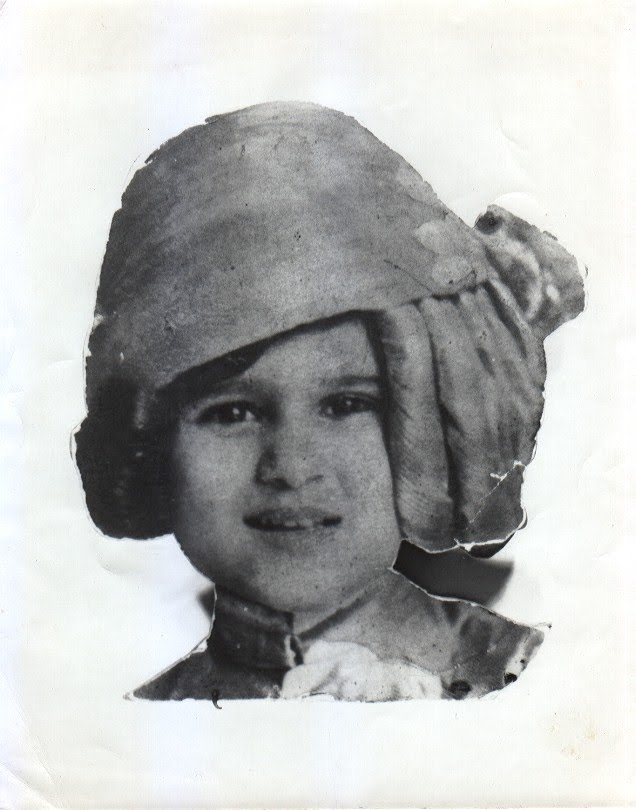
My mother as a young girl, though people often mistake this as a photo of me as a young girl.

Most of us kids resemble our mother, but in my case the resemblance is rather strong. My sister Puchi is the only one among us who looks like my father. My mother’s genes must have been stronger when it came to us kids.

Sometime around 1986 Puchi and I were commenting that she was the only one who looked like our father’s side of the family. Then we began to wonder if my parents were still having sex. “Do you think Ami and Aba still have sex?” I asked my sister.

“I don’t know,” she said. “What do you think?”

Later that evening we were in the living room with our mother and Puchi said, “Foo has something she wants to ask you.”

“I do not!” I said blushing. But I really did want to know, so I said, “You ask her,” to Puchi.

“What do you want to ask me?” my mother said, intrigued by our cryptic exchange.

“Foo wants to know if you and Aba still have sex,” Puchi said.

“Puchi wants to know too,” I said, trying to minimize the embarrassment I was feeling.

“You think people lose their sex drive when they get older?” my mother asked. My parents were only in their fifties and sixties.

“Sort of,” I said.

“Well, we don’t,” she clarified. “We have a very active sex life,” she added. Okay, this was more information than I needed.

“We don’t need details,” I said.

With that mystery solved, we moved onto other topics. “Why do you think most of us look like you?” I asked Ami.

Before she could answer, Puchi said to me, “Well, I know who my father is. Do you?”