My Big Gay Funeral

We invited Jenny’s mom, Pat, to move to Long Beach the same year we moved here, in 2003. After many years of teaching elementary and middle school, she had retired and was living in Newburyport, Massachusetts and was starting to have a little trouble. Mostly small stuff, like opening a jar or making sense of her landlord’s puzzling demands. And since we had just moved to southern California we thought it would be a good idea for her to join us, especially since one of Jenny’s brothers, Neal lived nearby. “She’s getting old,” I said to Jenny. “She’s going to need help doing things.”

Pat, after she moved to Long Beach

Pat was happy when we suggested she move here. “My children have invited me to live closer to them,” she would say proudly.

Pat adored her kids, Dane, Neal, and Jenny. Sometimes I would poke fun, “Pat, I don’t know how you did it, but you managed to raise two gays and a hippie.”

Before the hippie grew his hair long and the two gays came out.

The gay stuff didn’t seem to bother her, at least by the time I came on to the scene. She welcomed me into her family when Jenny and I got together. “It’s been a happy time for me this past week to have you visit with Jennifer,” she wrote to me in 2002. “I enjoyed seeing you and Jennifer giving so much of your caring support to each other in your work and daily life.” Later that year, I started calling her my mother-not-in-law.

When we first met.

Jenny’s brother Neal is a big gay too, but he didn’t come out to Pat until after she moved to Long Beach. When she was well into her 70s and he was well into his 40s.

Before we moved to Long Beach, Jenny and I were living in San Francisco, and we invited Pat to visit us over her birthday. Neal decided he would fly up from Orange County to surprise Pat. So he flew up and let himself into to our apartment while the three of us were out to lunch. When we came back, Neal hid in the closet of the guest bedroom. And when Pat went into the bedroom, Neal jumped out of the closet.

“Oh my goodness!” Pat shrieked in surprise. “Neal, how long have you been in there?”

“Oh about 45 years,” Neal responded. Perhaps, subtly, or maybe not so subtly, trying to come out to her.

Later that evening, as we recounted the story to our friends Jim and Matthew, Pat said gently, “Neal, are you trying to tell me something?”

Neal is a big gay.

Neal and Pat had a special relationship. He was her second child and they always had a strong bond. She visited him every winter and would stay three or four months. The two of them were inseparable. “Meet my significant mother,” Neal started saying.

After she moved to Long Beach, Pat did her best to be helpful. She called often.

“Girls,” she said once on the answering machine. “I just saw on the news that there’s a virus and it’s coming to California. On the computers. You know like the ones you two use? Well, they say the virus should be here by noon, so make sure you turn your computers off.”

She did the same thing to Neal. “Oh Neal,” she said leaving a message on his answering machine. “I just read an article in the Boston Globe, and it said men who tie their ties too tight get glaucoma, so don’t tie your tie too tight, okay?”

Sometimes when she’d get overly anxious, I’d say, “Pat, your having a patty meltdown.”

Even in these last years of her life, she kept making us laugh. A year or two ago, she was taken to the hospital and they had her all rigged up with wires and patches, probably monitoring her heart beat or some such thing.

We rushed to the hospital and when we got to her bedside, she looked at us, deadpan. “I’m wired.”

Sometimes her sense of humor was a little racy. “When they’re toes to toes his nose is in it, and when they’re nose to nose, his toes are in it.” I’m still figuring that one out. But it sounds inappropriate.

A few years ago, we were getting in our car. Pat was buckling herself up in the back seat and I turned to her wanting to know if she had enough room. “Are you good back there?” I asked.

“I’m trying to be,” Pat said. And she was good. For all of her 82 years.

Pat passed away peacefully on December 10 with Neal at her side holding her hand and playing music. Silent Night was on the iPod and the words “sleep in heavenly peace” had just played when she took her last breath.

Now we’re planning her memorial service and I’m beginning to think it’s pretty gay. We asked her former neighbor and good friend, Bill Benson, to officiate the service. “I think you’re really going to like my neighbor,” Pat said when she met Bill. “He’s gay.”

And the funeral director is gay too. Even the priest who is going to say a prayer for Pat is a gay.

I’m beginning to think we should call Pat’s memorial service, “My Big Gay Funeral.” I’m sure the hippie will not be offended.

Read more about Pat on her Memorial website.
That’s So Gay

I am a big gay. And since today is National Coming Out Day, I thought I would make a big note of it. Most, if not all, of the people in my life know that I am a lesbian, so I’m not sure I have anyone to come out to on Coming Out Day. (See Gay, Gay, Gay, posted on April 23, 2010 and I Need a Lesbian Lawyer, posted March 25, 2010).

My friend Shauna, who is not a big gay, updated her Facebook status to show support for the gays. She wrote on her status update that she “is a straight ally and today is National Coming Out Day. I’m coming out for lesbian, gay, bisexual and transgender equality because it’s 2010 and almost 90% of LGBT youth experience harassment in school, and too many lives have been lost.”

I posted a comment on her status update in response, “That’s so gay.”

Shauna seemed to like that comment a lot because then she wrote on my wall, “You know what I think I’m going to do? Start using that phrase for when things are really cool. As in, Hey, great job on your paper! It was so gay! And, Wow. Beautiful dog. She’s… so gay! And maybe even, Congratulations on your nuptials! That’s so gay! Do you think it’ll catch on?” she asked.

I told her I did think it would catch on. “Oh yes,” I replied. “I do think it will catch on.” And then I suggested she also try, “You’re acting like a gay.”

She really liked that suggestion too, but asked for clarification. “As in, Hey, that was quite eloquent. You’re acting like a gay?

Then our friend Liz chimed in and said, “This conversation is so gay! Did I use it correctly?” she wanted to know.

I commended them both on their usage of the term. “Good job girls. You are both being über gay.”

I also had another suggestion for Shauna. “You can also use a variation and say: Wow. Are you a gay?

Or if the person is really interesting, I suggested, “Wow. Are you a BIG gay?

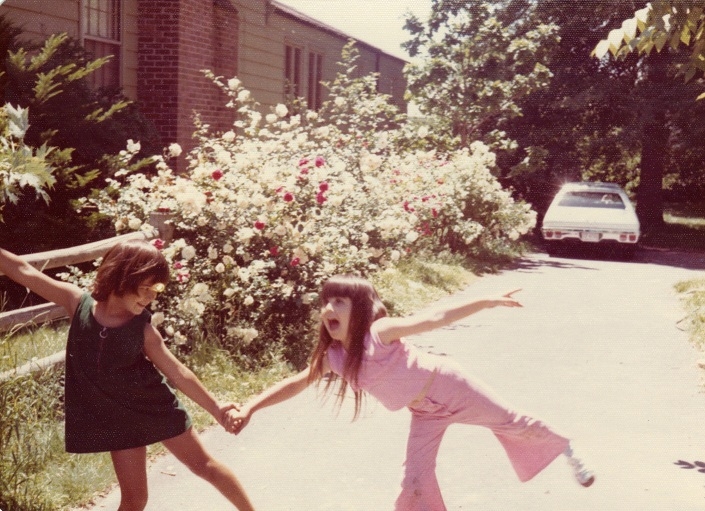
Here I am (on the left) acting like a big gay in earlier days.

Don’t Ask

This gays in the military thing has been going on for a long time. Earlier this week, a defense bill that would repeal the military’s “don’t ask, don’t tell” policy got blocked in the Senate by a Republican-led filibuster. Back in the early 90s I was co-publishing a gay magazine called Metroline with my friend and colleague Bill Mann. Anytime something gay would hit the mainstream news, they would call us for a comment.

“It’s the Gayle King Show,” Bill said, the phone pressed to his ear. “They want one of us to go on the show this afternoon to talk about gays in the military.” Gayle King, also known as Oprah’s BFF, was a prominent African-American news anchor who had her own show in Connecticut.

Bill didn’t want to do the show. “I didn’t shave today,” he said. “And look at what I’m wearing. I can’t go on television like this. You do it,” he said to me.

“Me?” I responded. “I don’t think I know enough about gays in the military to go on television.” I was in my early twenties and was not an expert on much, let alone the military. But Gayle King was Oprah’s best friend, and going on her show would be good visibility for our rinky dink publication.

We had editorialized about the issue in the magazine, calling for lifting the ban. Though we were careful not to liken it to the ban on African-Americans in the late 1940s and early 50s when the military balked at integrating African-Americans into the armed forces, a comparison made by many gay and lesbian leaders.

White soldiers will not shower or sleep in the same barracks as African-Americans. Mixing African-American troops with whites will weaken a unit’s cohesion. “These are arguments that opponents of integration were making 50 years ago,” gay leaders would say. “Substitute ‘gay’ and ‘lesbian’ and it’s the same arguments being heard today. The common denominator is prejudice.” That may be true, but these were leaders who had done little, if anything at all, to build alliances with African-American communities. Not to mention that there are many differences and nuances. African-Americans have a history of slavery in this country, after all. Bill and I understood that discrimination against African-Americans was not the same as discrimination against gays and lesbians, so we were careful not to make this comparison.

When I got to the set in downtown Hartford. I took the elevator to the basement where the show was filmed. On a commercial break, before the gays in the military segment began, Gayle motioned for me to come over and put me at ease. Without mentioning that she was preparing me for the show, she casually asked me questions about the issues.

And then the real thing started. Live. “Joining us today is Surina Khan, co-publisher of Metroline, a local gay and lesbian newspaper,” Gayle said as the cameras panned over to me. I was trying not to look like a nervous wreck.

Gayle was gentle. “Tell us why you think the ban on gays in the military should be lifted,” she said.

I went on and on about equal rights this and equal rights that. “We deserve the same rights as everyone else,” I said.

As the interview progressed I got more nervous. Gayle was calmly talking about how there were many people who opposed lifting the ban.

“What do you say to people who are concerned about unit cohesion?” She asked. I was sure I did not have any idea what she was talking about.

“Units will be cohesive,” I responded as if I knew what I was saying.

“Well,” Gayle said, looking slightly puzzled. “There are soldiers who do not want to serve with gay service members and military officials are concerned that they would not perform properly if forced to do so.” I think she was trying to explain unit cohesion to me.

I had no idea how to respond. And then things really began to devolve. “Well what about the Blacks, Gayle? What about the Blacks?” I couldn’t even pull myself together to clearly articulate the comparison, which I knew I should not be making, to the integration of African-Americans into the military. I kept repeating, “What about the Blacks?” as Gayle’s head tilted to one side and she looked at me quizzically. Gayle cut to a commercial, and I sat there, thinking I cannot believe I just said that, on live television. To a Black woman.

When I got back to the office, Bill asked how the show went.

“Don’t Ask,” I said as I considered crawling into a filing cabinet.

Mistaken Identity

My name gets misspelled a lot. “It’s K-h-a-n,” I correct people. “Not K-a-h-n.”

“Oh, but don’t worry,” I say trying to make the misspeller feel better. “It happens all the time. I’m used to it.”

When I did more freelance writing, years ago, I would file my articles with my byline, typed correctly, “Surina K-h-a-n.”

“On many an occasion, it would come out in print, “Surina Kahn.”

“Does the editor think I don’t know how to spell my own name?” I would ask who ever happened to be sitting around me.

Colleagues have been known to misspell my name, too. People will invite me to conferences to speak and ask me for my bio. I send it with my name spelled correctly, but then I see Surina Kahn in the conference program.

Just last week, I got the Sun Dial, my high school alumnae magazine, in the mail. “Look there’s a picture of your class at the reunion,” Jenny pointed.

“Oh great,” I grumbled. “They spelled my name wrong.”

So it should not come as a big surprise, that in some misguided circles, I am known as a Zionist Jewish Lesbian.

I am listed on an anti-Semitic, and seemingly white supremacist, website titled, “Jewish Control of Gay Rights.”

The website notes, “The Jews know damn well that most heterosexuals aren’t at a spiritual level where they can grasp this truth, so they use heterosexual animosity towards gays to keep our Aryan peoples divided.”

Another website called, “The French Connection,” has me listed alongside a number of other LGBT “Jewish” activists. All because of sloppy spelling.

They say, “Here is an exhaustive list proving, once and for all, that the radical homosexual movement in the United States is a Jewish movement. Jews created it and run it from top to bottom. They are pushing the perversion and degeneracy that is spreading disease, sin and sickness through America like a wildfire.” I wonder if I should let them know my name is spelled K-h-a-n? Although I’m guessing they don’t like the Muslims either.

They might be interested to know that I’m not a good Muslim, or Jew for that matter. I enjoy pepperoni on my pizza, after all. (See Where’s the Beef, posted April 2, 2010) Or prosciutto wrapped around grilled figs. I drink alcohol which is also a sin in Islam. I like to sip a glass of prosecco or an old vine zinfandel from time to time. But does that make me Jewish?

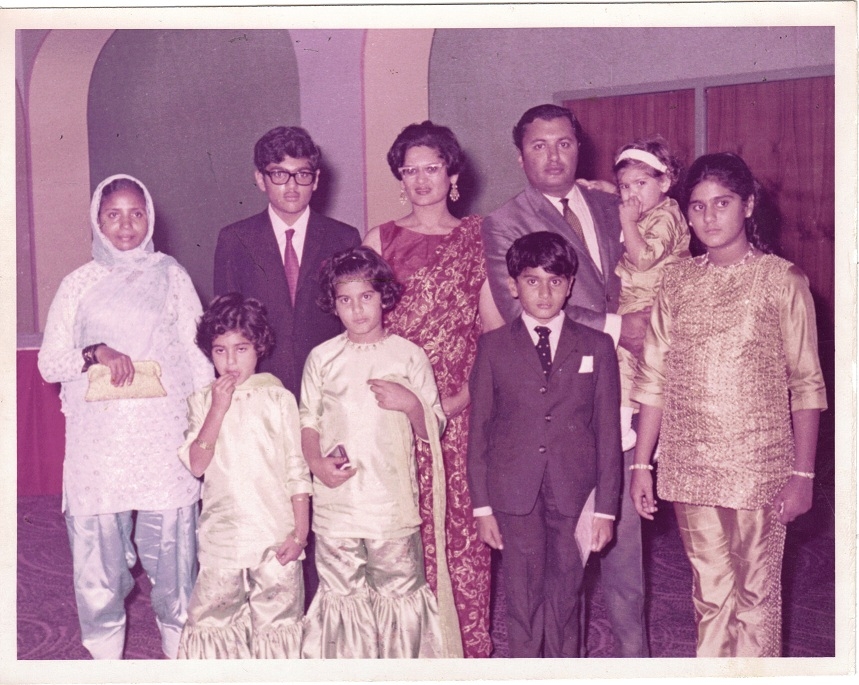
Do we look Jewish? My brothers and sisters with our parents and our Nanny Saeeda, circa 1968. I am the little one in my father's arms.

Gay Gay Gay

Mimo offered to host a tea party for me when I visited Pakistan in 2001. “If everyone comes here for tea,” she explained, “It will save us time calling on all the relatives.” Ever the strategic thinker, Mimo was conscious of the limited time I had. I was only in Islamabad for a few days, stopping on my way back to the US from a work trip that took me to India and Sri Lanka.

Shortly before my trip, I received an invitation from a policy research institute based in Islamabad to give a talk on lesbian, gay, bisexual, and transgender issues. Puchi was living in Hawaii by now, but she had been a journalist in Pakistan, so I mentioned the invitation to her, asking if she had ever heard of this particular Institute. “Yes,” she said. “It’s one of the leading policy institutes in the country.” But then she discouraged me from giving the talk, saying that it would put our extended family in a very uncomfortable position. “You have to consider how it will affect the family,” she said.

“Okay,” I said. “I wont do it.” I was clear that the primary purpose of my trip to Pakistan was to visit my family and if it made them uncomfortable, I would decline the invitation. “But go ahead and do it,” Puchi then said. “It’s a reputable policy institute and it’s about time the family began to understand these issues.” So with her encouragement, I accepted the invitation, which to my knowledge may have been the first time a public conversation on LGBT issues was held in Pakistan.

When the guests started arriving for the tea party–various aunts, uncles and cousins– we entertained them in the proper fashion. My mother, who had died just over a year ago, would have been pleased. We served high tea with an assortment of pastries, biscuits and savory items. We dressed appropriately. I didn’t have a shalwar kameez, and didn’t like wearing the traditional outfit anyway, but I covered myself with a dupatta over my blouse and long pants. We poured the tea for our guests offering them chicken patties, cucumber sandwiches, samosas, pakoras, lemon tarts, and cakes from the tea trolley.

High Tea

The conversation inevitably turned to me. “What are you doing these days? Where are you working?” they would ask. I had just come from a large human rights conference in Pune, India where I gave a keynote address on the importance of integrating sexual rights and lesbian, gay, bisexual, and transgender issues into the human rights movement in South Asia. At the time, I was the executive director of the International Gay & Lesbian Human Rights Commission.

“You’re a professional lesbian,” my friends in the US would say to me. And it was true. I was always talking about gay this and lesbian that. And I got paid for it.

Most of my extended family knew that I was a lesbian. And if they didn’t, it was only a matter of time before I outed myself, usually in response to the question, “Where do you work?”

“The International Gay & Lesbian Human Rights Commission,” I would respond. This would leave some people stunned into silence. So I started saying vaguely, “I work for a human rights agency,” not wanting to make anyone feel uncomfortable or to force the homosexuality conversation.

But someone would inevitably ask, “Whose human rights are you working for?”

“Gays and lesbians,” I would respond “and bisexual and transgender people.”

Often the response would be, “Well then you must not do much work in Pakistan. We don’t have gays and lesbians.” Or, “I know gay and lesbian, but what is this bisexual? This is perversion. Bisexual. Liking sex with everyone?”

“If it makes you feel uncomfortable, we don’t have to talk about it, ” I offered.

And as soon as I said that, the flood gates opened. “It’s not uncomfortable. In our society we have people in the villages who do this sort of thing, but they are not gay and lesbian.” True that. No need to take on the identity, just go with the sex.

“I read your letter on the internet,” another cousin whispered to me. “I think it’s brave what you are doing.”

“What letter?” I asked. I wasn’t aware of writing a letter on the internet.

“You know the letter about…that.”

“Oh,” I said. “Yes, that. Well thank you.” I wasn’t sure what she was referring to exactly, but I took it as a compliment.

Later that year, an aunt and uncle were visiting their son, my cousin, in San Francisco, where I was also living. I had been invited to speak at an LGBT Muslim conference organized by the LGBT Muslim organization, Al-Fatiha.

“Your parents know I’m a lesbian, right?” I asked my cousin.

“I’m not sure,” he said.

“But they know I work for IGLHRC,” I said since they had been at the tea party in Islamabad earlier in the year.

“Yes, but I think that they think you are just being a good person, working for the rights of gays and lesbians because you feel sorry for them and want to help them. I don’t think they know you’re a lesbian.” This scenario had not occurred to me.

Both my aunt and uncle are avid newspaper readers. “Well, there’ll be an article in the San Francisco Chronicle about the conference in tomorrow’s paper,” I said. “And they interviewed me for it. So if they don’t know I’m a lesbian, they will tomorrow.”

When my cousin came home from work the next day, my aunt showed him the newspaper. “Did you know,” she said with a smile, pointing to the article, “that Foo is a lesbian leader?”

I Need a Lesbian Lawyer

My mother wanted a new lawyer. She was on the verge of settling a lawsuit started by my father before he died, and was unhappy with her lawyers. They were advising her to settle the lawsuit because their star witness, my father, was dead.

He slipped and fell in a parking lot in 1986, hit his head on the concrete, suffered a head injury, and was in the process of suing the company that owned the parking lot when he got sick. He died before the case was settled. My mother was still grieving the loss of her husband, and her desire to not settle the lawsuit had more to do with her grief over my father’s death than the settlement that was being offered.

“If you aren’t happy with the counsel your lawyers are giving you, get a new lawyer.” I advised. My mother and I had recently reconciled after a two-year period of not speaking with each other. Our rift occurred because of  her discomfort with my choice to live openly as a lesbian. Despite this period of estrangement, I knew her well. I thought her grief process was more important than the money the settlement offered, and I wanted her to do what she needed to face the loss of the love of her life. “Get a lawyer whose advice you value,” I said.

By the look on her face, this thought had not occured to her. “Well then, find me a new lawyer,” she said.

I found her a lawyer in town that I knew from my work at the lesbian and gay magazine that I was publishing. I made an appointment for my mother and I to meet with the new lawyer to explain the lawsuit. We were in the car on the way to the lawyer’s office, when my mother said, with an air of disapproval, “I presume this woman is a lesbian?” Just when I thought she was finally coming to accept my lesbian identity she started up again with the lesbian stuff.

“Yes, she is.” I replied, thinking to myself, I cannot believe we are going to rehash all this lesbian stuff. Again.

“Well, the men aren’t helping me,” she said. “I might as well go to the dykes,” the smile on her face widening. I didn’t even know she knew the word dyke. Maybe she really was changing her attitude.

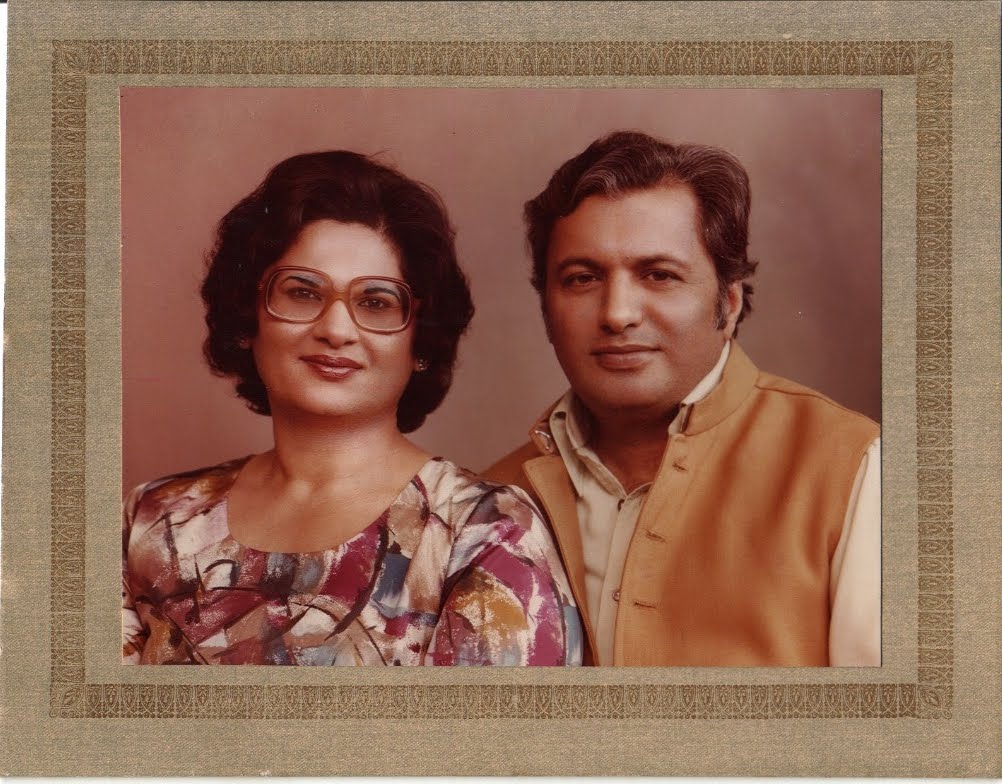
Sunny and Afzal a few years before my father died.

Pass the Talking Stick

I was texting Jenny, “Having found my purpose, I am now going to work on my vision.” Since I travel so much for work, I try to keep her informed about the kinds of things I am up to.

“Umm, What?” She texted back.

Jenny is in a different line of work than me.  She is a humanities professor, so when I say things like, “I really need to see measurable outcomes,” she looks at me quizzically.

Last year we had a dinner party and I noticed all our friends were interrupting each other so I told them about the Talking Stick.

“The what?” everyone responded almost in unison. I explained the concept of the Talking Stick, which has been used for centuries by Native American Tribes as a means of just and impartial hearing.

“You are all interrupting each other. In my line of work, we are very intentional about giving everyone the space to talk, so sometimes, we pass around a Talking Stick, which can come in just about any form. When you are holding the Talking Stick, you are the one speaking and the others have to listen actively to what you are saying. Let’s try it!” I said passing around a fork to symbolize the Talking Stick.

They humored me. Though I think they rather liked the concept of the Talking Stick, because now I notice sometimes at parties, when someone is dominating the conversation, another person will say, “We need the Talking Stick.”

 
The talking stick might look something like this.

Last week I was at a Rockwood Leadership Institute training called the Art of Leadership. I applied last fall for it and was excited when I was accepted.

We learned quite a lot in the Institute. Active listening. Staying centered on our purpose,  thinking carefully about our outcomes and process. This is called a POP analysis: Purpose, Outcomes, Process.

One of the nights we had a free night so some of us went out for cocktails. Around the third or fourth cocktail, we  started talking about how outcomes-focused philanthropy can be. So we made a friendly addition to the POP analysis. We came up with the PUP Analysis: Purpose Unleashing Power. What we liked about PUP is that it it can be a PUPPY that grows into a DAWG. If an idea or concept is in its infancy or if it is geared towards young people it can be a PUPPY: Process Unleashing Progressive Power for Youth. When it grows into a DAWG it is Doing a World of Good.

The other thing I learned is that it is really important to pay attention to how you say things, because it’s easy to misinterpret what gets said. For instance, at the training, my friend Todd said, “We should look for some far out liars.” And I said, “Why would we want to look for liars?” What he meant to say was, “Far outliers.”

Later, Todd was getting a little unnerved by all the negative comments people were making about the anus. He thinks when people say things like, “that’s so anal retentive,” it’s derogatory because he believes retaining things in one’s anus can be a source of pleasure.

He asked me if I would join his Ass Lander committee. And I said, “Why would I want to join an Ass Lander committee?” I have nothing against people landing on each others asses, but I am on enough committees and I wasn’t sure I wanted to join this one. “No, not the Ass Lander Committee, the Ass Slander Committee,” explained Todd.

“Oh, well in that case,” I said, “I’m in.” I wanted to be supportive of him and his efforts to reclaim the ass as a source of pleasure.

I told Jenny about the Ass Slander Committee when I got home, and she’s considering joining too. I love it when our activist and academic worlds come closer together.

The Homosexual Agenda: 2010

Just think of me as a lazy blogger today. I’m re-posting something that Neal, my other brother-not-in-law, posted on my Facebook page recently.

Earlier this month I posted a report published by Political Research Associates about anti-gay activity in Uganda. Something about  a “Seminar on Exposing the Homosexuals’ Agenda.”

Both Terry brothers, Dane (the hippie) and Neal (the gay) had something to say about this. Dane’s post said, “All the homosexual people I’ve ever known do seem to have the same agenda…I believe it’s called ‘Live And Let Live’…I like it so much I’ve made it my own.”

Neal responded to Dane with his own version of the Homosexual Agenda. They sure are funny those Terry brothers. 

Today’s Homosexual Agenda:
6:00am Pilotis (note to Neal: use dictionary.com when unsure of spelling. It’s Pilates, doll)

7:00am Protein Shake

7:30am Walk French bulldogs, Oliver and Tullulah

8:00am Check Facebook and Gay.com… 

9:00am Hair appointment

10:00am Bloomingdales: check for new Prada sneakers; admire LV bags

12:00pm Brunch with girlfriends at Neiman Marcus Rotunda (warm goat cheese spinach salad, balsamic vinaigrette, 2002 Montrachet)

2:00pm Assume control of government; recruit all straight youths to gay lifestyle; destroy all heterosexual marriages; bulldoze all houses of worship

2:30pm Disco Nap

3:00pm Facial at Day Spa

4:00pm Gym: ab workout

5:00pm Grey Goose appletinis at Splash

6:00pm Sex in the City rerun

7:00pm Dinner (Pan seared Chilean Sea Bass with shitake, coriander and lime-pepper, 2007 Gamba Maratto)

8:00pm Theater: “Billy Elliot, the Musical”

10:00pm  Nightcap at “The Web”

11:00pm Bed

Here’s Neal, looking pretty gay.