Lost Luggage

We were sitting in the back of the plane. “Make sure your father is on the plane,” Ami said to Tito.

Aba had died a few days earlier in London where he was being treated for a rare illness. Mimo, Tito, and I flew to London as soon as we got the news, to accompany Ami back to Pakistan with our father’s body. His body was placed in a coffin which had a square piece of glass over his head so that we could see his face, which seemed to be turning bluer with every passing day. “Why do they have a piece of glass there?” I asked Mimo when we went to view his body at the mortuary. “Probably because he died here and the family will want to view the body when we get back to Pakistan,” she responded.

Tito went to the front of the plane to speak with the airline staff to make sure Aba’s coffin was in the cargo section.

“They can’t find him,” he said when he returned.

“Oh good God,” Ami said. “We’ve lost your father.” For some reason this seemed funny to us and we all started giggling.

The coffin was located several minutes later. “He’s still up to his tricks,” Ami said about Aba as if, even in death, he was still playing pranks by making his own coffin disappear.

When we landed in Islamabad we were met at the airport by Puchi, Muna and Baba and my father’s brothers and sisters who took us to our family home in Abbottabad for the funeral services. Hundreds of family and friends gathered at our house to mourn the loss of our father. The men and women were segregated with the men sitting outside and the women, many of them on the floor, sitting around the coffin. Some of them held prayer beads as they wailed in grief.

“Who are all these people?” I asked my sisters. I didn’t know most of the people who had gathered, so I went up to my old bedroom. Puchi and Mimo joined me a few minutes later and we sat there sneaking cigarettes. Occasionally one of our young nephews would burst into the room.

“Where’s Dada?” Ali, the three-year old asked about Aba, calling him the Urdu term for grandfather.

We sisters looked at each other, not knowing how to respond. How do you tell a three-year old that his grandfather is dead?

“Where do you think he is?” we asked, thinking the question might buy us some time as we figured out how to tell him the truth.

Distracted by his older brother, Asif, the two boys went running from the room, continuing to play their games. They probably thought we were having a party, not realizing it was a funeral.

A few minutes later, they came back in the room. “We know where Dada is!” they said excitedly.

“You do?” we asked. “Where is he?”

“He’s in that box in the room with all the old biddies! We saw him! Through the glass.” And sure enough, that was the truth.

Aba with his first grandchild, Asif, about seven years before he died.

London Calling

When I landed at Heathrow, I took the Tube to Hyde Park Corner Station. “It’s not far from the station,” Mimo instructed me on the phone before I left. “It may shock you to see him in this state,” she said about Aba, describing the feeding tube that went through his nose to his stomach. “So prepare yourself, and try not to act stunned when you see him.”

We were taking turns helping Ami take care of Aba. His health had declined rapidly after we sold the Stoner house. His muscles were deteriorating slowly. He could still walk, but had lost the ability to speak. And eventually he lost the ability to swallow, so he stopped eating, which is when he went to London for medical care. Ami and Aba were staying in a small two bedroom flat near Hyde Park that one of their friends had generously offered them.

Mimo came to the door when I arrived. Everyone seemed cheerful, despite the fact that Aba looked like a walking skeleton. “Foosie!” Ami greeted me. Aba was sitting on a chair in the living room with a blanket over his legs.

“Come,” Mimo said just as I was sitting down on the sofa. “I’ll show you how I do the laundry.There isn’t a washer dryer in the flat, so we have to go to the laundromat.”

She led me out of the building and straight to a pub where we both ordered a lager. “Are you okay?” Mimo asked. “It’s shocking at first,” she said. “But he’s in good spirits.”

We finished our beer, and headed to the laundry while Mimo explained the routine. She was leaving to go back to Connecticut the next day. The laundry needed to be done daily since he soiled himself and the bedding at night.

In the morning we’d bathe him. Towel him dry and put lotion on his body. He always put powder between his toes when he was healthy, so we continued that ritual. But we didn’t bother to dress him fully. It was too complicated. Instead we’d pull a t-shirt over his head and a makeshift diaper under his underwear and lead him to the chair in the living room where he sat happily most of the day. A blanket would cover his bare legs.

We fed him through the tube in his nose, keeping up with his rituals like afternoon tea. He had lost so much weight that we tried to load him down with calories, hoping he’d put on a few pounds. “Let’s put condensed milk in his tea,” I suggested to my mother.

“Good idea,” she said. I loaded his afternoon tea down with sugar and condensed milk. “It’s not like he can taste it,” I said to Ami.

When Akhter Aunty came to visit, Aba got out a piece of paper and a pen and wrote her a note. “They think I don’t know that they are putting condensed milk and sugar in my tea,” he wrote. “Please tell them to stop. All I want is a simple cup of Earl Grey tea.” He was serious, but the note made me smile.

“Too bad,” I teased him. “I’m the decision-maker now.”

He still had his sense of humor, too. On occasion, he’d get up from his chair, walk down the hall to the kitchen where Ami and I might be preparing food and motion for me. “What is it?” I’d ask. “Do you need something?”

I’d follow him down the hallway, marveling at how he seemed so comfortable walking around in a diaper. His whole life he never came down in the morning unless he was impeccably dressed. But that vanity disappeared with his illness.

He’d walk back into the living room and sit in his chair pointing to the blanket, which I would pick up and put back on his legs. About the third time this happened I figured out his trick.

“Wait just a minute,” I said. “You’ve been getting up from the chair for no reason, so the blanket falls to the ground and then you walk down the hallway, interrupt what I’m doing to make me come and put the blanket on you?” Well, I’m on to you now.” Aba smiled. That twinkle in his eye glistening.

Aba, before he got sick.

Haunted House

My father refused to sell the Stoner house, even though there was an interested buyer. “I wont sell to that man,” Aba said about Gary Blonder, a high-profile, flamboyant Hartford business man who made his fortune in used auto parts. “He’s a creep,” Mimo would say. And sure enough, Blonder was later convicted for tax evasion, fraud, and lying to federal authorities, the last of which was in 2005 for trying to conceal a $100,000 bond investment from federal bank regulators. He was sentenced to 28 months in prison for that crime.

Blonder was a shady character, but he had money and we needed to sell the house. “No,” was all my father would say when we broached the subject. His stubbornness caused the house to go into foreclosure (See Walk of Shame posted May 31, 2010).

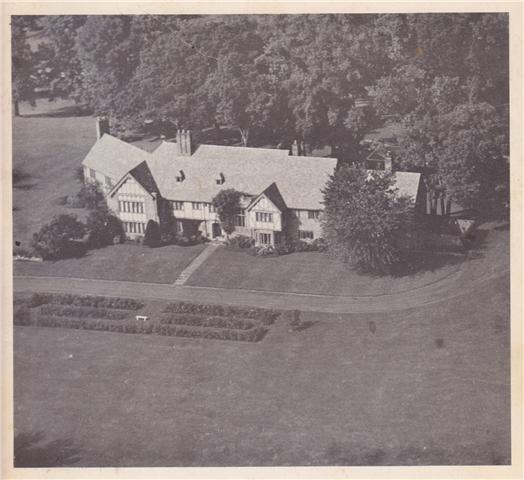
The Stoner Mansion was a former estate of the Stoner Family. It was completed in 1928 for Louis Stoner, a manufacturer who became wealthy from the Jacobs Chuck company, which produces holding devices for stationary equipment and portable power tools. The property was sold off into single lots starting in the 1950s after Louis Stoner committed suicide and his widow, Clara Stoner, faced financial hardship. (See 112 Stoner Drive, posted January 26, 2010).

Before the land was sold, the estate encompassed the entire street and contained a small 9-hole golf course as well as a stable and a rose garden. The mansion remains at the top of the hill overlooking what used to be the golf course. My parents purchased the house in 1974 for a mere $180,000. I’m sure they must have refinanced or taken a second mortgage on the house in later years and were not able to keep up with the payments, especially after my father’s head injury in 1987, which among other things, led to financial troubles.

On the day of the public auction, we got the house ready and prepared ourselves for the indignity. Mr. and Mrs. Large, our close family friends came with a cashier’s check for $50,000 in hand, the amount required to bid on the house. They didn’t want the house, but thought that bidding on it would help drive the sale price up so that at least my father would be able to pay what he owed his multiple creditors.

An hour or so before the auction was set to start, we were all looking glum. “I can’t believe this is happening,” I said to Mimo. “Why wont he agree to sell it and spare us the embarrassment of a foreclosure?”

In the final hour, my father changed his mind. “Tell the bank I’ll agree to sell to Blonder,” he said quietly, keeping the house from going into foreclosure. The public auction was called off and the sale negotiations began in earnest. He sold the house to Blonder for $1.1 million, and even that didn’t cover all his debts.

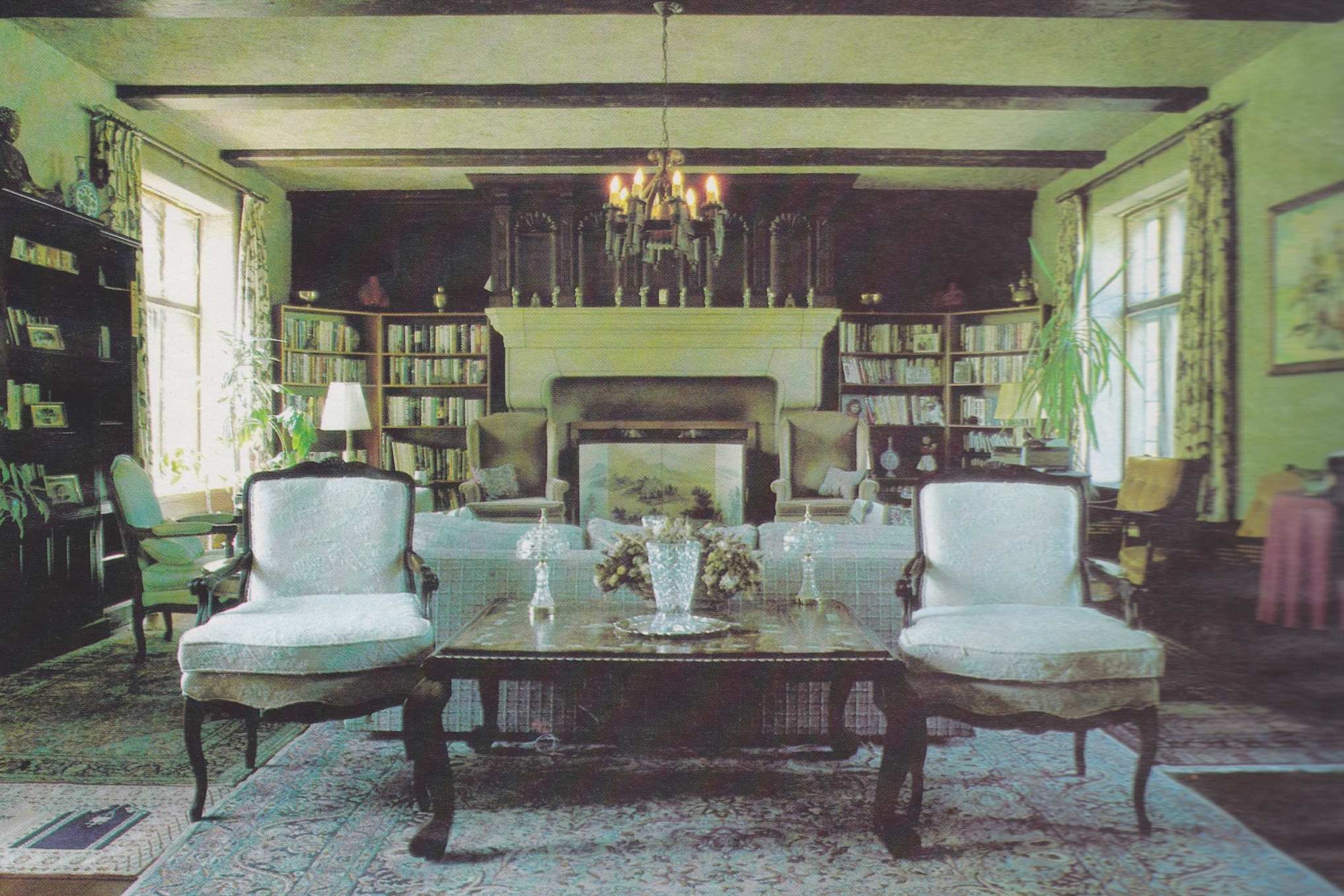
As we we packed up the house over the following weeks before the closing, my father would sit in the same chair in the Billiard Room, which we called the Big Room since we didn’t have a billiard table. There was plenty to pack up, fifteen years of memories tucked away in drawers and cabinets. A full attic and basement and piles and piles of stuff. We sold what we could and moved the rest into a friend’s storage facility. The Big Room was the last room to be packed, but eventually we had to pack it. And my father just sat there as we packed up around him. Boxes of his books and other artifacts. Until all that was left was the chair he sat on. We moved the chair after Aba walked out of the house for the last time.

My father hated leaving that house, and he hated that he had to sell it to Gary Blonder. Blonder didn’t last long in the house, which has had a series of owners after we moved out, most of whom I don’t think have really inhabited it for long.

When we lived in the house, I felt the presence of Clara Stoner’s ghost at various times. I think she mostly liked us and the hustle and bustle we brought to the house, but maybe she didn’t like Blonder and the other owners that resided in the house after him. Or maybe my father’s ghost lives there now too. He and Clara must have pretty high standards, because the house is for sale again.

The Big Room

Walk of Shame

When I saw the foreclosure sign, I panicked. The sign at the bottom of the driveway, for everyone to see, had big black letters painted on it that read, “Notice of Public Auction.” As I kept reading in stunned silence I saw the warning, “Do not remove: violation subject to punishment by court.”

I continued driving up to the house, engulfed in shame and embarrassment that my family’s financial troubles were so public, with what seemed like a slightly smaller version of a billboard. I had just returned from my shift at the Keg restaurant, where I was waiting tables. The money I earned from tips contributed to the household bills. My sister Mimo paid for most of the bills out of her own salary as the Manager of the Edelweiss Restaurant, a small popular German restaurant in West Hartford Center. I was responsible for the weekly groceries and for paying for the classes I was taking at the University of Connecticut, trying to finish my college education.

As soon as I got inside the house, I called Mimo who was working at the Edelweiss. “There’s a foreclosure sign at the end of the driveway,” I said. “Anyone who drives by can see it. All the neighbors.”

When Mimo got home, I suggested we take the sign down. “We have to get rid of it.” We drove down to the end of the driveway so we could make a quick exit once we got the sign out of the ground, avoiding a walk of shame up the driveway. Pulling the sign out was not easy. “How far did they push these stakes in?” we both grumbled, hoping no one would drive by to see us removing the foreclosure sign. The sign was bad enough, but to be caught removing it would have been in its own category of shame.

Our determination was strength enough to pull it out, and when we finally got it out of the ground, we threw it in the back of Mimo’s red Chevrolet Cavalier and drove it up the driveway.

“Now what are we supposed to do with it?” we both wondered.

“We have to hide it,” I said. “It’s illegal to pull it out of the ground.”

“Where should we put it?” Mimo pondered. “Maybe in the attic?” The house was plenty big enough. A full basement and attic the entire length of the house which had twenty-three rooms. Known as the Stoner Mansion, this had been our home in Connecticut for the last fifteen years, since 1974.

“That’s the first place someone would look,” I said. “We need a better hiding place.”

The Stoner Mansion circa 1973 when my parents purchased it.

When we first moved into the house, it was bustling, home to us six kids, my parents, and any number of guests who were welcome to stay as long as they liked. By the mid eighties my father’s chicken business was not doing well, and after he got sick in 1987 things went from bad to worse. But my father refused to sell the Stoner house, even though it was a shell of its former self. There were just three of us living there in 1988, the year the foreclosure sign went up– Mimo, me, and Aba when he was not in Pakistan trying to revive the chick business. Amin, our cook, was also with us. Mimo put him to work at the Edelweiss so he could earn money to send home to his family in Pakistan. And he continued to cook and clean for us, though with only three of us in the house there wasn’t much to do. Ami, Baba, Muna and Puchi had moved back to Pakistan, one by one. Tito was an officer in the US Marine Corps, living in San Diego with his wife and son, and Mimo and I stayed in Connecticut and kept the house running.

Aba would sit in the same chair in the Big Room at one end of the house, reading or watching television most of the day. Mimo and I generally hung out near the kitchen, usually late at night after our restaurant shifts. The rooms were mostly uninhabited and dark. The pool hadn’t been used in years.

“Let’s put it in the swimming pool,” I suggested. “No one will look there.”

“Good idea,” Mimo said. “Let’s go. You pick up that end of the sign.” We walked around to the back of the house and threw it in the deep end.

When the bank called inquiring about the missing sign, we responded with proud condescension, “What sign? I’m sure we haven’t any idea what you’re referring to.”

Airmail

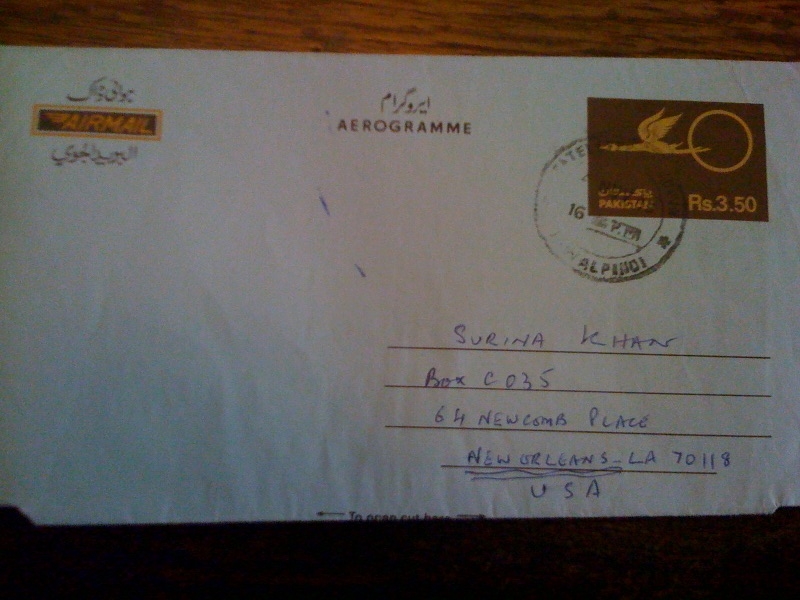
My father suggested we write letters to each other every week since we were often apart. He was in Pakistan running his poultry breeding business, and I was in Connecticut attending boarding school, and then New Orleans for college. We wrote to each other on aerogrammes, the thin blue paper with postage included that functioned as letter-writing paper and an envelope when folded into thirds.

letters from my father

We mainly corresponded about grades, money and weight. “Things are going pretty well here,” I wrote from college, in October of 1985. “I’m working hard, but my grades aren’t where I want them to be yet, so I guess I’ll just keep working until my brain falls out.”

The letters are mostly boring. In November of 1985 I wrote, “There really isn’t much going on here. I’m keeping up with my studies. I really don’t have much more to say. I’m going to continue this tomorrow.” The next day I wrote, “Nothing happened since last night. So you get a pretty boring weekly letter. But don’t blame me it was your idea.” I think the weekly letter writing was getting on my nerves.

My father was very focused on my weight which seemed odd since he had not seen me in more than a year. I was a healthy size 10 and could sometimes even fit into an 8, which seemed respectable, especially now since I would love to be a size 10 again. Nevertheless a size 10 could easily become a 12 or (gasp!) a 14. Dieting was encouraged from the time you could understand language in my family. I went on my first diet at the age of eight. It didn’t help that my nickname was Fatty. Which thankfully turned into Fatty Foo, and eventually I had the courage to insist that everyone drop the Fatty and just call me Foo.

“I understand from Nafisa and Lalarukh that you are making every effort to put on more weight. This is the time in life you have to be careful and watch what you eat. Best way is to write down everything you eat and convert it to calories. At your age you have to watch it now otherwise you will become like Mimo. Basically everything is 100 calories like a cookie, an apple, or another fruit.”

I responded, “As for my weight, let’s not be sarcastic. It’s a pretty touchy subject.”

That didn’t stop him. “Dear Fatty,” my father wrote later that same November. “Received your letter and I’m glad your grades are going up and your weight (?) going down. I am confident that you will do well in your grades once you get used to the system.” This was encouraging, but then came the dieting diatribe.

“For your weight, the main problem is mental attitude and will power. If you make up your mind to bring it down, it is then easy, but lot of will power is needed to keep it down at the right level.” I was beginning to think this was more about his weight than mine.

“You should go on a zero carbohydrate diet to bring it down and then keep track of the total calories you consume. About 1500 calories a day should keep you trim. Write down what you eat daily and add up the calories. This way the stomach also shrinks and one does not feel hungry.” Really? Writing down what you eat makes your stomach shrink? I should have listened to him years ago.

“If it is any help,” he continued, offering me his daily regimen. “Breakfast: 1/2 glass of juice (anar) these days.” Anar is Pomegranate which I gather was in season in November. For breakfast, he also had green tea. “No sugar,” he was careful to emphasize any chance he got. And he had “one toast with malai and honey.” Malai is the clotted cream that rises to the surface of milk before it is skimmed off. It looks like a thick yellowish layer of fat. The sight of it made me gag. I already had a deep aversion to milk, and in my world malai was in its own special category of disgusting, right next to mayonnaise. Sometimes, a little speck of the malai would make its way into my tea, not having been skimmed properly from the milk. “Eeew!” I would shriek dropping my tea cup. “There’s malai in the milk!”

My father’s diet tips were not making sense. Malai is full of fat. So basically he was telling me he put a layer of fat on his toast and then covered it with honey. I wonder how many calories he allotted to this coveted morning ritual?

“Lunch,” he continued, “is meat cooked without any oil and also vegetable or daal without any oil. And one chapati.” I’m pretty sure chapati, which is made with wheat flour, is full of carbohydrates, but I didn’t want to point out this contradiction either.

For evening tea he had, “Two cups of green tea without sugar and no cookies or biscuits.” In case I was not paying attention, in the following week’s letter he wrote, “I lost two pounds in the last two weeks by cutting out United Bakery cookies at evening tea time and switching to green tea without sugar.”

His advice for dinner was not helpful. “Dinner,” he wrote, followed by all caps. “NO dinner. At night I have some fruit, an apple, or grapes and that’s it.” I was beginning to think the man had an eating disorder.