Family Feud

Puchi was a bit put off by my recent post about Akber’s first words (See Repeat After Me, posted on February 14, 2010). She wrote on my Facebook page, “I would think that you would need some sort of permission/approval to continue posting my pics/stories that concern me? I really am quite a private person…the only reason, I didn’t say anything before is cause you have all the photos and the blog is the only way I can see them I guess.”

Oops. I felt bad, but I couldn’t help noticing the fact that she posted this on a comment thread related to one of my status updates, which didn’t seem to be the most private way to express her concern. But, whatever, I didn’t want her to be mad at me.

Trying to avoid a Facebook fight with my sister, I responded that I would keep her on the DL from now on. “Or,” I offered, “You could try considering Rodge and Podge’s advice?” (See Who Needs Marriage? posted February 12, 2010).

This seems to have done the trick. Because then she wrote, “Oh yeah…forgot that great advice already. Never mind my earlier post. I must remember that Rodge and Podge are my new gurus.”

“Good,” I responded. “Because, I must warn you, the Patsy and Eddy stories are coming.” If you’ve ever watched the show Absolutely Fabulous, this will make a lot more sense to you: Growing up, I felt like Sapphy living with Patsy (Puchi) and Eddy (Mimo). Puchi will need to heed Rodge and Podge’s advice when I start posting those stories.

According to Mimo, Rodge and Podge say, “If I could care less, I would.” Words to live by.

I still don’t know who they are, but thank goodness for Rodge and Podge. They have no idea, but they helped avert a potentially public family feud.

 
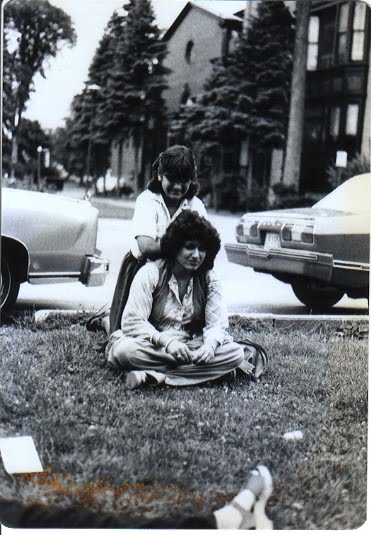
Puchi and me. I seem to be annoying her here too.
This photo was taken in Saratoga Springs in 1978.

Repeat After Me

When Puchi had her first son, Akber, we were all thrilled. He was a cutie.

I never pictured Puchi as a mother. Let’s just say, maternal is not one of the first things that comes to mind when you think about her. That said, her boys, Akber and Abbas, turned out pretty good, so she did something right.

 
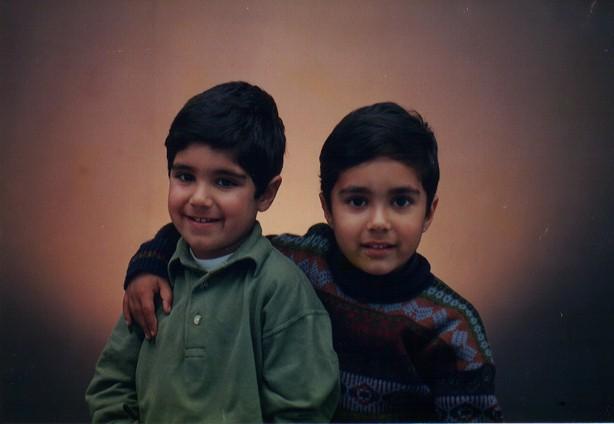
Akber, on the right, with his arm around his younger brother Abbas. 
The photo was taken in Islamabad in 1998.

When Akber was a baby, maybe about 8 months old, he started saying a few words. Puchi had begun to teach him what she thought were interesting sounding words, not necessarily interesting in their meaning. She started with relatively innocuous words like feminist and mountain. She would say “fem-i-nist.” And Akber would repeat, “fem-i-nist.” She would say, “moun-tain.” And he would repeat, “moun-tain.”

Then she started teaching him more complicated words, like phen-o-barbi-tal. She would say, “phen-o-barbi,” and he would finish it, “tal.”

He was a fast learner, and began to repeat other words he heard around the house. We were at the Large’s house one day, and Mrs. Large, who had just returned home from Church, was fixing us a snack. And Akber cooed, “bong hit?”

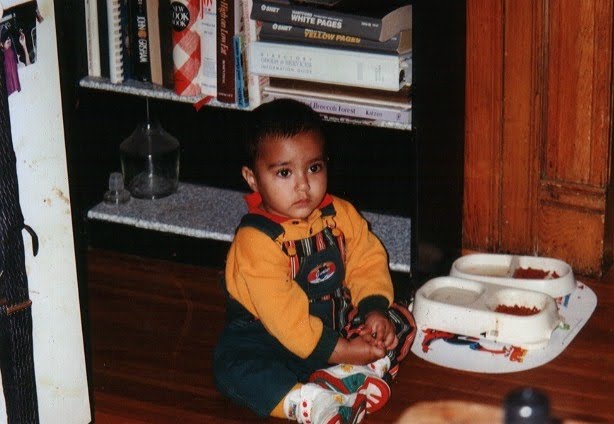
 Akber, around the time he learned the word phenobarbital. 
Should he really be seated that close to the cat food?

School Girls

Puchi reminded me that 37 years ago, on Valentine’s Day, we started attending the King Philip School in West Hartford. We had arrived in Connecticut the previous month, in January.

“I remember getting cards, not realizing what Valentine’s Day was and thinking how friendly the kids were,” Puchi reminisced. “Of course I couldn’t understand the American accents for another few weeks.”

I couldn’t understand the American accents either, or English for that matter. I didn’t speak any English when we first arrived, though I picked it up quickly. Puchi was my translator for the first few months.

After I learned English, I went about perfecting my American accent. I had a Fisher Price television set that played “London Bridge is Falling Down.” My mother would sing it with me from time to time, with her British Colonial-influenced English accent. “London Bridge is Falling Down, Falling Down, Falling Down, London Bridge is Falling Down, My Fair Lady.”

I corrected her. “No, it’s fawlling, fawlling, not falling.”

 
It also played Row Row Row Your Boat.

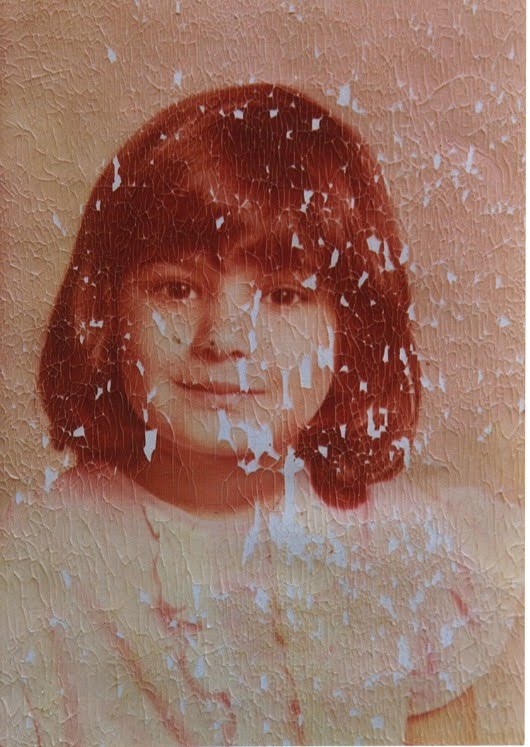
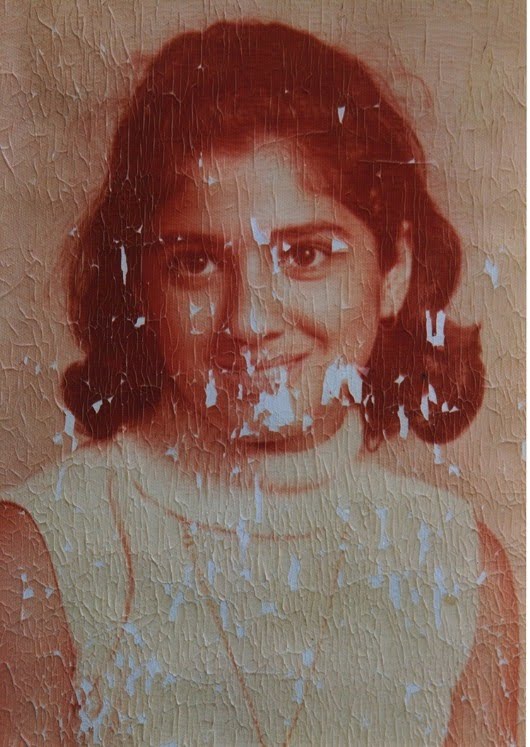
The day our school pictures were taken, my mother asked me what I wanted to wear for the big occasion. My favorite article of clothing was a ruffled pink nightgown, and I said I wanted to wear it. My mother said, “Good.” And off to school I went in my nightgown to have my first school picture taken. Fortunately it was fancy enough to pass as a dress. Puchi had the good sense to wear a stylish sleeveless white turtleneck. Here we are in our first American school pictures.

 I’m five years old.
 
Puchi is nine years old.

Who Needs Marriage?

When Mimo and Seamus got engaged, I asked her, “How did Seamus propose to you?”

“Oh, you know,” she said “He just proposed.”

“I want the details,” I replied. “Were you out to dinner? Was it romantic? Were you drinking champagne? What were you wearing?”

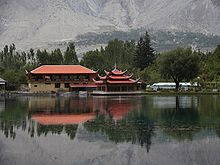
“Well, actually,” she said, “It wasn’t really like that.” Apparently the “engagement” happened sort of by accident. Mimo wanted to take Seamus on a short vacation to Shangrila, a resort in the northern areas of Pakistan started by my uncle, one of my father’s older brothers, Brigadier Aslam Khan, and now owned by one of his sons. Shangrila is nestled amongst the Karakorum mountain range in Skardu, which is the main town of the Baltistan region in the Skardu Valley, at the confluence of the Indus River near the border of Tibet.

My uncle had owned the land for many years. At some point, maybe in the 1950s, I’m not quite sure, a plane crashed onto the property and instead of having the wreckage removed, he moved the plane to a more desirable location on the property, by a lake, and refurbished it into a small cabin where he would take his young family for holidays. In later years he built the resort around the plane, with self-standing cottages surrounding the lake. The extended family loved going there for holidays in the summer.

 
Shangrila

When Mimo called to make a reservation for a romantic getaway for her and Seamus, she said, “I’d like to reserve a cottage for my fiancée and me.” Seamus had not actually proposed, but Mimo thought it would be more acceptable for them to share a cottage if she called Seamus her fiancée. Seemed like a good idea. That is, until my entire extended family started calling her to congratulate her on her engagement.

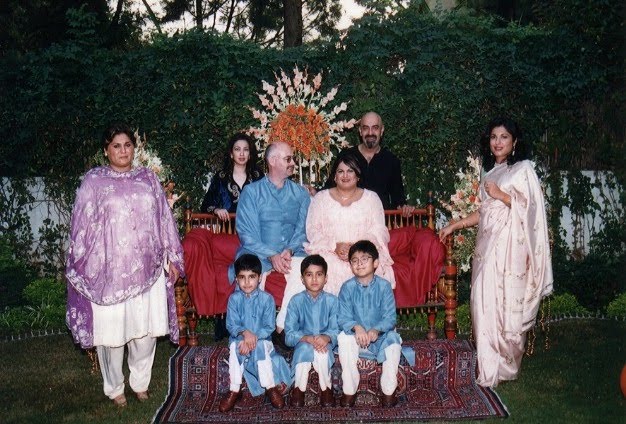
We have a large extended family. Last time I counted, we had about 60 first cousins. And word travels fast through this mostly close-knit family. So when the news got out about her “engagement” Mimo thought she better follow through with it, and she organized an elaborate engagement party, with custom-made outfits, jewelry, and a dais for the happy couple.

 
The engagement party.

Seamus, good-natured as he is, went along with the plan. Mimo picked out an emerald and gold engagement ring and wedding band, and told the family that the engagement party would be the only function in Pakistan since they had friends and family in the US and in Ireland. So the family assumed that she got married sometime shortly after the engagement party.

The truth is they could not get married right away because Seamus was in the process of getting a divorce from his first wife, and in Ireland a divorce typically takes five years. Mimo asked us sisters to be discreet about this fact, and loyal as we are to each other, we were vague when asked about the details of her wedding. After all, I knew what it was like to be in the closet, so I honored her wishes and kept my mouth shut.

They’ve been a happy, devoted couple ever since.  They did finally seal their union, brought about somewhat abruptly by some immigration issues Mimo was having because they were not legally married. They got their marriage license from the Norwalk County Court House, near our house in Long Beach. The Justice of the Peace had trouble pronouncing their names, stumbling over Fazilet and pronouncing Seamus, “Seemouse.” Her good friends Lulu, Peter, and Edward flew in from London, Massachusetts, and Florida and we had a small celebration afterward. Prior to this legal recognition of their relationship, Mimo and I had something in common: neither of our relationships was recognized by the state.

 
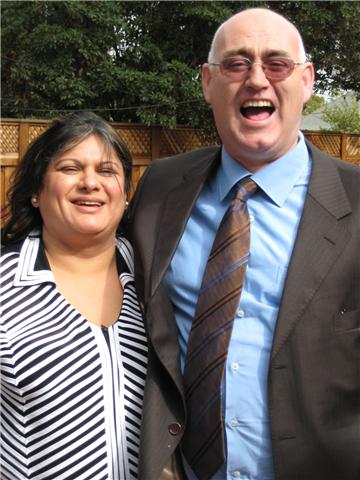
The happy couple

I wouldn’t even be blogging about this, since I thought we were still supposed to be discreet about this series of events. But Mimo emailed me yesterday to tell me how much she was enjoying reading the blog, and I told her I was dying to tell her engagement story, but that I wouldn’t do it without her go ahead.

“Of course you have the go ahead. I am beyond caring what people think,” she wrote. “As Podge and Rodge say, ‘If I could care less, I would.'”

I don’t know who Podge and Rodge are, but I like the way they think.
The Smoking Section

I smoked part of a cigarette for the first time when I was five years old. My mother gave it to me. We had recently settled into the Wiltshire Lane house in West Hartford and I think she thought it would be funny to give me a puff. I might have coughed a little, but I remember enjoying it. One of my siblings even snapped a photograph of smoke billowing out of my mouth (I didn’t inhale), and the photo was proudly displayed in one of the family photo albums, but I can’t find it now.

The next day Muna and I took a walk to Liggett’s Pharmacy and I told her I wanted to buy a packet of cigarettes.
“You’re not old enough to buy cigarettes,” she said.
“But you are. You can buy them for me.”
Responsible older sister that she was, she refused to buy me the cigarettes, which made me want them all the more. I was obsessed with cigarettes as a kid. Just about everyone in my family smoked. My mother, my father, even my brothers and sisters, though they hid their smoking from my parents. I had the burden of double deception. I had to hide my smoking from my parents and my sisters and brothers.
My father mostly smoked cigars, and my mother’s cigarette brand was Kent. My parents smoked everywhere. We had ashtrays on just about every surface in the house. They smoked in the car, sometimes without rolling the windows down. They smoked in restaurants, in hotel rooms, and would always request the smoking section on airplanes, back when they had smoking sections on airplanes.

I was used to smoke all around me, but the airplane was where I really drew the line. It was bad enough being in a metal tube full of stale air for the twenty or so hours it would take to fly back and forth from Pakistan, but to have to sit next to my mother and other passengers smoking was pretty unbearable. Still, it did not stop me from wanting to smoke.

When we lived in the Stoner Drive house, my mother would often forget where she had left her cigarettes, and I would be tasked with finding them. This could take a while, since I would have to search numerous rooms.
“Are you sure you don’t remember where you left them?” I would ask.
By the time I found them, I really felt like I needed a cigarette, so I would light one up, place it down carefully, run to give my mother her packets of Kent’s. And then run back to the burning cigarette and find a bathroom where I could smoke in peace.

 
My preferred brand as a kid.

My sister Mimo caught me in the act once, sitting on the toilet in the bathroom off my bedroom. I  fumbled to flush the cigarette down the toilet, but by now the entire bathroom was enveloped in a thick cloud of smoke.

“What are you doing?” Her eyes looked like they were about to pop out of her head.
“Um. Nothing.”
“You’re smoking!” She admonished. I thought this was hypocritical. I mean how many times had I walked in on her sitting on the toilet smoking?

Special Delivery

My junior year in boarding school, I complained to my mother, “The other mothers send their girls care packages.”

My mother asked what they put inside these packages. I thought her inquiry was encouraging, and I replied, “Oh all kinds of things. Homemade cookies, maybe a pair of socks, a letter with news from home.”

The Stoner Drive house was only twenty minutes away from the Ethel Walker School in Simsbury, so it probably seemed absurd to her that I would want her to send me news from home. And my mother did not bake cookies.

“Go down to the Cheese Shoppe in West Hartford Center and order yourself a monthly care package and have it delivered,” she said matter-of-factly. So I did.
She didn’t give me a budget so I chose quite a few things. An entire David Glass flourless chocolate cake, an assortment of cookies and chocolates, cheese biscuits, and other specialty items. My friends and I would eagerly await my “care package” which would arrive like clock work on the 10th of every month. 

 
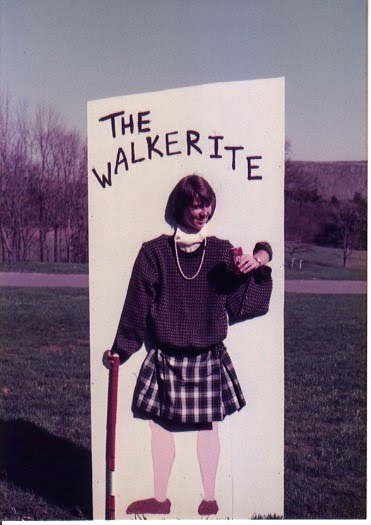
We looked something like this in our school uniforms.

 
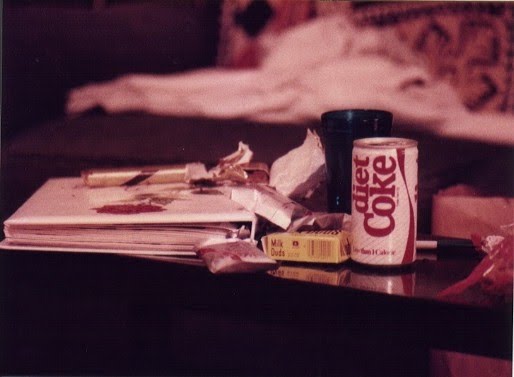
Here’s a photo from the Ethel Walker years. The Diet Coke can dates the photo. Before I arranged for the care package from the Cheese Shoppe, we would snack on Milk Duds.
During these years, my parents would travel back and forth to Pakistan with some regularity. So a few months later when my mother left for Pakistan, I suggested that she might consider sending me a letter regularly. “The other mothers write to their girls.”
By now my father had hired a secretary to handle his business affairs from the Connecticut house. Puchi and I were in school, and while my parents had many chores for us when we were kids, they also valued a good education. My mother asked my father’s secretary, Mrs. Murphy, to purchase several hallmark cards which she wrote out in advance of leaving for Pakistan. She then asked Mrs. Murphy to mail me one per month, in no particular order.
I appreciated the gesture, but I think she missed my point. I would get these random cards every month, without any context of her current environment. They would say things like, “Hope your studies are going well. Thinking of you kiddo.” Or “Some mail for your box. Hope all is well at school.”
A few years later, my mother took me to College. I went to Newcomb College at Tulane University for my first year. Before she left New Orleans, she wrote me a post card. “Mail for your box before I leave.” It’s postmarked August 22, 1985. “Hope you have a happy time. It’s going to be difficult for me going home alone, but that’s how it goes. Thank God for everybody there and I know we will miss you although we are being blasé and brave. Have a good time kid and come through happy, healthy, and proud.”

Khanvalescence

I spent several weeks in the hospital after my horseback riding accident, and when I was finally able to come home, my mother thought it would be a good idea to put my bed in the drawing room (known to most people as the formal living room). I protested this idea, but she didn’t think I could manage the stairs.

I came home in a plaster cast that made me look rather buxom. It seemed to function as a bustier in the way it pushed my breasts up closer to my chin. The cast started below my waist and went all the way up to my chest. I tried my best to hide my now voluminous bosom with various shawls, which would have been much easier to do in the privacy of my own bedroom. But no, there I was in the middle of the drawing room, propped up with several pillows, to greet all the guests who would invariably stop by for lunch or afternoon tea.

We lived in a four-bedroom A-frame house on Street No. 1 in F 6/3 in Islamabad. The house was modernist but the interior decorations were antique reproductions. My mother had all the furniture custom made out of walnut wood in a style that resembled the Louis VI period.

We went to F. Shumacher and Co. in Manhattan to purchase fabrics in ornate classic styles and designs for the Islamabad house, which we moved into in 1979. We bought  fine silks, printed fabrics and European-influenced wovens for the draperies and the upholstery.

My single bed was placed, quite literally, in the center of the drawing room in the middle of all the household activity. The tea trolley would be rolled out at four o’clock every day, and more often than not people would drop by for afternoon tea. I did my best to smile gracefully and respond to questions and observations about my injury.

“Darling, you look positively sickly,” some Aunty would say. “Quite like an invalid, really.” Or, “My, that cast makes you look rather robust.” This last comment made me decline the offers of cakes and cookies from the tea trolley and I lost about fifteen pounds or so. Normally, I would have been happy to drop a few pounds, but the cast became loose and didn’t offer much in the way of support for my cracked vertebrae and I had to be fitted for a new cast.

I hadn’t spent that much time in Pakistan, so I didn’t know most of the people who dropped by. I found this picture as I was going through old family photos. It reminded me of the kinds of ladies who would drop by for tea.

I have no idea who they are, and I don’t know if they actually dropped by for tea when I was convalescing, but they may have. And if they did, I’m sure I didn’t know who they were back then either.

Take a Letter

Ami must have told Aba that I didn’t think he had a job (See Hold the Phone, posted on January 27, 2010). Shortly after our conversation, Puchi and I became Aba’s personal secretaries, and we became painfully aware of the details of the poultry breeding business. The daily fluctuations in the price per chick, for instance, or the production levels for each of the hatcheries.

Aba had an office set up in the basement with two desks and a typewriter. Why the basement when there were 23 rooms in the main house, I have yet to figure out. Maybe because he did not really spend much time in the office, his secretarial staff did. He would say, “Take dictation, I have a letter I need typed.” And I’d have to be sure to type it on a carbon copy and then file the copy.

The secretarial task I dreaded most was being asked to “get such and such person on the phone.” I was basically a shy kid, so the typing I could handle since it was a solitary task, but calling someone on the phone was nerve-racking. For one thing, my nickname in the family is Foo. So when I would place a phone call, I’d have to identify myself. “Hello, may I speak to such and such person?”

“Who’s calling?”

“This is Foo, calling for my father.” The response would almost always be, “Who?”

“Foo.”

“Sue? Sue who?” And it would go on and on like this.

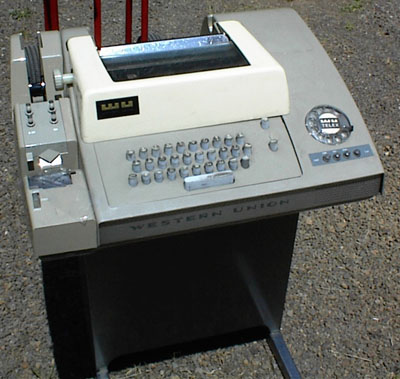
Often he’d hand me a piece of paper with his poor penmanship, which I struggled to read, and would say, “Send this message over the Telex machine.” We got Telex machines for instant communication between Connecticut and Pakistan in the late seventies. In the Stoner house the Telex machine was in the TV room, and in the Islamabad house it was under the staircase on the first floor. My father was always using the latest technology. The Telex is a communications system consisting of teletypewriters connected to a telephonic network to send and receive signals.

I don’t have a picture of our Telex machine, but I found a similar one on the internet.

A major advantage of the Telex is that the receipt of the message by the recipient could be confirmed with a high degree of certainty by the “answerback.” At the beginning of the message, we would transmit a WRU (Who aRe yoU) code, and the recipient machine would automatically initiate a response which was usually encoded in a rotating drum with pegs, much like a music box. The WRU code would also be sent at the end of the message, so a correct response would confirm that the connection had remained unbroken during the message transmission. This gave Telex a major advantage over less verifiable forms of communications such as telephone and fax. In order to send a Telex, we would have to prepare the message off-line, using a yellow paper tape. All common Telex machines incorporated a 5-hole paper-tape punch and reader. Once the paper tape had been prepared, the message could be transmitted quickly. Telex billing was always by connected duration, so minimizing the connected time saved us money. But, it was also possible to connect in “real time,” where I could type something standing at the Telex machine in Connecticut and the person standing in front of the Telex machine in the Islamabad house would immediately see my message. Now we call this instant messaging.

This early secretarial training has served me well. I have good phone etiquette and initiating phone conversations became so much easier when I started using my given name, Surina, instead of Foo. This early training also taught me to be more assertive, self-confident, and outgoing. Now, I have no problem calling people on the phone. And my typing skills have improved a little, too. I type faster now, but still with two fingers like I did back then. I never did learn the QWERTY way.

I’ll Have a Bloody Mary

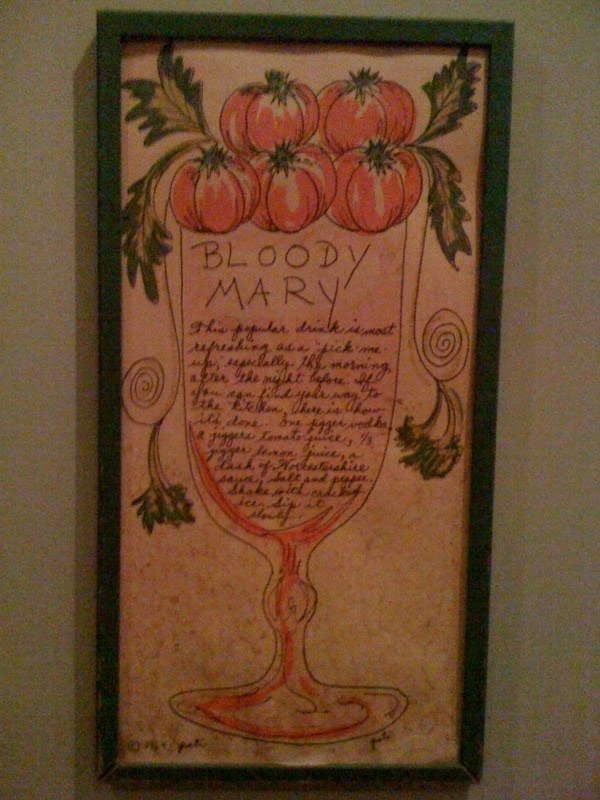
I have a watercolor of a Bloody Mary that used to hang in the bar of the Stoner house. It’s one of many items that Louis and Clara Stoner left behind when they vacated the house. A box of old family photos, a safe with hundreds of canceled checks. A cedar closet full of mink fur coats. An oil portrait of the Stoner’s granddaughter and her yellow Labrador Retriever posing on the front lawn.  My parents requested in the bond for deed that the oil painting remain with the house, but the other things the Stoner’s just left behind. They did ask for the mink fur coats, which I gather they left behind accidentally, but they didn’t seem to care about the other stuff. The Bloody Mary watercolor now hangs in our kitchen in Long Beach.

In the glass is a recipe for a Bloody Mary:

This popular drink is most refreshing as a “pick me up,” especially the morning after the night before. If you can find your way to the kitchen, here is how it’s done. One jigger vodka, 2 jiggers tomato juice, 1/3 jigger lemon juice, a dash of Worcestershire sauce, salt and pepper. Shake with cracked ice. Sip it slowly…

It’s signed by “pati” in 1964.

I prefer my Bloody Mary with a little horseradish, a few dashes of hot sauce, a celery stalk and some olives. The best Bloody Mary I ever had was at El Rio in San Francisco. They top it off with a little Guinness. Yum.

Don’t Become a Feminist

My mother was diagnosed with breast cancer when she was 46. It was the beginning of 1982 and I was in my first year of high school at the Ethel Walker School, an all-girls boarding school in Simsbury, Connecticut.

They found the cancer sort of by accident when she went to the hospital to have her gallbladder removed. Mimo was the one who told me. I think they were trying to keep the news from me. Maybe thinking I was too young.

It was a regular night around the Stoner house. I was home for the weekend from school. Dinner was being prepared and I was watching Mash reruns in the television room. Mimo came in and told me to set the table. Not an unusual request since this was one of my regular responsibilities. But something about her bossy attitude really rubbed me the wrong way and I said, “No.”

“What do you mean, no?” she said. “Go set the table.”

“I’m watching TV.”

“Ami has cancer. Go set the table.”

I was really taken aback by this news, but I didn’t want to admit that I didn’t know so I said, “I know that.” And then I went and set the table for dinner.

My mother was prone to the dramatic, and that night there was drama. She began to talk about how she was going to die and that my father would get remarried and we kids better watch out about the new wife and make sure she didn’t take everything. It was bad. My father sat there stoically while Ami accused him of remarrying some woman who did not exist.

For the first few weeks she continued with the “I’m dying and I can’t get up” kind of talk. We all tried to be understanding. After all, she did have cancer.

We also begged her to stop smoking and she almost agreed, but then her doctor said, “As much as I want you to stop smoking too, this probably isn’t the best time to do it.” He said her body was already under so much stress that quitting smoking would be too major of a change and would be too much for her to handle. Wow, really? Do they still tell cancer patients not to quit smoking?

She went through chemotherapy and radiation and responded quite well. Puchi was with her most of this time since I think the rest of us were away at college, or in my case boarding school. And my father, probably tired of being accused of getting remarried, decided he better go to Pakistan and look after the chickens.

Eventually she changed her attitude and decided, “This cancer is not going to get me, not yet anyway. I’ll beat it.” And things started looking up. She ended her treatment six months early, and to celebrate, she took my sisters and me to Barbados.

She was in remission for many years. When the cancer came back, she was in her late fifties and living in Pakistan again. I think it was around 1994 and I was about 27. We had sold the Stoner Drive house in 1989 and I was living with some friends in the West End of Hartford on Fern Street. My mother and I had recently reconciled after two years of not talking to each other. She had “disowned” me because I came out as a lesbian. She had a really hard time with the lesbian stuff, but that’s another, much longer, story.

We were speaking on the phone, one of our regular calls. I asked her if she needed anything from the US. Ami had recently had a mastectomy which she refused to do the first time around. “Well,” she said. “I’m having a hard time finding a prosthetic bra here, so if you could send one of those that would be good. And a wig. I’m losing my hair.”

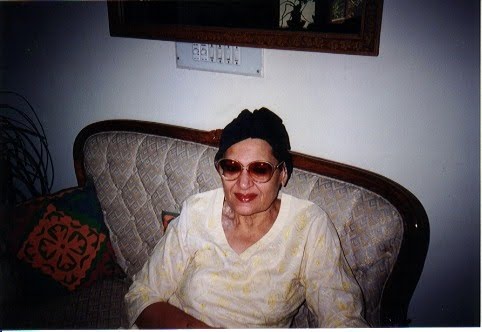
Trying to make her feel hopeful, I responded.  “I’ll send the wig, but I think you would look much more glamorous in one of those head wraps Elizabeth Taylor wears. I’ll send both. And the prosthetic bra, well, those are easy to find here. You know there are a lot of breast cancer awareness efforts and the government is putting more resources into breast cancer research so I’m sure it will be easy enough to find a prosthetic bra.”

And her response? “I know you’re a lesbian, but don’t become a feminist on me now.” First of all, the fact that she thought I might not already be a feminist was a bit of a surprise, but even more astonishing was  the fact that she, a woman with cancer, and only one breast, was frowning upon the “feminist” position that more money for breast cancer research is a good thing. Wow.

 
Ami, wearing the head wrap I got for her.