Toxic Shock

I was confused by this concept of a Milk Lunch. Since I despise milk, I thought it might be best to skip it altogether. Milk Lunch was on the schedule every weekday at ten minutes after ten in the morning. This was the part of the day at my high school, the Ethel Walker School for girls, where we were served a mid morning snack of milk and cookies. I skipped the milk. And the cookies felt a bit infantile too. Really? Milk and cookies? Weren’t we supposed to be young ladies by now? Who gets milk and cookies in high school? Kindergarten, maybe, but I felt we were a little old for a mid morning snack of milk and cookies.

The Ethel Walker School for Girls.

Milk Lunch was also an opportunity to check our mail, if we were boarding students, and buy any items from the school bookstore. In addition to books and school supplies, the bookstore also carried personal care products like shampoo, toothpaste, soap, and feminine hygiene products. We’d ask for what we wanted and sign for it.

“I need a box of tampax,” I said pretty much on a monthly basis, signing for my purchase on my account which would be billed to my parents. The household bills were usually paid by my father’s secretary so I rarely heard anything about my monthly bookstore activity.

When I went home the following weekend, my mother was holding my bookstore bill, waving it at me. She did not look happy.

“You’ve been purchasing tampax at school,” she said with disapproval. My mother forbid us to wear tampons. “It’s not natural,” she instructed. “Use a sanitary napkin.”

It was bad enough menstruating, and the sanitary “napkin” was, well, a sanitary “napkin.” I didn’t like it.

“Either you stop purchasing the tampons or I’ll call the school and tell them you are forbidden to buy them,” she said. The thought of having my mother call the school to forbid me from buying tampons at the school store was too humiliating.

“You don’t need to call the school,” I said. “I’ll stop buying them.” Which I did, sort of. I stopped buying tampax from my account, but I was able to arrange a trade with a friend. “If you put my tampax on your account,” I offered, “I’ll buy your shampoo or anything else you need.” The purchases secured, we went back to Milk Lunch.

“Can I get you another cookie?” I asked my friend.

I had to hide my monthly purchase of tampax from my mother.
I Can’t Eat That

I’m not a fan of the egg. I especially don’t like boiled eggs or fried eggs. If I’m going to eat an egg, the yolk and the whites have to be mixed together as in a scrambled egg. Or an omelet or fritatta is even better because it is more likely to have other things to mask the actual egg. The worst is a soft boiled egg, a poached egg or a fried egg over easy with the yolk all runny.

Given that my father was in the poultry breeding business, this was not a popular position in my family. We always had eggs. Often the eggs had double yolks, a great source of family pride since they came from my father’s chicken farms. In addition to grossing me out, the double-yolked eggs were also confusing to me, especially when it came to baking. If a recipe called for three eggs, how many was I supposed to put in if each egg had two yolks? One and a half? Or three? And how do you halve a raw egg anyway? I’m surprised I didn’t lose interest in baking at an early age.

As a child I was made to eat a concoction of eggs and milk. The egg would be dropped in a pot of boiling water for thirty seconds and then cracked open into a glass of milk and mixed together. “Nashta,” which means breakfast in English, one or another servant would say to me, following my mother’s instructions. I didn’t understand why I was being tortured like this. None of my other siblings was made to drink this horrific concoction.

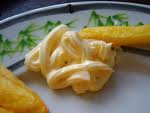
As I grew up, I stayed away from anything to do with eggs and dairy which for some reason began to equal all white foods. Milk and mayonnaise were, and still are, the worst in my opinion. I can hardly watch someone eat a sandwich if it has mayonnaise creeping out the sides. Sometimes my friends will order fries and ask for a side of mayonnaise. This causes me anxiety since the thought of having to watch people willingly dip things in mayonnaise and then consume it is too much for me so I might say, “You’re going to dip your fries in mayonnaise? Why not try the ketchup? I hear it’s very good here.” And they might respond, “Oh no, it’s aioli,” as if I don’t know that aioli is just a fancy word for mayonnaise.

French fries served with mayonnaise is a problem in my world.

Milk is also in my “avoid white foods” category. I can’t drink it. I’ll take milk or cream in my coffee, but by the time it makes it into my coffee it turns a creamy chocolate brown, so that works for me. I like yogurt, but not plain (read: white) yogurt. If it’s berry flavored, preferably strawberry, I’ll eat it. I sometimes put coriander chutney in plain yogurt which causes it to turn green and then I am fine to eat it, usually with a samosa.

I like ice cream, but not vanilla. Chocolate is my favorite, but I’ll eat just about any kind as long as it is not white. I also don’t like whipped cream, unless it has been whipped with something to cause it to turn slightly off white, like chocolate or a little espresso. Malai, the clotted cream that rises to the top of milk, is in it’s on special category of disgusting as are all things related to it like Russ Malai. And no Kulfi or Lassi for me, please.

Rice is the exception. I’ll eat basmati rice, or jasmine rice and since it’s usually served with a masala of some kind or dal, it doesn’t stay white long anyway.

When I tell people about this strange behavior of mine related to white foods, they ask, “So you don’t like mashed potatoes?” And I say, “Oh, mashed potatoes are fine. Potatoes are off white, not white.” This causes them to look at me quizzically.

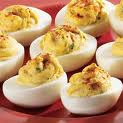
When Jenny and I first got together, she made one of her specialties, deviled eggs, which just about did me in. I looked at the platter of eggs, the hard boiled whites with a mixture of yolk and mayonnaise in the middle, and decided I had to tell her the truth. “I can’t eat that.”

I can't eat deviled eggs.

Zero Balance

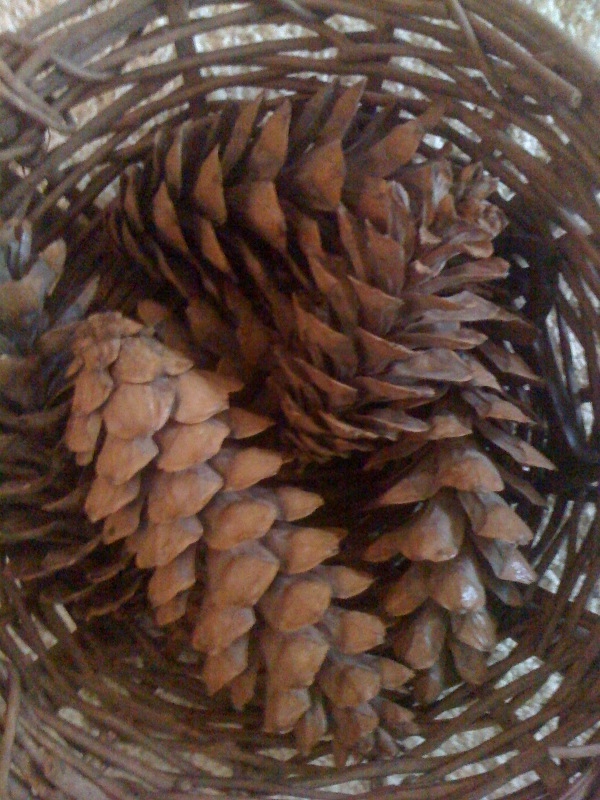
I was shellacking pine cones. “What in the world are you doing?” my mother asked me, looking a bit bewildered. She was sick again with the cancer. I was visiting her in Pakistan and we were staying at Mimo’s house.

“I’m shellacking pine cones from Nathiagali,” I responded. “It’s probably the only piece of Nathiagali I’ll ever get to keep.”

I had picked up the pine cones the previous weekend when Puchi, her boys, Akber and Abbas, and I went up to the Nathiagali house for a few days.

“What are you doing?” I asked the boys as they played in the garden.

“We’re collecting pine cones,” they said in unison.

“Well that sounds like a good idea,” I said. “I’m going to collect some pine cones too.”

Because of the debt that my father left behind when he died, Baba convinced Ami to put the Nathiagali house in his wife’s name when she was in the last stages of her cancer diagnosis,  after the final payment on the house was made.

“I have the power of attorney on the house,” my mother told me. “I’ll make sure it reverts back to all you kids.” She died before that happened and since then Baba has insisted that the house belongs to his wife.

The Nathiagali house, named Miranjani House because it looks onto Miranjani Mountain in the foothills of the Himalayas, was my favorite house. An old, rustic place that my parents purchased in the 1960s from a man named Sheikh Iqbal. He was a tender old man who indulged me when I was a young girl with laddu’s, my favorite sweet. The final payment on the house was made in the early 1990s, after my father’s death.

After Aba died, the rest of us asked for financial statements for the real estate holdings and the companies. In September of 1993 Baba sent me, and I presume the others, financial statements for 1993.

The curious thing about these financial statements is that the revenue coming in and the expenses going out balance out exactly. In the income and expenditure statement for 1993 Rs. 2,823,584 is listed as revenue. And exactly Rs. 2,823,584 is listed in expenses. I’m not a trained financial analyst, though I have run a small business and I do oversee the programmatic budget for the Women’s Foundation of California so I know a thing or two about financial statements.

You don’t have to be a financial analyst to figure out that revenue coming in does not exactly match expenses going out. Anyone who has a bank account can tell you that. Or if you’ve managed a household budget you can probably attest to the fact that you don’t spend exactly what you bring home to the penny or paisa. There’s usually money left over, or you might overspend in any given month. But things don’t balance out exactly. This was my first indication that Baba was cooking the books.

Cattle Call

One of my uncles writes regular commentary for the Pakistani newspapers. Once in a while he will forward his articles and other noteworthy pieces to family and friends. For some reason, I am not on his email list, but Jenny is.

She showed me an email he sent the other day. Apparently it is an actual essay written by a candidate applying to the Pakistani Civil Service (CSS). Although upon further internet research, I noticed that a Bihari candidate applying to the Indian Civil Service supposedly wrote the same essay for his exam. And they say Indians and Pakistanis can’t agree. Or maybe it is a case of plagiarism. Who knows? Maybe it isn’t even real, but it is entertaining. Apparently the Pakistani and Indian candidates, if this is to be believed, wrote their civil service essay exams on the Cow.

Titled simply, “Cow,” it begins, “He is the cow. The cow is a successful animal. Also he is 4 footed. And because he is female, he gives milks, [but will do so when he is got child.].” After reading this first part of the essay, I started giggling. I wonder if the writer meant to make the Cow transgender.

“He is same like-God, sacred to Hindus and useful to man. But he has got four legs together. Two are forward and two are afterwards.” Afterwards?

“His whole body can be utilized for use. More so the milk. Milk comes from 4 taps attached to his basement. [horses don’t have any such attachment].” The taps are attached to his basement? This made me think how my taps are not attached to my basement.

“What can it do? Various ghee, butter, cream, curd, why and the condensed milk and so forth.” I think he meant to write whey, not why.

“Also he is useful to cobbler, water mans and mankind generally. His motion is slow only because he is of lazy species. Also his other motion. {gober} is much useful to trees, plants as well as for making flat cakes [like Pizza], in hand, and drying in the sun.” The flatcakes he refers to are dung patties, which are used for fuel for heating and cooking.

“Cow is the only animal that extricates his feeding after eating,” Really? What do the other animals do after they eat?

“Then afterwards he chews with his teeth that are situated in the inside of the mouth.” Good to know. What else would the Cow chew with? The writer may be interested to know that I also chew with the teeth inside my mouth.

“He is incessantly in the meadows in the grass,” True enough. The Cows are always in the meadows and the grass.

“His only attacking and defending organ is the horns, specially so when he is got child.” Is he referring to the transgender Cow again? “This is done by knowing his head whereby he causes the weapons to be paralleled to the ground of the earth and instantly proceed with great velocity forwards,” if I were an editor, I might suggest he rewrite that last sentence.

“He has got tails also, situated in the backyard, but not like similar animals. It has hairs on the other end of the other side. This is done to frighten away the flies which alight on his cohesive body here upon he gives hit with it.” Okay seriously. Is this for real?

“The palms of his feet are soft unto the touch. So the grasses head is not crushed. At night time have poses by looking down on the ground and he shouts. His eyes and nose are like his other relatives. This is the cow.”

The cow. His four taps in his basement are showing.

Clearly, I need to get on my uncle’s mailing list. In the meantime, I decided to check out the CSS website as well as the Indian Civil Services exam requirements.

The Indian essay exam has five general topics that applicants are required to choose from including, “Good fences make good neighbors,” and “Are our traditional handicrafts doomed to a slow death?” Applicants can also choose to write about “Globalism vs. Nationalism,” or “Are we a ‘soft’ state?”

The Pakistani CSS exam offers many more options for essay topics, which include, “Man is Condemned to be Free,” or “Spare the Rod and Spoil the Child,” or “Not Everyone in Chains is Subdued.” Here’s one the makes no sense, “One Today is Worth Two Tomorrows.” The options also include an essay on, “A Living Dog is Better Than a Dead Lion.” My personal favorite topic might be, “All that Glitters is not Gold.” But then I saw an option to write about “Frailty thy Name is Woman.”

This one threw me for a bit of a loop, “There is a tide in the affairs of men. Which, taken at the flood, leads on to fortune.” I have no idea what this means.

One can also write about “Weather Forecasting,” or “Table Manners,” or ‘Sports for Women–Suitable and Unsuitable.” And here’s a particularly appropriate one for many a nation state, “Is Democracy Out of Date?”

Another option is to write about the “Theater of the Absurd,” which is what I feel like I am doing right now.

Bee Positive

I had only planned on staying in Pakistan for a few months. “I’m only staying two months,” I said to my mother the day I arrived in Islamabad from Connecticut. It was October of 1986. “I want to be back in Connecticut by New Year’s Eve,” I added.

Shortly after that I fractured my vertebrae in three places when Puchi insisted we go horse back riding. It took me several months to recover. (See Back in the Saddle, posted January 14, 2010 and Khanvalescense, posted February 8, 2010).

A month or two after my cast was removed, my father got sick. He started losing movement on the left side of his body during the course of one day, and we all thought he was having a stroke. There were no MRI machines in Islamabad so we flew him immediately to Karachi where the doctors discovered a collection of blood on the right side of his brain.

“They need to drill into his skull,” my mother told us. “To get the blood out.”

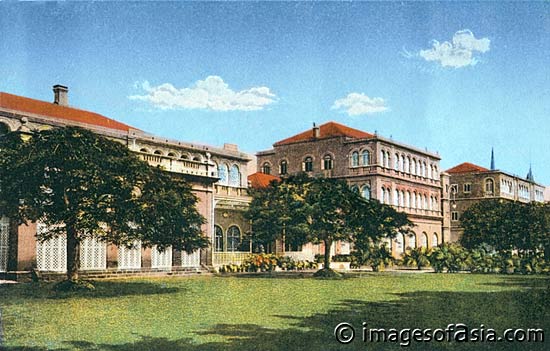
Ami, Puchi and I moved temporarily to Karachi and took up residence at our apartment at the Sind Club while Aba was hospitalized. Though I wasn’t too happy about extending my stay in Pakistan by what was sure to be another several months, I did love the Sind Club. Started as an exclusive European men’s residential club, the Sind Club was deluxe. In its early years though, women were not allowed in except to attend a ladies’ dinner held every two months and the celebrated Sind Club Ball organized once a year. Until 1950 when the Prime Minister of Pakistan lived across the road, the Sind Club was still used almost exclusively by Europeans.

The sign “Natives and dogs not allowed” was removed only a day after Mohammad Ali Jinnah took his oath as Governor-General of Pakistan on August 14th, 1947. I gather my mother’s family became members shortly after that because she always talked of going there as a young girl. After my parents married in 1955, they too became members and began maintaining an apartment there in the late 1960s.

For me, not knowing the history of the place until recently, it was a small slice of heaven. I learned to swim as a baby with my arm band floaties in the swimming pool. I ordered chicken patties and lemon tarts from the full service on-site bakery. I ordered Mulligatawny Soup in the fancy restaurant. At the snack bar by the swimming pool I would order fresh lime sodas or chicken masala or ice cream bars known to us as choc bars. The bearers or waiters all knew me by name and seemed never to move on to other jobs. They grew old as I grew up. There were lush gardens to be strolled around, as well as tennis courts, and room service in case I wanted to stay in. While my father was hospitalized, I took up tennis lessons.

The Southern Italian-style sandstone buildings of the Sind Club.

After Aba recovered from the first surgery, they discovered more blood, so they had to drill for a second time. And after that they discovered a blood clot on his brain, which meant they had to open up his skull and remove the clot.

“He needs a blood donor,” my mother informed us. “I don’t want him getting just anyone’s blood so we’ll have to see whether one of you can give him blood since I’m not a match.”

My blood was a match as was Puchi’s and we both went to the Blood Bank at P.N.S. Shifa, the Naval hospital where my father was being treated, to donate our blood.

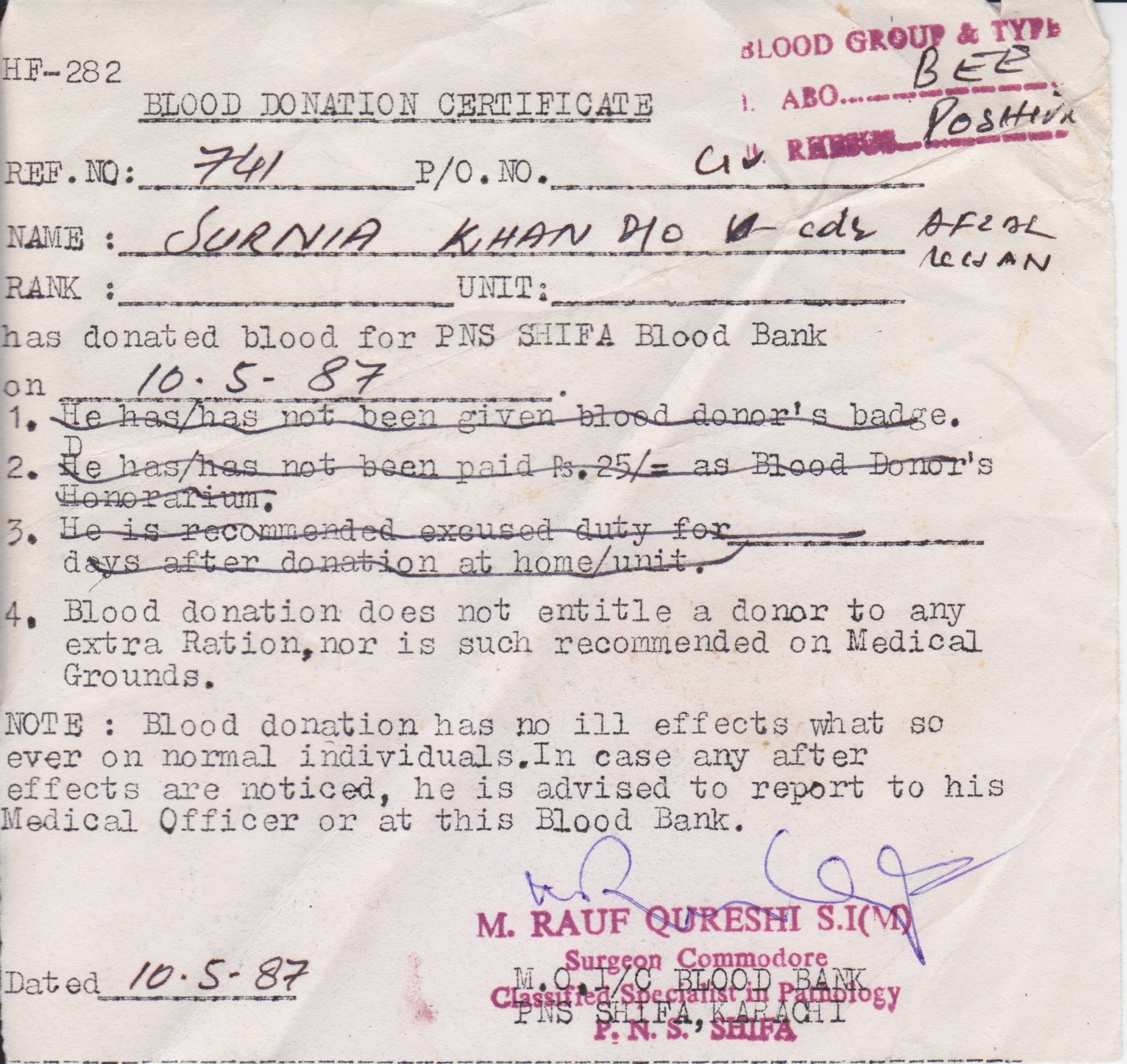
The Blood Donation certificate, dated 10-5-87 or 10 May 1987, notes that my Blood Group and Type is “Bee Positive,” which did not give me much confidence in the hospital. “They can’t even spell it correctly,” I said to Puchi. “And they also spelled my name wrong,” I added for emphasis.

The certificate also notes, “Blood donation does not entitle a donor to any extra ration, nor is such recommended on Medical Grounds.” What ration, I wondered? I did get a stale cookie after donating my blood. I wondered if people asked for seconds claiming they felt dizzy from all the bloodletting just so they could get an “extra ration?”

My Blood Donation Certificate

In case I felt woozy afterward, the certificate assured me, “Blood donation has no ill effects what so ever on normal individuals. In case any after effects are noticed, he is advised to report to his Medical Officer or at this Blood Bank.” I pointed this out to Puchi as well, “What is a normal individual? Am I normal?”

Doesn’t matter, at least I am Bee Positive, which according to some medical professionals makes me “carry the genetic potential for great malleability and the ability to thrive in changeable conditions.”

Identity Theft

Mimo was mad at me. “I can’t believe you stole my driver’s license!” she blurted when she found it amongst my things. She thought she had misplaced it which meant she had to go through the hassle of standing in line at DMV to replace her license.

“Sorry,” I offered. “I should have asked you.”

My own license had been suspended after some high school friends and I were shopping for alcohol. “Let’s try that liquor store,” one of my friends said as we were driving down Route 44 from Salisbury to West Hartford. One of us had a fake ID and we sent him in to make the purchase for our party weekend at my parent’s house while they were in Pakistan. He got a case of the nerves inside the store and returned with only a fifth of vodka. “That’s all you got?” the rest of us said in unison. “There’s six of us. That won’t even be enough for one drink a piece.”

So we stopped at the next liquor store and sent him back in with another friend for support. This time they came out with a case of beer and a large bottle of vodka. We put the unopened booze in the trunk of the car and continued on our way. We were on the road for less than a minute when we heard the sirens and noticed the flashing lights of the police car behind us.

I handed the officer my recently acquired license and registration. He asked to look in the trunk where he found our party supplies. We had to go to the police station where they detained our friends who had purchased the liquor, and allowed the rest of us to go.

I got a ticket for driving underage with alcohol in the car, albeit unopened and in the trunk where it was supposed to be. But I was sixteen and had no business driving with booze in the car.

Shortly after that I got a notice to appear in court. Puchi offered to come with me for moral support, and we agreed to keep this news from Ami and Aba who were still in Pakistan. The morning of the court date Puchi and I woke up and I said, “I’m scared. I don’t want to go to court.”

I had visions of a judge in a black robe. Admonishing me and judging me for my bad behavior. So we blew it off. Next came the notice that my license had been suspended for missing my court date and I was instructed to send it to DMV. “Driving in Connecticut is a privilege granted by the Connecticut Department of Motor Vehicles. And, like all privileges, it can be taken away―temporarily or permanently―if you prove yourself unable to follow the rules under which it was granted. Once your license is suspended or revoked, you can face serious criminal penalties if you continue to drive,” the notice said.

Mimo and I look a lot alike, so I thought I could use her license until my suspension was over. And since she was six years older than me, her license also had the added benefit of functioning as a fake ID should I ever want to purchase alcohol again. When she discovered I had stolen it from her she demanded it back.

“But you have another license,” I said. “You don’t need two. I’ll just use it until I get my license back.”

“No way,” Mimo said, not even considering it for a moment.

Mimo

When we went to Mimo’s graduation from Ithaca College a few months later, Mimo and Puchi wanted to stay on in Ithaca for the graduation parties, and asked me to drive Ami back to Connecticut. Ami hated driving.

“But I don’t have a license,” I said looking at Mimo. “I wouldn’t want to risk getting stopped without a license,” I added, giving her a bitchy smile. So there, I thought to myself.

“Give Foo your license,” my mother suggested to Mimo, not knowing that I had stolen it a few months earlier and had recently returned it to Mimo.

“You know she can use it for other things than driving,” Mimo said. This from the sister who took me to a bar on my sixteenth birthday. The hypocrisy was confusing me.

“If she wanted to do those other things, she wouldn’t need your license,” Ami said. “She looks old enough.”

Mimo reluctantly handed me her license. This time I got to keep it, thanks to Ami.

Escape to Wisconsin

I wasn’t keen on going back to Tulane after a short spring break at home in Connecticut. “I’m going to Beloit to visit Sly for a few days before I go back to school,” I told Mimo and Puchi who were managing the Connecticut house while my parents were in Pakistan.

I had only planned to stay in Wisconsin to visit my high school friend for a few days. But then I extended the visit one day at a time without really notifying anyone.

I called my roommate at school and told her I would be back soon. “In the meantime, if anyone calls for me, like my sisters, just tell them I’m in the library.” One day turned into the next, and into another, until a month had passed.

My friend Sly and his girlfriend Ellen, had gone out to get some lunch when there was a knock on the door of their apartment where I had been staying.

I opened the door and saw a police officer. “Are you Surina Khan?” he asked.

How did a police officer in Beloit know my name?
“Why do you want to know?” I responded.

“How old are you?” he said, asking for my identification.

I had recently turned eighteen. “Eighteen,” I responded nervously as I handed him my license.

“The New Orleans Police Department has an APB out on you,” he said looking over my driver’s license and confirming my date of birth. “Who do you think is looking for you? Your parents?” he asked, returning the license to me. I didn’t know what an APB was, but it did not sound good. I later learned it stands for an All Points Bulletin.

“No,” I said. “I don’t think it’s my parents. They’re out of the country. Maybe my sisters?”

“Can you give them a call?” he asked. “They’re probably worried about you. And since you’re eighteen, there’s nothing I can do.”

When I called Mimo and Puchi, they were not happy. “Where the hell are you?” Mimo berated me.

“I’m still in Wisconsin,” I said sheepishly.

“What are you still doing in Wisconsin? We thought you went back to school weeks ago.”

“I don’t know,” I said.

“Well the school is looking for you. They called us asking where you were and we said you were back at school. Your roommate said you were in the library every time we called. Your professors thought you were dead in a gutter somewhere when you didn’t show up to your classes,” Mimo continued.

“I’m sorry,” I offered.

“Ami and Aba are going to be really upset,” she said.

“Maybe we don’t need to tell them,” I said. “No need to worry them,” I suggested.

Mimo did not agree. “They need to know what you’ve done,” she said. “And you should be the one to tell them. If you don’t, I will.”

“Okay,” I groaned. ‘You’re right.”

When I got back to school, I had to go see the Dean. “Do you have any idea what is going to happen to you?” he said.

“Actually, I was hoping you could tell me,” I replied.

“If you’re lucky you’ll get incompletes, but you’re likely to fail all your classes and will have to make-up your coursework in summer school.”

The thought of staying in New Orleans over the summer was unbearable. The heat and humidity in the spring was bad enough. It was ten days before final exams, but I decided to try and make-up the work.

I went to each of my professors and explained my situation. “I don’t feel comfortable talking to you about where I was or the reasons for my absence,” I said. “It’s personal. But before you make a decision about what to do with me, let me make-up the work and take the final, and then decide if you want to give me an incomplete, fail me or give me a grade,” I suggested. They each decided this was a fair request. And then I really did spend every waking hour in the library doing my best to make-up the work I had missed. In the end I did well, getting mostly A’s and B’s. My professors all decided to give me grades, and I successfully avoided summer school.

When my mother called I told her I needed to tell her something. “I went to visit Sly in Wisconsin and stayed longer than I planned,” I explained. “I missed almost a month of school, but I’ve made up the work and my grades are good. I’m not sure why I stayed away so long, but I think I was just trying to work some things out,” I said.

“Well good for you,” my mother responded.

“Good for me?” I asked. “What do you mean?”

“You recognized you needed to take some time for yourself and you had the courage to do it. Good for you.”

My mother never ceased to surprise me. I called Mimo and Puchi. “Ami thinks I did the right thing by taking some time for myself,” I said feeling vindicated. “She wasn’t upset at all,” I added.

“Time for yourself?” Mimo said. “That’s really rich. I’m sure she doesn’t know the half of it.”

Anger Management

I needed more Valium. “Three boxes of Valium, please,” I said to the clerk behind the counter.

“5 or 10 milligrams?” he asked.

“10 please,” I responded.

After my back injury, the doctor said I should take Valium “as needed.” In Pakistan you didn’t need a prescription for most drugs so I purchased the Valium over the counter at the local drug store. More than anything, it was a muscle relaxer which helped with the back pain I was experiencing after my cast came off. The three vertebrae I had fractured had healed well, but the doctor said I might experience muscle spasms which the Valium would help with. I noticed the Valium was also good for my mood. Things just didn’t seem to bother me as much. I was calm, and generally content.

My mother, on the other hand seemed to be easily agitated. “Why don’t they listen?” she said upset with the house servants. “I told the bloody fools to set the table for the food on that end of the garden,” she hissed. Muna was hosting an afternoon luncheon and fashion show at the Islamabad house for the high school students from the school where she was teaching.

The house servant walked onto the veranda where we were sitting and offered my mother the fresh lime and water she had asked for. She took one sip and slammed it back down on the silver tray, spitting it out. “Saccharin, not sugar.”

“I’ll fix it,” I said, taking the tray and the fresh lime and water into the kitchen. I’m not sure whose idea it was, maybe Puchi and I thought about it at the same time.

“Let’s put half a Valium in her fresh lime,” one of us said. The label inside the box noted that Valium can also be used for the “treatment of anxiety, panic attacks, and states of agitation.”

“She seems really agitated,” I said. “Maybe this will help her relax,” I said, crushing half the blue pill along with the saccharin tablet and putting it into the fresh lime and water.

I walked back out to the veranda with the new fresh lime and water on a clean tray. “Here we are,” I said to my mother. “Just the way you like it.”

She sipped it slowly. By the time the party started, she was calm and relaxed.

The following week, when we noticed the rage coming on again, I asked my mother, “Can I get you a fresh lime and water?”

Christmas Condolences

My mother called me from Pakistan to wish me a happy Thanksgiving. “Hello Foosie,” she said when I picked up the phone. “Happy Thanksgiving. We’re all here about to eat our turkey and we’re thinking of you.”

“You’re having Thanksgiving dinner in Islamabad?” I asked, a bit surprised that they would be celebrating Thanksgiving in Pakistan. “Do they even have turkeys there?”

“Well not exactly, but you know Mimo. She’s arranged the whole thing.” Mimo had moved back to Pakistan in the mid 1990s. “She found us a wild turkey and had it plucked and prepared to go in the oven. She’s even made stuffing and mashed potatoes and gravy and cranberry sauce!” my mother said happily. I couldn’t see her, but I could tell she was smiling.

My sister Mimo is trained in hotel and restaurant management. She loves cooking, planning, and all things entertaining. She will throw a party for just about any reason. In college she had monthly full moon parties. It was probably her enthusiasm that made my family embrace Thanksgiving as our favorite American holiday.

Mimo knows how to throw a good party.

When my mother died several years later in December of 1999, I immediately made arrangements to fly back to Islamabad from Boston where I was living. Ami had been sick for a while with another recurrence of cancer, so her death was not a surprise to any of us, even though she was a young sixty-four years old.

When she died, Mimo was in the middle of planning a Christmas celebration at her house. She put the planning on hold and we attended all the funeral services, which like Pakistani weddings, last several days. Men and women were segregated in different parts of the house. Women, dressed in white, were clutching prayer beads as they prayed and wailed in grief. I didn’t know who many of them were and took the greatest comfort when we would go back to Mimo’s house with some of our cousins and sit around the kitchen table, ordering in Chinese food and remembering the joyful times in our mother’s life. We had many good laughs in those moments, tender and poignant. We were not filled with grief, but rather the memories of our mother and how fully she embraced life.

After the services were over, Mimo went back to planning Christmas. Although we celebrated many American holidays, Christmas was not one of them. We were Muslim after all.

“I’m having a tree cut down and we’ll trim it with ornaments and lights,” Mimo was explaining.

The guest list included us four sisters, our brother Tito who was also in town for Ami’s funeral, our close friends and their children as well as Puchi’s boys. Our oldest brother, Baba, was not included since by now the relationship between the rest of us and him was deeply strained.

Mimo had arranged toys for all the kids, but before they could open their Christmas gifts they distributed flour, lentils, and sugar to communities living in deep poverty on the outskirts of the city. “That way they’ll learn the value of giving and receiving gifts,” Mimo said.

Her living room was going to be rearranged to accommodate a long table for the Christmas dinner and she was going to put a bar in the corner for the Christmas cocktails. It all sounded great to me, especially since I had left behind a series of holiday parties in Boston.

Meanwhile family and friends continued to call on us daily to condole the loss of our mother.

“Don’t you think it’s inappropriate to be having a Christmas party?” I asked.

“No, why?” Mimo said.

Did I really need to enumerate the reasons? “For starters, Ami just died and people are coming to your house every day to condole. And we’re Muslim. We’re not supposed to be celebrating Christmas,” I explained looking at her like I couldn’t believe she had not already thought of these things. “What if someone drops by on Christmas day to condole with us and they’ll see a Christmas tree with us celebrating Christmas, drinking cocktails and wine and otherwise being merry when we should be grieving the loss of our mother? I don’t think that will look good.”

“Good point,” she said. “We’ll have to move the party to Mona’s house. No one will come there to condole with us.”

Easter Bunny Blooper

I’ve lived in the US long enough to enjoy various holidays. I especially like Thanksgiving and I can even get into the Christmas spirit. But Easter has never really been my thing. I never understood why people painted hard boiled eggs and then hid them from small children.

But I’m learning. Jenny likes Easter, so we usually go to Church and yesterday we had a little Easter brunch even. But I’m still left a little confused by the Easter bunny. What does the Easter bunny have to do with Christ’s resurrection?

My friend Laura posted this photo of two bunnies on her facebook page the other day.

Her facebook friends got a good laugh, but I was confused. “I don’t get it,” I wrote.

Laura wrote back, “You’ve been in this country too long to use the ‘I wasn’t raised here’ excuse.”

But I didn’t even use that excuse this time, I pointed out to Laura. “And I really don’t get it. Please explain.”

Laura explained that someone bit off the first chocolate bunny’s butt so he tells his friend that his butt hurts, but someone had already bitten off the second bunny’s ears, so he can’t hear the first bunny’s complaint.

Okay, now this was all starting to make sense. I appreciated her explanation, especially the part about the bunny who could not hear anymore. I also didn’t realize they were chocolate bunnies, which was my first problem. Even Laura gave me a pass, “the fact that you didn’t realize they were chocolate explains your confusion,” she wrote.

I may not have known they were chocolate, but I did wonder why the bunnies were brown. I thought it was some kind of Easter bunny diversity thing.