No Fly Watch List: Part 11

I’m getting mixed messages from the Department of Homeland Security. Last year I was placed on the No-Fly Watch List which made traveling a real hassle, mainly because I was not able to print my boarding pass from home for several months. You can read No-Fly Watch List: Parts 1-10 for greater detail.

Shortly after I discovered my status on the No Fly Watch List, I filed my paperwork with the Department of Homeland Security’s Traveler Redress Inquiry Program. A month or two later, I received a redress number and was able to print my boarding pass from home. Traveling resumed pretty much to normal. In fact, it kind of became easier.

Last November I was traveling to Albuquerque for a conference on a Southwest travel voucher. Because it was a voucher, I had to go to the airline counter to get my boarding pass.

“Here you go,” the nice lady said to me as she handed me my boarding pass.

I was in line at security when I noticed my last name was spelled wrong on the boarding pass. My name gets misspelled with some regularity. Khan becomes Kahn, which I’ve also written about on this blog. See Mistaken Identity. Oh great, I thought to myself. I’ll probably get held up in security because the spelling doesn’t match my identification.
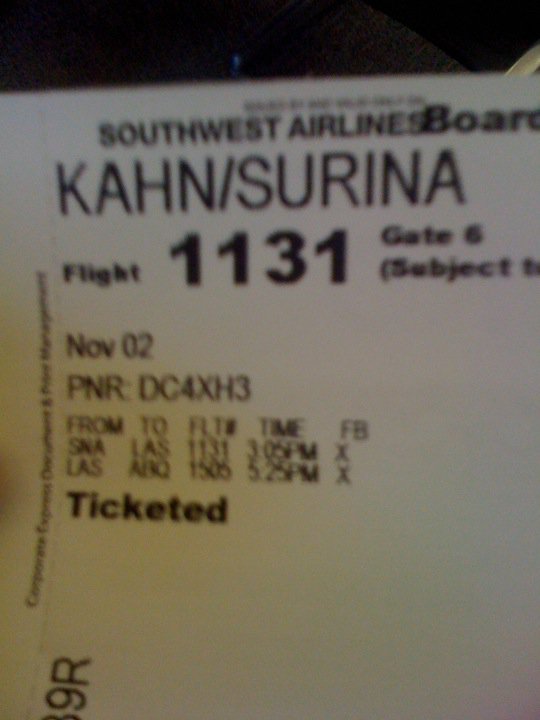
It's Khan, not Kahn.

I didn’t have time to go back to the counter so I chanced it. And they waved me through. Hmmm, I thought to myself. Have I advanced from the No Fly Watch List to the Go Ahead and Fly Even if Your Name on Your Boarding Pass Doesn’t Match Your ID?

Yesterday, I checked in for a flight and it seems the Department of Homeland Security and the TSA are trying to get their act back together because this time, I got a new message.

“Please enter the redress number for Surina Ms. Khan, if available. We have all other required information.”

Good thing I got that redress number, because I entered it and I was able to print my boarding pass, even though I was confused by the new name they gave me. Surina Ms. Khan. Usually I go by Ms. Surina Khan. At least they spelled my last name right.

Don’t Ask

This gays in the military thing has been going on for a long time. Earlier this week, a defense bill that would repeal the military’s “don’t ask, don’t tell” policy got blocked in the Senate by a Republican-led filibuster. Back in the early 90s I was co-publishing a gay magazine called Metroline with my friend and colleague Bill Mann. Anytime something gay would hit the mainstream news, they would call us for a comment.

“It’s the Gayle King Show,” Bill said, the phone pressed to his ear. “They want one of us to go on the show this afternoon to talk about gays in the military.” Gayle King, also known as Oprah’s BFF, was a prominent African-American news anchor who had her own show in Connecticut.

Bill didn’t want to do the show. “I didn’t shave today,” he said. “And look at what I’m wearing. I can’t go on television like this. You do it,” he said to me.

“Me?” I responded. “I don’t think I know enough about gays in the military to go on television.” I was in my early twenties and was not an expert on much, let alone the military. But Gayle King was Oprah’s best friend, and going on her show would be good visibility for our rinky dink publication.

We had editorialized about the issue in the magazine, calling for lifting the ban. Though we were careful not to liken it to the ban on African-Americans in the late 1940s and early 50s when the military balked at integrating African-Americans into the armed forces, a comparison made by many gay and lesbian leaders.

White soldiers will not shower or sleep in the same barracks as African-Americans. Mixing African-American troops with whites will weaken a unit’s cohesion. “These are arguments that opponents of integration were making 50 years ago,” gay leaders would say. “Substitute ‘gay’ and ‘lesbian’ and it’s the same arguments being heard today. The common denominator is prejudice.” That may be true, but these were leaders who had done little, if anything at all, to build alliances with African-American communities. Not to mention that there are many differences and nuances. African-Americans have a history of slavery in this country, after all. Bill and I understood that discrimination against African-Americans was not the same as discrimination against gays and lesbians, so we were careful not to make this comparison.

When I got to the set in downtown Hartford. I took the elevator to the basement where the show was filmed. On a commercial break, before the gays in the military segment began, Gayle motioned for me to come over and put me at ease. Without mentioning that she was preparing me for the show, she casually asked me questions about the issues.

And then the real thing started. Live. “Joining us today is Surina Khan, co-publisher of Metroline, a local gay and lesbian newspaper,” Gayle said as the cameras panned over to me. I was trying not to look like a nervous wreck.

Gayle was gentle. “Tell us why you think the ban on gays in the military should be lifted,” she said.

I went on and on about equal rights this and equal rights that. “We deserve the same rights as everyone else,” I said.

As the interview progressed I got more nervous. Gayle was calmly talking about how there were many people who opposed lifting the ban.

“What do you say to people who are concerned about unit cohesion?” She asked. I was sure I did not have any idea what she was talking about.

“Units will be cohesive,” I responded as if I knew what I was saying.

“Well,” Gayle said, looking slightly puzzled. “There are soldiers who do not want to serve with gay service members and military officials are concerned that they would not perform properly if forced to do so.” I think she was trying to explain unit cohesion to me.

I had no idea how to respond. And then things really began to devolve. “Well what about the Blacks, Gayle? What about the Blacks?” I couldn’t even pull myself together to clearly articulate the comparison, which I knew I should not be making, to the integration of African-Americans into the military. I kept repeating, “What about the Blacks?” as Gayle’s head tilted to one side and she looked at me quizzically. Gayle cut to a commercial, and I sat there, thinking I cannot believe I just said that, on live television. To a Black woman.

When I got back to the office, Bill asked how the show went.

“Don’t Ask,” I said as I considered crawling into a filing cabinet.

Mistaken Identity

My name gets misspelled a lot. “It’s K-h-a-n,” I correct people. “Not K-a-h-n.”

“Oh, but don’t worry,” I say trying to make the misspeller feel better. “It happens all the time. I’m used to it.”

When I did more freelance writing, years ago, I would file my articles with my byline, typed correctly, “Surina K-h-a-n.”

“On many an occasion, it would come out in print, “Surina Kahn.”

“Does the editor think I don’t know how to spell my own name?” I would ask who ever happened to be sitting around me.

Colleagues have been known to misspell my name, too. People will invite me to conferences to speak and ask me for my bio. I send it with my name spelled correctly, but then I see Surina Kahn in the conference program.

Just last week, I got the Sun Dial, my high school alumnae magazine, in the mail. “Look there’s a picture of your class at the reunion,” Jenny pointed.

“Oh great,” I grumbled. “They spelled my name wrong.”

So it should not come as a big surprise, that in some misguided circles, I am known as a Zionist Jewish Lesbian.

I am listed on an anti-Semitic, and seemingly white supremacist, website titled, “Jewish Control of Gay Rights.”

The website notes, “The Jews know damn well that most heterosexuals aren’t at a spiritual level where they can grasp this truth, so they use heterosexual animosity towards gays to keep our Aryan peoples divided.”

Another website called, “The French Connection,” has me listed alongside a number of other LGBT “Jewish” activists. All because of sloppy spelling.

They say, “Here is an exhaustive list proving, once and for all, that the radical homosexual movement in the United States is a Jewish movement. Jews created it and run it from top to bottom. They are pushing the perversion and degeneracy that is spreading disease, sin and sickness through America like a wildfire.” I wonder if I should let them know my name is spelled K-h-a-n? Although I’m guessing they don’t like the Muslims either.

They might be interested to know that I’m not a good Muslim, or Jew for that matter. I enjoy pepperoni on my pizza, after all. (See Where’s the Beef, posted April 2, 2010) Or prosciutto wrapped around grilled figs. I drink alcohol which is also a sin in Islam. I like to sip a glass of prosecco or an old vine zinfandel from time to time. But does that make me Jewish?

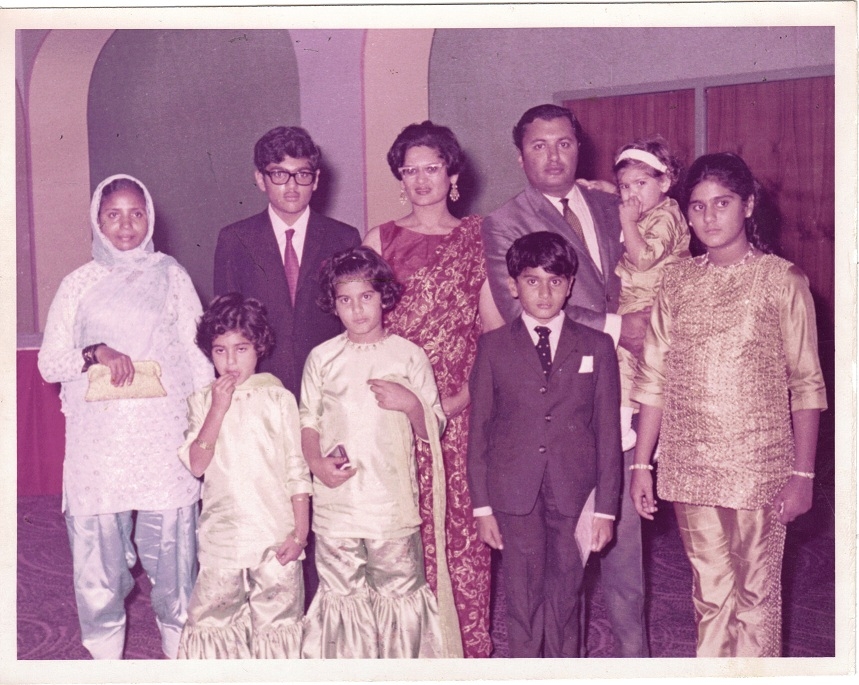
Do we look Jewish? My brothers and sisters with our parents and our Nanny Saeeda, circa 1968. I am the little one in my father's arms.

No Fly Watch List: Part 10

I got a good scare when I tried to print my boarding pass and the JetBlue website would not let me. “Oh no!” I started overreacting. Am I back on the No-Fly Watch List?

Earlier this year I was placed on the No-Fly Watch List. I’ve written about the experience on this blog at least nine other times, all tagged in the No Fly Watch List category. For the past few months though, I’ve been traveling with ease. No problems with security, no problems printing my boarding pass out in advance. I even heard directly from the Department of Homeland Security, letting me know that they could neither confirm nor deny that I was on the List. Even though this was not particularly helpful information, I appreciated the effort.

“No need to get to the airport early,” I say to Jenny with some regularity now. “I’ve got my boarding pass right here,” as I wave the coveted piece of paper, feeling confident in my frequent flier status.

Maybe a little too confident, because the last time I had to fly, I had trouble printing my boarding pass. I was sitting in the San Francisco office in back to back meetings when I realized I better print my boarding pass out in advance. But that day the website would not let me. The button where it usually says “Check-In for Your Flight,” now said, “Check in (avail. 24 hrs before flight)” and would not respond to my furious clicking.

The flight was later that same afternoon, certainly within the 24-hour time frame. “Why can’t I print my boarding pass?” I blurted in the middle of the meeting. I then looked at the actual flight coordinates and realized the problem. I thought I was flying home that evening, but in fact, I had actually booked the flight for the next evening. The problem? I had put the flight in my calendar on the wrong day, and organized everything including hotel accommodations and the next day’s meetings in Los Angeles thinking I was traveling home on a Wednesday when in fact I purchased a ticket for Thursday. This is not good.

I no longer have any administrative support due to economic cutbacks so I have to keep myself organized. I manage my own schedule. I book my own travel. I do my own filing. I reconcile all my receipts. And for the most part this has worked out okay, even if I do look a bit harried from time to time.

After a moment of panicking, realizing I had no lodging for the evening and two in-person meetings in downtown Los Angeles the next day, I regained composure. “Get a grip,” I said to myself, realizing I needed to change the flight. A change fee and one hundred and thirty dollars later, boarding pass in hand, I was headed home. The Department of Homeland Security had nothing to do with this particular travel snafu. I was on the No Fly list because I didn’t have a ticket. This month’s travel chaos was all of my own doing.

Lesson learned: seek administrative assistance.

Masala Madness

When I was helping Ami take care of Aba in London, I asked her to teach me how to cook Pakistani food.

She showed me a basic recipe for chicken masala. “You have to make sure to bhoono the spices,” she instructed. This technique, done on high heat with constant stirring, cooks the spices and prevents them from tasting raw.

“When the oil separates from the water, you know you’ve bhoonoed it enough.”

I used this technique over the years for all kinds of dishes. Chicken masala, vegetable masala, ande (egg) ka masala. And then an aunt told me about Shan Masala. “Have you tired Shan Masala?” she asked.

“No, what is that?”

Shan Masala is “premium quality” pre-mixed spices for a variety of South Asian dishes. Everything from Dal to Chappli Kababs and Biryani. I found Shan Masalas at my local Indian grocery store. First I tried the Chappli Kababs. They were delicious. Every Shan Masala I tried, tasted authentic. Never mind the high sodium content.

The instructions, however, can be confusing.

“How many grams in a pound?” I asked Jenny. The Chappli Kabab recipe called for 500-600 grams of minced beef.

I like Dal with my Chappli Kababs so I got out the Shan Dal Curry box. “Let’s make Dal, Doll,” I said to Jenny. I carefully measured a cup of lentils or 175 grams plus three tablespoons.

The recipe instructed me to add six glasses of water to the lentils. “Six glasses? What do they mean six glasses?” I blurted. “What size glasses? Tall glasses, or small glasses?”

Before that I was instructed to fry some onions “for few minutes.” That’s straight forward enough, but how many minutes equals “few minutes?” Three to five? Or more like ten? And a few minutes until what? Until they turn golden brown? Or just translucent? On high heat or medium high? Fortunately, I had my mother’s cooking training to fall back on. I decided one glass is the equivalent to one cup and cook for “few minutes,” means until they are golden brown. Which takes close to ten minutes.

I still don’t know how many grams are in a pound.

Canine Confusion

When Jenny talks to the dog, sometimes I think she is talking to me.

The other day Jenny was picking Rosie up to put her in the car and she said, “You are getting so heavy.”

“What?” I said surprised. “You think I’ve gained weight?” And then I realized she was talking to Rosie.

“I don’t mind feeding you twice a day if you exercise,” Jenny said yesterday. I was a little surprised that suddenly Jenny seemed so interested in my diet and exercise.

“I have been exercising,” I said, slightly defensively as I munched on some crusty French bread and stinky cheese. And then I realized she was talking to Rosie.

Or sometimes Jenny will coo, “Oh such a pretty girl,” and I start smiling and fluttering my eyes. “Oh, sorry. I thought you were talking to me.”

I’ve seen the same thing happen to Rosie. Jenny might say to me, “Should we have some dinner?” And Rosie will look at us expectantly thinking another serving of Grammy’s Chicken Pot Pie might be served.

Does this dog make me look fat?

Cherry Picking

I was opening a kitchen drawer looking for a clean cloth when a cockroach the size of a baby hummingbird scurried across the inside. “Ugh! there’s a cockroach!” I screamed.

Jenny came running into the kitchen. “Over there! Over there!” I yelled pointing at the drawer.

Jenny swatted at it. “Did you get it?”

“I don’t think so. It got away.”

“Ewwwe,” I said in disgust. “We need to remodel the kitchen. I can’t cook in this place.”

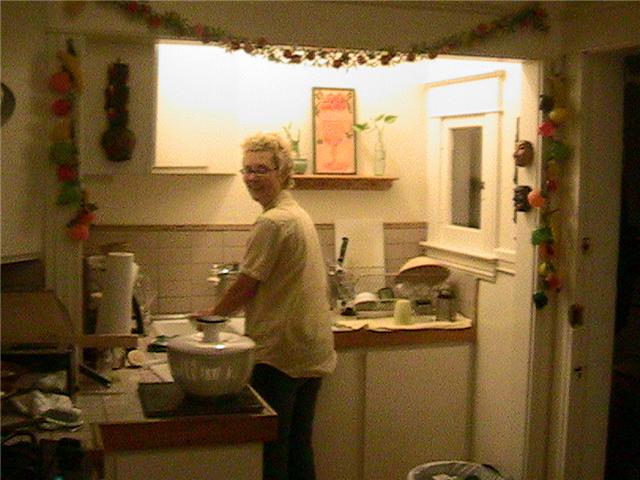
Jenny in the old kitchen.

We had purchased the house in Long Beach a few months earlier. For the most part it was in good shape, but the kitchen was a dump. The cabinets seemed to be made of plywood and the drawers required a lot of maneuvering to open and close. When we pulled up the interior of a lower cabinet to install the new stove when we moved in, we found rat droppings. I almost threw up.

“No sense in waiting,” I declared, even though we had already taken on a big debt with the purchase of the house. “I’m calling the bank to see if we can get a loan.”

With the loan secured, I called our contractor, Earl Weaver. Earl is a gentle older man, originally from Pennsylvania. His suspenders look like tape measures.

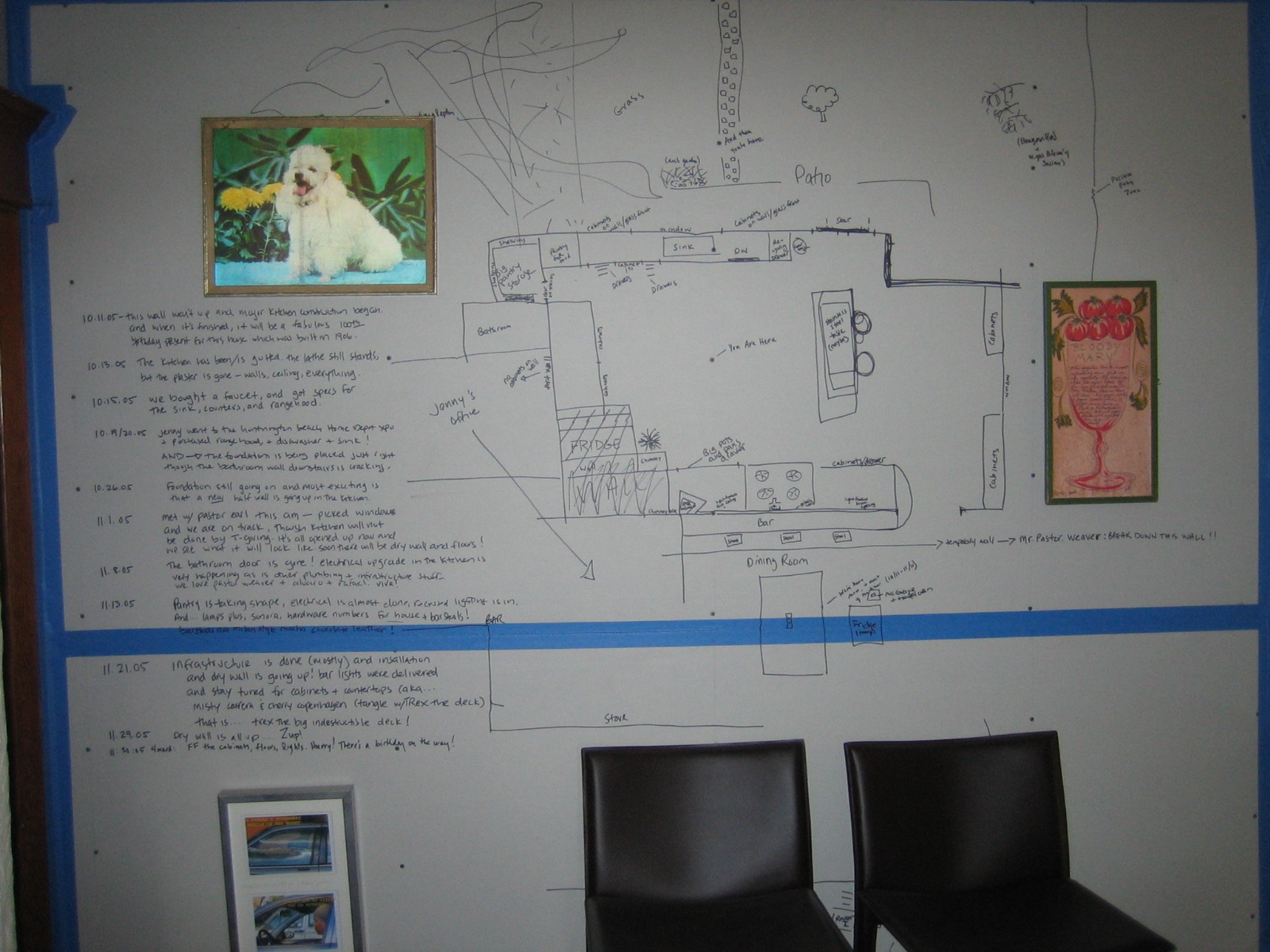
Earl arrived the next day to survey the kitchen. “We want to take down the wall between the dining room and the kitchen,” I explained. I decided I could design the place myself. Not that I am trained as an architect or a designer, except in my fantasy life, but I sketched out a rough design on a piece of paper anyway, and Earl, his assistant, Alvaro, and I made decisions along the way.

My attempt at sketching out a design for the new kitchen. Super-imposed on the temporary wall while the remodel is in progress.

“What kind of cabinets will you want?” Earl asked.

“I’m not sure,” I replied. “Maybe Maple?”

“I recommend Cherry wood,” Earl said.

“I love Cherry wood,” I said. “But we might not be able to afford it. I’m trying to stay within our budget.”

“How about if I bring over some wood samples?” Earl asked.

The next day Earl brought five samples of wood, some stained lighter than others. “Which one is the Maple?” I asked, eying a lighter stain.

“Oh, these are all Cherry,” Earl responded.

“I thought you were bringing over samples of different kinds of wood.” I said.

“No, these are all Cherry, with different stains so you can see the variety.”

“But we might not be able to afford Cherry,” I reminded him.

“I recommend you go with the Cherry wood,” Earl said. It seemed easier to agree with him on this rather then keep pressing for Maple.

“Ok, then.”

The new kitchen, almost finished. Earl was right about the Cherry wood.

When it came time to install the windows, Earl gave me a card of a woman he uses to purchase windows. “But this is a housecleaning service,” I said reading the card.

“That’s her other business,” Earl clarified. “The window business is on the other side.”

“Well that’s handy. We need a housecleaning service.”

I called Adriana the next day. “Our contractor, Earl Weaver, gave me your card. We’re going to be purchasing windows from you, but I notice you also have a house cleaning business and we need a housecleaner.”

“Oh, yes, Earl Weaver. He’s my pastor,” Adriana said on the other end of the phone.

“No,” I corrected her, thinking she must have had someone else in mind. “Earl Weaver is a contractor.”

“No, you see. Earl is like me. During the day he has one job, and at night and on weekends, he is a pastor.”

Not that I am religious, but for some reason, knowing my contractor is also a pastor, gives me great comfort.

Pass the cherry wood, please, Pastor Earl.

No-Fly Watch List: Part 9

The mail came early this morning. “Looks like I got a response from the Department of Homeland Security,” I told Jenny as I opened the envelope.

I had submitted a Traveler Redress Inquiry Form to the Department of Homeland Security’s Traveler Redress Inquiry Program back in February when I learned I had been placed on the No-Fly Watch List. (See No Fly Watch List: Part 3, posted February 15, 2010).

For most of February and March, traveling was a hassle. I couldn’t print my boarding pass in advance. I waited in lines at the airport while the airline staff completed the No-Fly Watch List paperwork. I’d often get stopped for extra screening. I generally tried to have a good attitude about it, but flying as often as I do, I needed a long-term solution so I filed my paperwork with the Department of Homeland Security to try to get my name off the list. Sometime around late March I was able to print my boarding pass from home, which made me think the system was working. I filed my paperwork, and I am off the list. Hooray. But according to the letter I received, that may or may not be the case.

“What does the letter say?” Jenny asked.

“It says they have researched and completed review of my case.”

And then the letter goes on to say, “Security procedures and legal concerns mandate that we can neither confirm nor deny any information about you which may be within federal watchlists or reveal any law enforcement sensitive information.” That is so not helpful.

They also suggest I provide my redress control number when booking travel. “This information will assist new technologies being introduced in 2009-10 to help prevent misidentifications.”

And after all these not so helpful explanations, the letter concludes, “Despite these positive efforts, we cannot ensure your travel will be delay-free.” Thanks a lot.

I can only hope that the Department of Homeland Security may or may not have communicated this information to the Transportation Security Administration because for the past couple of months I have been able to print boarding passes out in advance and breeze through security. Have I triggered a new watch list status? Or did filing my paperwork actually help? Hard to tell.

Walk of Shame

When I saw the foreclosure sign, I panicked. The sign at the bottom of the driveway, for everyone to see, had big black letters painted on it that read, “Notice of Public Auction.” As I kept reading in stunned silence I saw the warning, “Do not remove: violation subject to punishment by court.”

I continued driving up to the house, engulfed in shame and embarrassment that my family’s financial troubles were so public, with what seemed like a slightly smaller version of a billboard. I had just returned from my shift at the Keg restaurant, where I was waiting tables. The money I earned from tips contributed to the household bills. My sister Mimo paid for most of the bills out of her own salary as the Manager of the Edelweiss Restaurant, a small popular German restaurant in West Hartford Center. I was responsible for the weekly groceries and for paying for the classes I was taking at the University of Connecticut, trying to finish my college education.

As soon as I got inside the house, I called Mimo who was working at the Edelweiss. “There’s a foreclosure sign at the end of the driveway,” I said. “Anyone who drives by can see it. All the neighbors.”

When Mimo got home, I suggested we take the sign down. “We have to get rid of it.” We drove down to the end of the driveway so we could make a quick exit once we got the sign out of the ground, avoiding a walk of shame up the driveway. Pulling the sign out was not easy. “How far did they push these stakes in?” we both grumbled, hoping no one would drive by to see us removing the foreclosure sign. The sign was bad enough, but to be caught removing it would have been in its own category of shame.

Our determination was strength enough to pull it out, and when we finally got it out of the ground, we threw it in the back of Mimo’s red Chevrolet Cavalier and drove it up the driveway.

“Now what are we supposed to do with it?” we both wondered.

“We have to hide it,” I said. “It’s illegal to pull it out of the ground.”

“Where should we put it?” Mimo pondered. “Maybe in the attic?” The house was plenty big enough. A full basement and attic the entire length of the house which had twenty-three rooms. Known as the Stoner Mansion, this had been our home in Connecticut for the last fifteen years, since 1974.

“That’s the first place someone would look,” I said. “We need a better hiding place.”

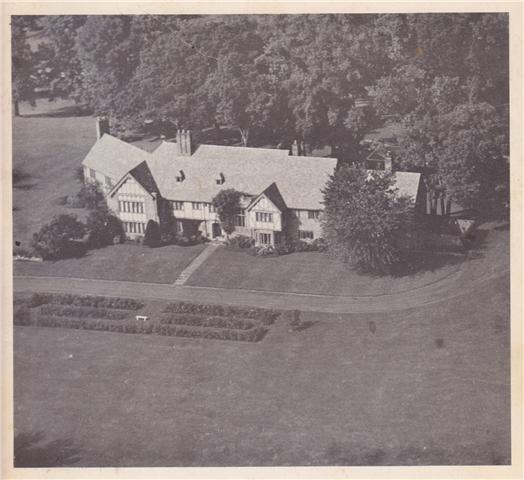
The Stoner Mansion circa 1973 when my parents purchased it.

When we first moved into the house, it was bustling, home to us six kids, my parents, and any number of guests who were welcome to stay as long as they liked. By the mid eighties my father’s chicken business was not doing well, and after he got sick in 1987 things went from bad to worse. But my father refused to sell the Stoner house, even though it was a shell of its former self. There were just three of us living there in 1988, the year the foreclosure sign went up– Mimo, me, and Aba when he was not in Pakistan trying to revive the chick business. Amin, our cook, was also with us. Mimo put him to work at the Edelweiss so he could earn money to send home to his family in Pakistan. And he continued to cook and clean for us, though with only three of us in the house there wasn’t much to do. Ami, Baba, Muna and Puchi had moved back to Pakistan, one by one. Tito was an officer in the US Marine Corps, living in San Diego with his wife and son, and Mimo and I stayed in Connecticut and kept the house running.

Aba would sit in the same chair in the Big Room at one end of the house, reading or watching television most of the day. Mimo and I generally hung out near the kitchen, usually late at night after our restaurant shifts. The rooms were mostly uninhabited and dark. The pool hadn’t been used in years.

“Let’s put it in the swimming pool,” I suggested. “No one will look there.”

“Good idea,” Mimo said. “Let’s go. You pick up that end of the sign.” We walked around to the back of the house and threw it in the deep end.

When the bank called inquiring about the missing sign, we responded with proud condescension, “What sign? I’m sure we haven’t any idea what you’re referring to.”

Hotel Fetish

I love hotels. The first thing I do when I get to my hotel room, no matter where I am, or how long I am staying, is unpack. I carefully hang my clothes in the closet, place my toiletries on the sink in the bathroom, and put away my suitcase. Even if I am just staying one night.

“Why are you unpacking everything?” Jenny will ask me on occasion. “We’re only staying one night.” I like things to be orderly in the hotel room, I tell her.

After I unpack, I look for the hotel information, usually in a binder titled Guest Services. I like to know when check-out time is, or how to get on the internet, room service options, fitness facilities and other helpful hints.

One of my favorite hotel lobbies.

A a kid I was often left to my own devices. Especially on family holidays. My siblings were a good bit older and didn’t want their kid sister hanging around. And my parents might have a dinner party to go to and didn’t want a ten year old tagging along.

“Oh don’t worry about me,” I’d say. “I’ll just stay here in the hotel and order room service.” Or if it was daytime I’d offer, “You all go ahead without me. I’ll just go to the pool.” It was a win-win situation. They didn’t want me hanging around, and I much preferred being on my own, especially if it involved a full-service hotel.

I imagined myself as Eloise, the young fictional character who lived in the Plaza Hotel in New York. Like Eloise, I would say, “Charge it to my room, please,” with an air of importance.

I’d roam the hallways. “May I help you?” a concierge might say, seeing me wandering aimlessly around the lobby. “No thank you,” I’d reply sitting down on a comfortable couch watching people walking in and out of the hotel.

Ordering room service was my favorite activity. “May I help you Miss Khan?”

“Yes, I’d like to order some dinner please.” This would usually consist of a hamburger.

“Will there be anything else? Some dessert perhaps?”

“Oh, yes please,” I’d respond. Possibly a slice of chocolate cake, or a scoop of chocolate ice cream, which I might have to eat first in case it melted too quickly.

I travel all the time for work now, and I stay in lots of nice hotels. I’m always trying to save the Foundation money, so I usually Priceline a hotel room. I have some basic criteria. I only stay in four star hotels, five stars if I can get it, but my price range usually goes no higher than $125, which is pretty good for a four star hotel, and almost unheard of for a five star hotel.

I frequently travel to San Francisco, where our main office is. At least twice and sometimes three times a month. For a brief moment I considered renting a room up there, but then I thought the better of it. “Then I’d have to do laundry in two places,” I told Jenny. This made her chuckle, because I don’t usually do the laundry at home, Jenny does. “And apartments don’t have room service,” I continued.

Room with a view.

My hotel etiquette of unpacking my bags and carefully hanging up my clothes does not apply at home, for reasons that Jenny is still trying to figure out. “Are you going to unpack your suitcase?” she asks me a day or two after I return from a trip.

“Yes, I’ll get to it,” I say, putting it off another few hours or another day. When I finally do take the clothes out of the suitcase, I tend to leave them in small piles on the washer-dryer, or the chest in the bedroom.

“Are these clothes dirty?” Jenny will ask me pointing to the pile on top of the washer.

“No,” I respond. “I need to put them away,” which I might not do for another day or two. “And what does this pile mean?” Jenny will ask, confused about the clothing on the chest in the bedroom. “I need to put those away too,” I say. And that hardly ever happens. The pile of clothes on the chest in the bedroom is a revolving pile. These are clothes that are not clean enough to put in a drawer, but not dirty enough to be washed. Or they might include a sweater or two that I wear with some frequency, so why bother putting them away?

When I do finally get around to putting my clothes away or putting them in the laundry, I might have a separate pile for delicates. “That’s delicate,” I’ll say, not realizing how delicate the whole situation may be from Jenny’s point of view. I think she’d prefer me to be as orderly around the house as I am in hotels.