Jean Hardisty hired me to be a research analyst at Political Research Associate in 1995. Getting the job at PRA was a dream come true. “If you offer me this job,” I said to Jean in my interview, “I would accept it in a heartbeat.” That seemed to work, because a day later she called to offer me the job and I moved from Connecticut, where I had been publishing an LGBT magazine, to Boston to research the Right.
On my first day, I was sitting at my desk around 6pm not wanting to leave because Jean was still at her desk and I wanted to make a good impression. We had an open office layout, like a newsroom, the idea being that it would enhance communication among us.
“Tell me again, what did you get your degree in, dear?” Jean said leaning over towards my desk. Oddly, this had not come up in my interview process.
Sh!*t! I thought to myself. I did not have a degree, which is another much longer story. The short story is that my first year of tuition at Tulane University had not been paid for family financial reasons and because of that, I could not matriculate anywhere else. Which left me with a huge debt from a private university and no degree. Meanwhile here I was at an esteemed think tank, on my first day of work, and the dreaded question of my degree had come up. So I told the truth. “I don’t actually have a degree,” I said, waiting for the other shoe to drop, expecting Jean to gasp in horror.
“Well, you’ll fit right in, dear. I’m the only one here who has a degree. Everyone else is a college drop out.”
“Even Chip?” I asked in disbelief.
“Oh, yes, he didn’t finish his BA either,” she said nonchalantly as she finished doing something at her desk. And that was the end of that, for a year or two. And then one day, she brought it up again. “I’m worried that it will hold you back, not having a degree,” Jean said. “I think we should pay your debt so that you can finish your BA.”
“It’s more than $20,000,” I said. “I don’t have that kind of money.”
“We can negotiate it down. I’ll pay the debt, if you promise me you’ll get your degree.” I was a little stunned by her generosity.
“That is very generous. I’ll think about it,” I said. But at that moment, I didn’t want to go back to school. I felt like I was just starting my career. I barely had enough money to get by, and I didn’t want to build up more debt. A day or two later, I thanked her for her offer and politely declined.
She didn’t judge, or make me feel bad. She just continued to mentor me, and teach me, with care, and calm, and her signature dry wit.
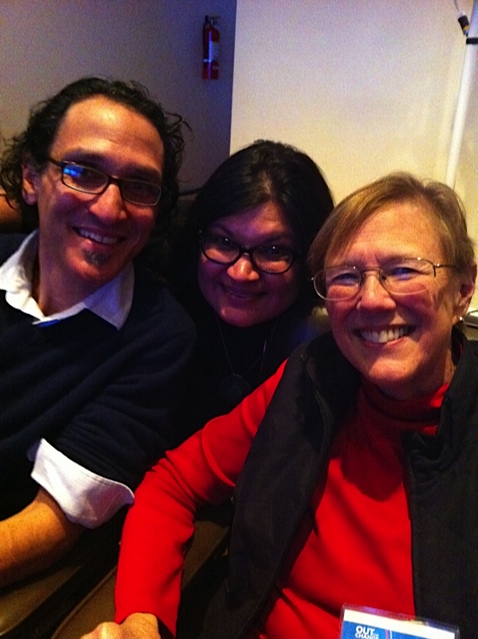
With Jean and Tarso Ramos, current Executive Director of Political Research Associates at the Ford Foundation launch of the LGBT Rights Initiative in November of 2012.
On my second day of work, I said to Jean, “So…should I be researching anything in particular?” I was reading various articles and publications, but was not really sure if I should focus on anything specific.
“Oh, that will probably take you a year or two to figure out,” she said. “Just keep reading and it will come to you. And if you need a more quiet atmosphere you should stay home and read.” I almost fell off my chair. “I’m getting paid to read,” I said to my housemate later that evening.
I didn’t stay home much to read, though. I was too excited about coming to work.
A few weeks later, an article I wrote about sexuality in South Asia that was published in Trikone magazine elicited a nasty letter to the editor, which I was upset about. “I can’t believe they would write something so mean,” I said, wanting Jean or anyone else around me to sympathize with me.
And Jean said, very calmly, “What did you learn from your attacker, dear?” Those simple words have lived with me ever since. In times of conflict and adversity, I think about what I am learning, rather than focusing on my anger or frustration.
Another time, Jean came back to the office after giving a talk. I don’t know who might have spoken with her at the same event, but when she returned to the office she offered us some unsolicited advice: “When you are giving a talk, it’s never a good idea to start with ‘I’m not feeling well or I’m nervous,’” she said. “No one will focus on the substance of your comments, they’ll focus on your cold or on how nervous you might appear.”
When I got my first iPhone, I showed her how I could search for anything I wanted. “This changes everything,” I said. “We have access to information in a new way.” And Jean, ever the measured sage and analyst said, “We might have access to information in a new way, but who will make meaning of it?”
Whenever I needed advice over the years, I would call Jean. When I had good news to share, I would call Jean. In 2010 I was appointed by the University of California as the Regents’ Lecturer and spent a week in residence at the University of California, Santa Cruz, teaching classes, meeting with students and giving a public lecture. “Oh that’s wonderful, dear,” Jean said. ‘I don’t think we need to worry about your BA now,” she said with delight in her voice.
In 2011, I was working at the Ford Foundation where I went to launch the LGBT Rights Initiative. A year later in 2012 I was promoted to lead the entire unit, which included LGBT Rights, Women’s Rights, and HIV/AIDS. Jean sent me an email titled, “Your Promotion,” which I still have on my computer. “I’m bustin’ my buttons with pride and delight. You go, girl! Love, xox Jean.”
One of our last email exchanges, late in 2014, when we were trying to find time to write something together for the Astraea Foundation, my schedule was overloaded. I was on and off a plane, moving across country back to California and starting a new job, and she said, “Let’s not stress about this. You have enough on your plate.” I was relieved and responded, “Thanks for saying that, because I really do have a lot on my plate. Monday is my first official day at the new job and let me tell you, they have got me tightly scheduled! Plus, did I mention I have a Board meeting my first week? It’s kind of comical.”
Jean responded, “Sending sympathy your way. As my old, beloved auntie used to say, ‘This too shall pass.’ I find I often have to invoke that saying, then try to believe it. Love, xox, Jean.”
In her quiet, gracious and genteel way, Jean Hardisty fostered courage, conviction, rigor, intellectual curiosity and generosity. She was, put simply, a treasure. And I will forever be grateful that I got to call her a mentor and a friend.
Rest in peace, dearest, Jean.

 Leaving Pakistan