A Tribute to Jean Hardisty

Jean Hardisty hired me to be a research analyst at Political Research Associate in 1995. Getting the job at PRA was a dream come true. “If you offer me this job,” I said to Jean in my interview, “I would accept it in a heartbeat.” That seemed to work, because a day later she called to offer me the job and I moved from Connecticut, where I had been publishing an LGBT magazine, to Boston to research the Right.

On my first day, I was sitting at my desk around 6pm not wanting to leave because Jean was still at her desk and I wanted to make a good impression. We had an open office layout, like a newsroom, the idea being that it would enhance communication among us.

“Tell me again, what did you get your degree in, dear?” Jean said leaning over towards my desk. Oddly, this had not come up in my interview process.

Sh!*t! I thought to myself. I did not have a degree, which is another much longer story. The short story is that my first year of tuition at Tulane University had not been paid for family financial reasons and because of that, I could not matriculate anywhere else. Which left me with a huge debt from a private university and no degree. Meanwhile here I was at an esteemed think tank, on my first day of work, and the dreaded question of my degree had come up. So I told the truth. “I don’t actually have a degree,” I said, waiting for the other shoe to drop, expecting Jean to gasp in horror.

“Well, you’ll fit right in, dear. I’m the only one here who has a degree. Everyone else is a college drop out.”

“Even Chip?” I asked in disbelief.

“Oh, yes, he didn’t finish his BA either,” she said nonchalantly as she finished doing something at her desk. And that was the end of that, for a year or two. And then one day, she brought it up again. “I’m worried that it will hold you back, not having a degree,” Jean said. “I think we should pay your debt so that you can finish your BA.”

“It’s more than $20,000,” I said. “I don’t have that kind of money.”

“We can negotiate it down. I’ll pay the debt, if you promise me you’ll get your degree.” I was a little stunned by her generosity.

“That is very generous. I’ll think about it,” I said. But at that moment, I didn’t want to go back to school. I felt like I was just starting my career. I barely had enough money to get by, and I didn’t want to build up more debt. A day or two later, I thanked her for her offer and politely declined.

She didn’t judge, or make me feel bad. She just continued to mentor me, and teach me, with care, and calm, and her signature dry wit.
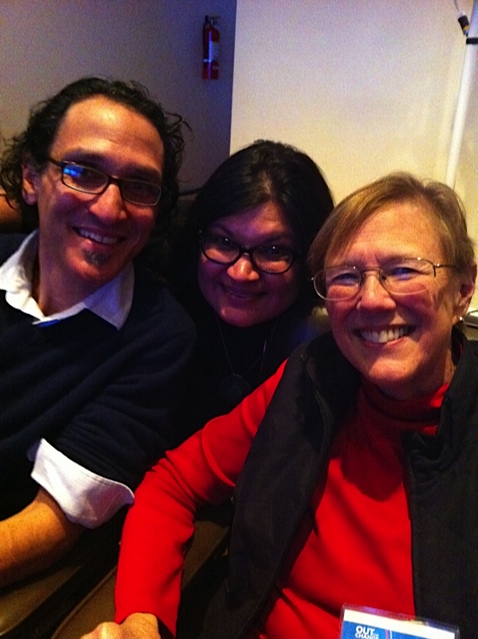
With Jean and Tarso Ramos, current Executive Director of Political Research Associates at the Ford Foundation launch of the LGBT Rights Initiative in  November of 2012.

With Jean and Tarso Ramos, current Executive Director of Political Research Associates at the Ford Foundation launch of the LGBT Rights Initiative in November of 2012.

On my second day of work, I said to Jean, “So…should I be researching anything in particular?” I was reading various articles and publications, but was not really sure if I should focus on anything specific.

“Oh, that will probably take you a year or two to figure out,” she said. “Just keep reading and it will come to you. And if you need a more quiet atmosphere you should stay home and read.” I almost fell off my chair. “I’m getting paid to read,” I said to my housemate later that evening.

I didn’t stay home much to read, though. I was too excited about coming to work.

A few weeks later, an article I wrote about sexuality in South Asia that was published in Trikone magazine elicited a nasty letter to the editor, which I was upset about. “I can’t believe they would write something so mean,” I said, wanting Jean or anyone else around me to sympathize with me.

And Jean said, very calmly, “What did you learn from your attacker, dear?” Those simple words have lived with me ever since. In times of conflict and adversity, I think about what I am learning, rather than focusing on my anger or frustration.

Another time, Jean came back to the office after giving a talk. I don’t know who might have spoken with her at the same event, but when she returned to the office she offered us some unsolicited advice: “When you are giving a talk, it’s never a good idea to start with ‘I’m not feeling well or I’m nervous,’” she said. “No one will focus on the substance of your comments, they’ll focus on your cold or on how nervous you might appear.”

When I got my first iPhone, I showed her how I could search for anything I wanted. “This changes everything,” I said. “We have access to information in a new way.” And Jean, ever the measured sage and analyst said, “We might have access to information in a new way, but who will make meaning of it?”

Whenever I needed advice over the years, I would call Jean. When I had good news to share, I would call Jean. In 2010 I was appointed by the University of California as the Regents’ Lecturer and spent a week in residence at the University of California, Santa Cruz, teaching classes, meeting with students and giving a public lecture. “Oh that’s wonderful, dear,” Jean said. ‘I don’t think we need to worry about your BA now,” she said with delight in her voice.

In 2011, I was working at the Ford Foundation where I went to launch the LGBT Rights Initiative. A year later in 2012 I was promoted to lead the entire unit, which included LGBT Rights, Women’s Rights, and HIV/AIDS. Jean sent me an email titled, “Your Promotion,” which I still have on my computer. “I’m bustin’ my buttons with pride and delight.  You go, girl! Love, xox Jean.”

One of our last email exchanges, late in 2014, when we were trying to find time to write something together for the Astraea Foundation, my schedule was overloaded. I was on and off a plane, moving across country back to California and starting a new job, and she said, “Let’s not stress about this. You have enough on your plate.” I was relieved and responded, “Thanks for saying that, because I really do have a lot on my plate. Monday is my first official day at the new job and let me tell you, they have got me tightly scheduled! Plus, did I mention I have a Board meeting my first week? It’s kind of comical.”

Jean responded, “Sending sympathy your way. As my old, beloved auntie used to say, ‘This too shall pass.’ I find I often have to invoke that saying, then try to believe it. Love, xox, Jean.”

In her quiet, gracious and genteel way, Jean Hardisty fostered courage, conviction, rigor, intellectual curiosity and generosity. She was, put simply, a treasure. And I will forever be grateful that I got to call her a mentor and a friend.

Rest in peace, dearest, Jean.
Airmail

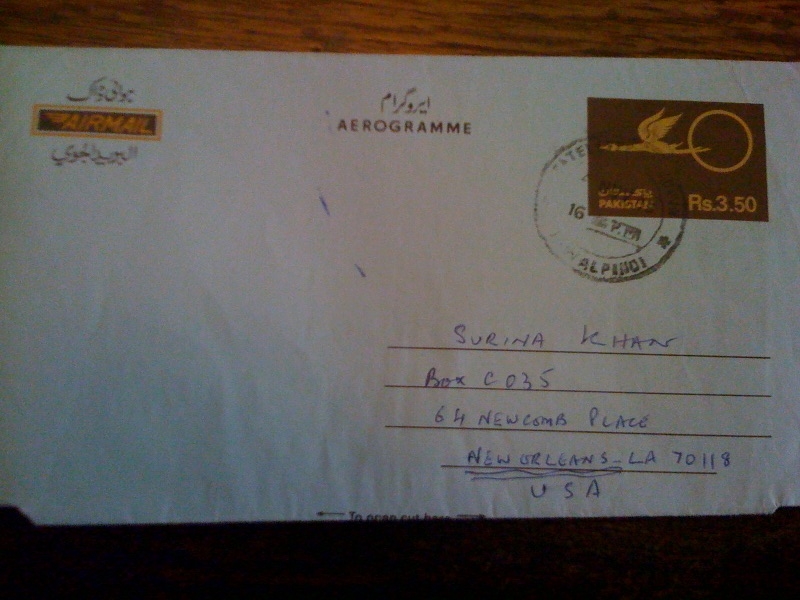
My father suggested we write letters to each other every week since we were often apart. He was in Pakistan running his poultry breeding business, and I was in Connecticut attending boarding school, and then New Orleans for college. We wrote to each other on aerogrammes, the thin blue paper with postage included that functioned as letter-writing paper and an envelope when folded into thirds.

letters from my father

We mainly corresponded about grades, money and weight. “Things are going pretty well here,” I wrote from college, in October of 1985. “I’m working hard, but my grades aren’t where I want them to be yet, so I guess I’ll just keep working until my brain falls out.”

The letters are mostly boring. In November of 1985 I wrote, “There really isn’t much going on here. I’m keeping up with my studies. I really don’t have much more to say. I’m going to continue this tomorrow.” The next day I wrote, “Nothing happened since last night. So you get a pretty boring weekly letter. But don’t blame me it was your idea.” I think the weekly letter writing was getting on my nerves.

My father was very focused on my weight which seemed odd since he had not seen me in more than a year. I was a healthy size 10 and could sometimes even fit into an 8, which seemed respectable, especially now since I would love to be a size 10 again. Nevertheless a size 10 could easily become a 12 or (gasp!) a 14. Dieting was encouraged from the time you could understand language in my family. I went on my first diet at the age of eight. It didn’t help that my nickname was Fatty. Which thankfully turned into Fatty Foo, and eventually I had the courage to insist that everyone drop the Fatty and just call me Foo.

“I understand from Nafisa and Lalarukh that you are making every effort to put on more weight. This is the time in life you have to be careful and watch what you eat. Best way is to write down everything you eat and convert it to calories. At your age you have to watch it now otherwise you will become like Mimo. Basically everything is 100 calories like a cookie, an apple, or another fruit.”

I responded, “As for my weight, let’s not be sarcastic. It’s a pretty touchy subject.”

That didn’t stop him. “Dear Fatty,” my father wrote later that same November. “Received your letter and I’m glad your grades are going up and your weight (?) going down. I am confident that you will do well in your grades once you get used to the system.” This was encouraging, but then came the dieting diatribe.

“For your weight, the main problem is mental attitude and will power. If you make up your mind to bring it down, it is then easy, but lot of will power is needed to keep it down at the right level.” I was beginning to think this was more about his weight than mine.

“You should go on a zero carbohydrate diet to bring it down and then keep track of the total calories you consume. About 1500 calories a day should keep you trim. Write down what you eat daily and add up the calories. This way the stomach also shrinks and one does not feel hungry.” Really? Writing down what you eat makes your stomach shrink? I should have listened to him years ago.

“If it is any help,” he continued, offering me his daily regimen. “Breakfast: 1/2 glass of juice (anar) these days.” Anar is Pomegranate which I gather was in season in November. For breakfast, he also had green tea. “No sugar,” he was careful to emphasize any chance he got. And he had “one toast with malai and honey.” Malai is the clotted cream that rises to the surface of milk before it is skimmed off. It looks like a thick yellowish layer of fat. The sight of it made me gag. I already had a deep aversion to milk, and in my world malai was in its own special category of disgusting, right next to mayonnaise. Sometimes, a little speck of the malai would make its way into my tea, not having been skimmed properly from the milk. “Eeew!” I would shriek dropping my tea cup. “There’s malai in the milk!”

My father’s diet tips were not making sense. Malai is full of fat. So basically he was telling me he put a layer of fat on his toast and then covered it with honey. I wonder how many calories he allotted to this coveted morning ritual?

“Lunch,” he continued, “is meat cooked without any oil and also vegetable or daal without any oil. And one chapati.” I’m pretty sure chapati, which is made with wheat flour, is full of carbohydrates, but I didn’t want to point out this contradiction either.

For evening tea he had, “Two cups of green tea without sugar and no cookies or biscuits.” In case I was not paying attention, in the following week’s letter he wrote, “I lost two pounds in the last two weeks by cutting out United Bakery cookies at evening tea time and switching to green tea without sugar.”

His advice for dinner was not helpful. “Dinner,” he wrote, followed by all caps. “NO dinner. At night I have some fruit, an apple, or grapes and that’s it.” I was beginning to think the man had an eating disorder.

Escape to Wisconsin

I wasn’t keen on going back to Tulane after a short spring break at home in Connecticut. “I’m going to Beloit to visit Sly for a few days before I go back to school,” I told Mimo and Puchi who were managing the Connecticut house while my parents were in Pakistan.

I had only planned to stay in Wisconsin to visit my high school friend for a few days. But then I extended the visit one day at a time without really notifying anyone.

I called my roommate at school and told her I would be back soon. “In the meantime, if anyone calls for me, like my sisters, just tell them I’m in the library.” One day turned into the next, and into another, until a month had passed.

My friend Sly and his girlfriend Ellen, had gone out to get some lunch when there was a knock on the door of their apartment where I had been staying.

I opened the door and saw a police officer. “Are you Surina Khan?” he asked.

How did a police officer in Beloit know my name?
“Why do you want to know?” I responded.

“How old are you?” he said, asking for my identification.

I had recently turned eighteen. “Eighteen,” I responded nervously as I handed him my license.

“The New Orleans Police Department has an APB out on you,” he said looking over my driver’s license and confirming my date of birth. “Who do you think is looking for you? Your parents?” he asked, returning the license to me. I didn’t know what an APB was, but it did not sound good. I later learned it stands for an All Points Bulletin.

“No,” I said. “I don’t think it’s my parents. They’re out of the country. Maybe my sisters?”

“Can you give them a call?” he asked. “They’re probably worried about you. And since you’re eighteen, there’s nothing I can do.”

When I called Mimo and Puchi, they were not happy. “Where the hell are you?” Mimo berated me.

“I’m still in Wisconsin,” I said sheepishly.

“What are you still doing in Wisconsin? We thought you went back to school weeks ago.”

“I don’t know,” I said.

“Well the school is looking for you. They called us asking where you were and we said you were back at school. Your roommate said you were in the library every time we called. Your professors thought you were dead in a gutter somewhere when you didn’t show up to your classes,” Mimo continued.

“I’m sorry,” I offered.

“Ami and Aba are going to be really upset,” she said.

“Maybe we don’t need to tell them,” I said. “No need to worry them,” I suggested.

Mimo did not agree. “They need to know what you’ve done,” she said. “And you should be the one to tell them. If you don’t, I will.”

“Okay,” I groaned. ‘You’re right.”

When I got back to school, I had to go see the Dean. “Do you have any idea what is going to happen to you?” he said.

“Actually, I was hoping you could tell me,” I replied.

“If you’re lucky you’ll get incompletes, but you’re likely to fail all your classes and will have to make-up your coursework in summer school.”

The thought of staying in New Orleans over the summer was unbearable. The heat and humidity in the spring was bad enough. It was ten days before final exams, but I decided to try and make-up the work.

I went to each of my professors and explained my situation. “I don’t feel comfortable talking to you about where I was or the reasons for my absence,” I said. “It’s personal. But before you make a decision about what to do with me, let me make-up the work and take the final, and then decide if you want to give me an incomplete, fail me or give me a grade,” I suggested. They each decided this was a fair request. And then I really did spend every waking hour in the library doing my best to make-up the work I had missed. In the end I did well, getting mostly A’s and B’s. My professors all decided to give me grades, and I successfully avoided summer school.

When my mother called I told her I needed to tell her something. “I went to visit Sly in Wisconsin and stayed longer than I planned,” I explained. “I missed almost a month of school, but I’ve made up the work and my grades are good. I’m not sure why I stayed away so long, but I think I was just trying to work some things out,” I said.

“Well good for you,” my mother responded.

“Good for me?” I asked. “What do you mean?”

“You recognized you needed to take some time for yourself and you had the courage to do it. Good for you.”

My mother never ceased to surprise me. I called Mimo and Puchi. “Ami thinks I did the right thing by taking some time for myself,” I said feeling vindicated. “She wasn’t upset at all,” I added.

“Time for yourself?” Mimo said. “That’s really rich. I’m sure she doesn’t know the half of it.”