A Tribute to Jean Hardisty

Jean Hardisty hired me to be a research analyst at Political Research Associate in 1995. Getting the job at PRA was a dream come true. “If you offer me this job,” I said to Jean in my interview, “I would accept it in a heartbeat.” That seemed to work, because a day later she called to offer me the job and I moved from Connecticut, where I had been publishing an LGBT magazine, to Boston to research the Right.

On my first day, I was sitting at my desk around 6pm not wanting to leave because Jean was still at her desk and I wanted to make a good impression. We had an open office layout, like a newsroom, the idea being that it would enhance communication among us.

“Tell me again, what did you get your degree in, dear?” Jean said leaning over towards my desk. Oddly, this had not come up in my interview process.

Sh!*t! I thought to myself. I did not have a degree, which is another much longer story. The short story is that my first year of tuition at Tulane University had not been paid for family financial reasons and because of that, I could not matriculate anywhere else. Which left me with a huge debt from a private university and no degree. Meanwhile here I was at an esteemed think tank, on my first day of work, and the dreaded question of my degree had come up. So I told the truth. “I don’t actually have a degree,” I said, waiting for the other shoe to drop, expecting Jean to gasp in horror.

“Well, you’ll fit right in, dear. I’m the only one here who has a degree. Everyone else is a college drop out.”

“Even Chip?” I asked in disbelief.

“Oh, yes, he didn’t finish his BA either,” she said nonchalantly as she finished doing something at her desk. And that was the end of that, for a year or two. And then one day, she brought it up again. “I’m worried that it will hold you back, not having a degree,” Jean said. “I think we should pay your debt so that you can finish your BA.”

“It’s more than $20,000,” I said. “I don’t have that kind of money.”

“We can negotiate it down. I’ll pay the debt, if you promise me you’ll get your degree.” I was a little stunned by her generosity.

“That is very generous. I’ll think about it,” I said. But at that moment, I didn’t want to go back to school. I felt like I was just starting my career. I barely had enough money to get by, and I didn’t want to build up more debt. A day or two later, I thanked her for her offer and politely declined.

She didn’t judge, or make me feel bad. She just continued to mentor me, and teach me, with care, and calm, and her signature dry wit.
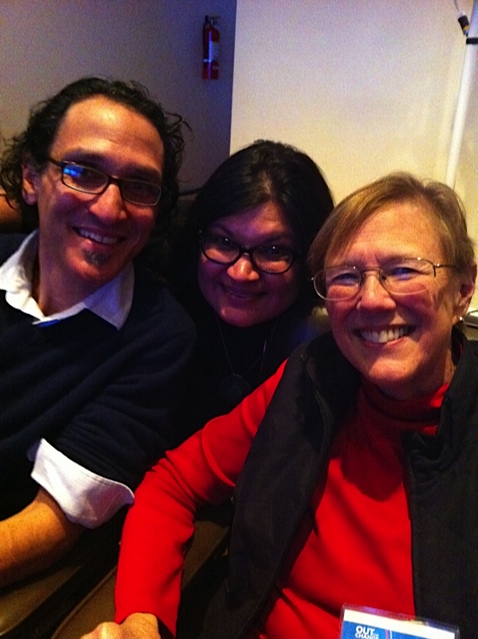
With Jean and Tarso Ramos, current Executive Director of Political Research Associates at the Ford Foundation launch of the LGBT Rights Initiative in  November of 2012.

With Jean and Tarso Ramos, current Executive Director of Political Research Associates at the Ford Foundation launch of the LGBT Rights Initiative in November of 2012.

On my second day of work, I said to Jean, “So…should I be researching anything in particular?” I was reading various articles and publications, but was not really sure if I should focus on anything specific.

“Oh, that will probably take you a year or two to figure out,” she said. “Just keep reading and it will come to you. And if you need a more quiet atmosphere you should stay home and read.” I almost fell off my chair. “I’m getting paid to read,” I said to my housemate later that evening.

I didn’t stay home much to read, though. I was too excited about coming to work.

A few weeks later, an article I wrote about sexuality in South Asia that was published in Trikone magazine elicited a nasty letter to the editor, which I was upset about. “I can’t believe they would write something so mean,” I said, wanting Jean or anyone else around me to sympathize with me.

And Jean said, very calmly, “What did you learn from your attacker, dear?” Those simple words have lived with me ever since. In times of conflict and adversity, I think about what I am learning, rather than focusing on my anger or frustration.

Another time, Jean came back to the office after giving a talk. I don’t know who might have spoken with her at the same event, but when she returned to the office she offered us some unsolicited advice: “When you are giving a talk, it’s never a good idea to start with ‘I’m not feeling well or I’m nervous,’” she said. “No one will focus on the substance of your comments, they’ll focus on your cold or on how nervous you might appear.”

When I got my first iPhone, I showed her how I could search for anything I wanted. “This changes everything,” I said. “We have access to information in a new way.” And Jean, ever the measured sage and analyst said, “We might have access to information in a new way, but who will make meaning of it?”

Whenever I needed advice over the years, I would call Jean. When I had good news to share, I would call Jean. In 2010 I was appointed by the University of California as the Regents’ Lecturer and spent a week in residence at the University of California, Santa Cruz, teaching classes, meeting with students and giving a public lecture. “Oh that’s wonderful, dear,” Jean said. ‘I don’t think we need to worry about your BA now,” she said with delight in her voice.

In 2011, I was working at the Ford Foundation where I went to launch the LGBT Rights Initiative. A year later in 2012 I was promoted to lead the entire unit, which included LGBT Rights, Women’s Rights, and HIV/AIDS. Jean sent me an email titled, “Your Promotion,” which I still have on my computer. “I’m bustin’ my buttons with pride and delight.  You go, girl! Love, xox Jean.”

One of our last email exchanges, late in 2014, when we were trying to find time to write something together for the Astraea Foundation, my schedule was overloaded. I was on and off a plane, moving across country back to California and starting a new job, and she said, “Let’s not stress about this. You have enough on your plate.” I was relieved and responded, “Thanks for saying that, because I really do have a lot on my plate. Monday is my first official day at the new job and let me tell you, they have got me tightly scheduled! Plus, did I mention I have a Board meeting my first week? It’s kind of comical.”

Jean responded, “Sending sympathy your way. As my old, beloved auntie used to say, ‘This too shall pass.’ I find I often have to invoke that saying, then try to believe it. Love, xox, Jean.”

In her quiet, gracious and genteel way, Jean Hardisty fostered courage, conviction, rigor, intellectual curiosity and generosity. She was, put simply, a treasure. And I will forever be grateful that I got to call her a mentor and a friend.

Rest in peace, dearest, Jean.
Who’s the Boss?

We were supposed to meet in the hotel lobby at ten after six. “Ladies, I’ll see you in the lobby at six ten,” instructed Ami, (pronounced Aimee). Ami is our coordinator for the Women’s Economic Security Campaign (WESC) and she is always telling us what to do. Ami should not be confused with my mother who we also called Ami (pronounced Ummi). Come to think of it Ami, my mother, was also often telling people what to do. And Ami, our coordinator, was herding us around like a bunch of kids. So much so that I noticed some of the ladies in our group started calling her Mom. “Okay, Mom. We’ll be there at ten after six.”

WESC is a collaborative of four women’s funds. My colleagues from Chicago, Memphis and DC and I are working together in collaboration with the Women’s Funding Network to improve economic security for women and girls. Earlier this month, WESC released the second in a series of policy reports, Aiming Higher: Removing Barriers to Education, Training and Jobs for Low-Income Women, which focuses on job creation, training and supports for low-income women. We were in DC to release the report and meet with national advisors and policymakers. Ami had arranged everything for the trip. And if it weren’t for her we would never have gotten our act together to actually complete the report.

We all have big important jobs and we work hard, but left to our own devices we could never accomplish all the things we want to do with this campaign, so we hired Ami. Through our work together, we’ve also really come to enjoy each other.

“Let’s go to the bar and get a drink,” Shelley said. Shelley is from the Chicago Foundation for Women and like me, she loves red wine, preferably a full-bodied red like a Cabernet or Zinfandel. “I need to go up to my room and change really quickly. I’ll meet you there,” Shelley said.

“Sounds good,” the rest of us said in unison. We’re a very agreeable group which is an essential quality for a collaborative.

“I’ll have a Pinot Grigio,” Jennifer said when we got to the bar. Jennifer is the Interim Co-President and Vice President of Programs for the Washington Area Women’s Fund. She has two jobs so she really needed that glass of wine.

“Make that two,” said Shante, our colleague from the Women’s Foundation for a Greater Memphis. When Shelley came down, she ordered a Cabernet.

My boss, the President of the Women’s Foundation of California joined us a few minutes later. “Can I get you anything?” the waiter asked.

“No,” Judy replied. “I’m just going to sit here and watch them drink.” Judy enjoys a glass or two of wine from time to time, but she was getting ready to head to the airport. She had to leave us early.

“Too bad you can’t join us at the White House,” we said to Judy. Ami and Shelley had worked together to get us a meeting with Tina Tchen, the Executive Director of the White House Council on Women and Girls. We were talking with excitement about this meeting when Ami found us in the bar.

“I knew I’d find you ladies in here,” Ami said appearing at our table and tapping her watch with her index finger.

“Is it ten after six already?” we said earnestly. “Time flies.”

“Let’s go, ladies. We don’t want to be late.” We had been invited by a well-connected DC colleague, Kathy, to her apartment at the Watergate. Kathy, who has done some communications work with some of our funds, was kind enough to invite some DC-based feminist leaders to have dinner with us. Everything was lovely, including her apartment and the dinner she had arranged. “Ruth Bader Ginsburg used to live just a few doors down,” Kathy told us. “And Condie Rice. She lived down there.”

My WESC colleagues and I put on our networking faces and charmed the elder feminists. Marcia Greenberger, the executive director of the National Women’s Law Center was there. And Ellie Smeal from the Feminist Majority was there with her colleague Kathy Spillar, the executive editor of Ms. Magazine.

We all nibbled on salmon, and chicken, and salads as we continued drinking wine.

“Ladies, we’ve got an early morning tomorrow,” Ami was trying to get us out the door after the chocolate cake had been served. Kathy told us we could get a cab at the Kennedy Center across the street.

It was spitting rain and slightly chilly and we were not happy with having to walk the short block. “Where’s the taxi stand?” we asked Ami expecting her to know the details of the Kennedy Center taxi stand.

“Maybe it’s up those stairs,” she said.

“Up the stairs?” Ruby, the executive director of the Women’s Fund for a Greater Memphis moaned. She had heels on and was not having it. And the rain was really complicating things. I’m surprised Ami didn’t remind everyone to bring an umbrella. I had my umbrella which was good because Shante kept sidling up to me trying to get cover from the rain. She forgot her umbrella. Jennifer and Ruby also forgot their umbrellas so they wrapped their shawls around their heads which made them look like they were good Muslim ladies wearing hijab.

“There’s the taxi stand,” Ami said pointing to a sign.

“But there are no taxis,” we noted as if Ami was not smart enough to notice the absence of any cabs. I think we were getting a bit too reliant on Ami’s coordinating skills. Surely the rest of us knew how to look up a cab company on our fancy iPhones and Blackberries. But instead we looked at Ami, like a bunch of kids. “What are we supposed to do now?” we asked Ami.

Ami called us a couple of cabs, and we waited. And waited. For forty minutes. In the drizzle.

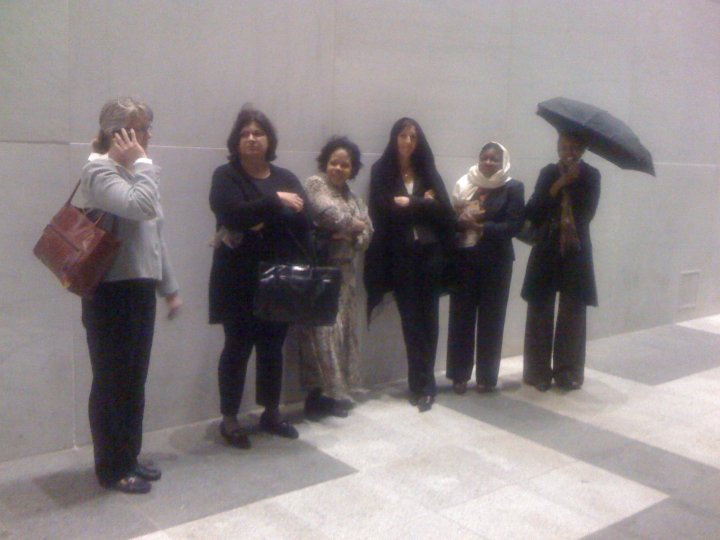
Ami is the one on the left on the phone trying to get us a cab as the rest of us look on while we wait in the rain at Kennedy Center.

“I want to see you at 8 am,” Ami said to me when we got back to the hotel. “And I want to see you at 8 am,” she instructed Ruby. She said the same thing to each of us. I was expecting the next words out of her mouth to be “and not a minute later,” but she was gentle with us. Ami has two young boys, and I could tell she had good, caring parenting skills. “Get a good night’s sleep,” she added.

The next day we had a series of meetings with our national advisors, and had to tape a segment for a webcast for the Spotlight on Poverty and Opportunity. Ami had us do a run through of the webcast earlier in the morning, reminding us each of our roles. “You’ll all be great,” she cheered.

When we got to the studio for the taping, the news anchor who was going to interview us was late, and Ami was not happy. “We need to get back to the hotel for the meeting with our national advisors by 11:30,” she said. Too bad Ami, wasn’t coordinating the anchor’s schedule. If she had, we would not be running late.

“Can we bring our notes on to the set?” we asked.

“No,” replied Ami. “But you guys know all this stuff. You’ll do great.” We couldn’t help but notice that the news anchor, when she finally arrived, not only got to bring her notes on the set, but she also had an ear piece into which the producer would speak to her giving her guidance.

“Why can’t we have Ami talking to us through an ear piece in case we forget anything?” we wanted to know. No one even bothered answering that question.

After the webcast taping we rushed back to the hotel for our lunch meeting. And then like clockwork, at 1pm we left for the White House, where we arrived in two cabs.

“Is this the right entrance?” we asked from the backseat of the cab. Ami was sitting up front with the cab driver and decided to go out and check. “You stay in the cab,” she told us.

When a police car pulled up to the cab, we knew we were at the wrong entrance. “You know you’re not supposed to be here, right?” the officer said over his speaker.

The cab began to pull away just as Ami was running back, and she jumped back in just before it took off. “We need to go to the Pennsylvania Avenue and 14th Street entrance,” Ami instructed the cab driver.

We arrived at the Northwest gate and waited for the rest of our colleagues who were in another cab. Ami got out her cell phone and guided them to the right entrance. “Walk faster,” she said.

When we were all assembled, Ami looked us over. I almost expected her to start fixing our hair, or straightening our collars. “Let’s go ladies,” she said as she rang the buzzer. After making sure our names were on the security list, the guard buzzed us in. We had to put our bags through an x-ray machine and we walked through a scanner, each one of us causing it to beep. Each of us was then scanned with a wand and passed through to the other side. We walked to the West Wing where we were greeted in the lobby by a young receptionist sitting at the cleanest desk I have ever seen. There was not a thing on it. I later noticed that she had a computer, but it was embedded in the desk.

“Remember our pact,” Shelley said. “No acting cool as a cucumber. We need to get some photos while we’re here.”

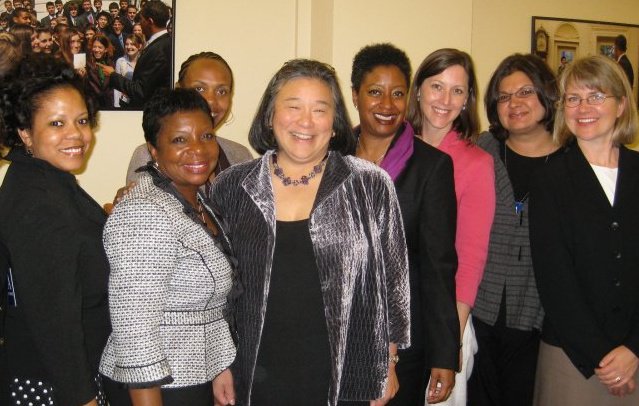
With Tina Tchen at the White House Council on Women and Girls. From left, Shante, Ruby, Shaune, Tina Tchen, Shelley, Jennifer, me, and Ami.

As we walked out of the West Wing, we passed by Valerie Jarrett’s office. “Someone told me that used to be Karl Rove’s office,” one of us whispered.

Back outside, we wanted to take a photo in front of the West Wing entrance. We were instructed by White house staff and security not to take any photos but Ami gave us permission, so we stopped and everyone got their cameras out. Ami even got in the photo with us.

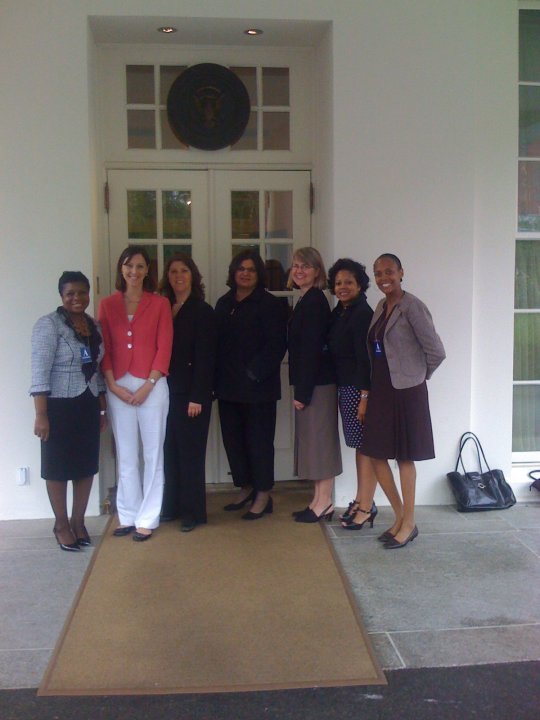
At the entrance to the West Wing: Ruby, Jennifer, Shara, me, Ami, Shante, and Shaune. Shelley is not pictured since she took this photo.

Fast Food

The driveway was full of school children. “What’s going on?” I asked Puchi.

“Ami’s been feeding school children everyday,” Puchi replied. I had recently arrived in Islamabad, in October of 1986.

My mother had noticed some local children passing by our house everyday on their way home from school. They looked malnourished, emaciated with runny noses and open sores on their tiny bodies. They were in elementary school and ranged in age from about five to nine years old.

Ami had the cook make a big pot of dal or masala and a stack of naans from the tandoori oven. He would put a scoop of dal or masala on the naan and offered it to the children. The first day one or two kids hesitantly took the food. And the next day a few more, and a few more after that until the driveway was full of forty or fifty children everyday. Within a couple of weeks they started looking healthier. The open sores went away and they put on a bit of weight looking bright-eyed and cheerful. “See how little it takes to give someone a chance in the world?” my mother would say.

Ami planned the menu so they would get all the basic food groups in a week. Naan or roti everyday, with a scoop of dal for protein, or vegetable masala another day, and meat the next day or maybe rice pudding with milk and fruit. “This way they get protein and carbohydrates,” Ami explained. “And we don’t need to use plates since we put the food right on the roti.” Eventually as the menus became more varied she purchased metal plates and cups.

The cook would put a scoop of food on top of the naan for the kids.

The kids were shy. At first they trickled in. Ami asked one of the household staff to stand at the gate to invite them for lunch but that wasn’t really working so she went out there herself and invited them to eat. Initially many brought their fathers so they could ask permission which helped. And then Ami asked Puchi to stand at the gate to invite the new kids. She had Puchi sit with the kids while they ate. “I don’t want them thinking we’re treating them like poor kids,” she said. “They should feel like they’re eating with a member of the family.”

“One boy used to stand outside the gate, too hesitant to come in when the servants invited him,” Puchi remembers. Ami asked Puchi to invite him in, and maybe because she was part of the family, he eventually came in. His father came to thank us later in the week. And some of the other parents would stand at the gate in a bit of shock that this was a daily event, moved by my mother’s generosity.

Ami knew that just feeding the kids wouldn’t solve the problem, so she formed a committee, deciding that working through the government-run schools would be the best way to help families living in poverty. The World Food Bank was giving nutritious food to Afghan children, and my mother thought they should expand the program for Pakistani school children as well. This never happened, but it was a good idea.

She worked with the village mothers as well, trying to get them involved in advocating for the schools to feed kids. “This will increase family income as well,” my mother explained, “because then families will spend less money on food.”

Ami had only one rule. The kids had to eat at the house. “No take aways,” she said. “I want to be sure that they eat the food.”

Gay Gay Gay

Mimo offered to host a tea party for me when I visited Pakistan in 2001. “If everyone comes here for tea,” she explained, “It will save us time calling on all the relatives.” Ever the strategic thinker, Mimo was conscious of the limited time I had. I was only in Islamabad for a few days, stopping on my way back to the US from a work trip that took me to India and Sri Lanka.

Shortly before my trip, I received an invitation from a policy research institute based in Islamabad to give a talk on lesbian, gay, bisexual, and transgender issues. Puchi was living in Hawaii by now, but she had been a journalist in Pakistan, so I mentioned the invitation to her, asking if she had ever heard of this particular Institute. “Yes,” she said. “It’s one of the leading policy institutes in the country.” But then she discouraged me from giving the talk, saying that it would put our extended family in a very uncomfortable position. “You have to consider how it will affect the family,” she said.

“Okay,” I said. “I wont do it.” I was clear that the primary purpose of my trip to Pakistan was to visit my family and if it made them uncomfortable, I would decline the invitation. “But go ahead and do it,” Puchi then said. “It’s a reputable policy institute and it’s about time the family began to understand these issues.” So with her encouragement, I accepted the invitation, which to my knowledge may have been the first time a public conversation on LGBT issues was held in Pakistan.

When the guests started arriving for the tea party–various aunts, uncles and cousins– we entertained them in the proper fashion. My mother, who had died just over a year ago, would have been pleased. We served high tea with an assortment of pastries, biscuits and savory items. We dressed appropriately. I didn’t have a shalwar kameez, and didn’t like wearing the traditional outfit anyway, but I covered myself with a dupatta over my blouse and long pants. We poured the tea for our guests offering them chicken patties, cucumber sandwiches, samosas, pakoras, lemon tarts, and cakes from the tea trolley.

High Tea

The conversation inevitably turned to me. “What are you doing these days? Where are you working?” they would ask. I had just come from a large human rights conference in Pune, India where I gave a keynote address on the importance of integrating sexual rights and lesbian, gay, bisexual, and transgender issues into the human rights movement in South Asia. At the time, I was the executive director of the International Gay & Lesbian Human Rights Commission.

“You’re a professional lesbian,” my friends in the US would say to me. And it was true. I was always talking about gay this and lesbian that. And I got paid for it.

Most of my extended family knew that I was a lesbian. And if they didn’t, it was only a matter of time before I outed myself, usually in response to the question, “Where do you work?”

“The International Gay & Lesbian Human Rights Commission,” I would respond. This would leave some people stunned into silence. So I started saying vaguely, “I work for a human rights agency,” not wanting to make anyone feel uncomfortable or to force the homosexuality conversation.

But someone would inevitably ask, “Whose human rights are you working for?”

“Gays and lesbians,” I would respond “and bisexual and transgender people.”

Often the response would be, “Well then you must not do much work in Pakistan. We don’t have gays and lesbians.” Or, “I know gay and lesbian, but what is this bisexual? This is perversion. Bisexual. Liking sex with everyone?”

“If it makes you feel uncomfortable, we don’t have to talk about it, ” I offered.

And as soon as I said that, the flood gates opened. “It’s not uncomfortable. In our society we have people in the villages who do this sort of thing, but they are not gay and lesbian.” True that. No need to take on the identity, just go with the sex.

“I read your letter on the internet,” another cousin whispered to me. “I think it’s brave what you are doing.”

“What letter?” I asked. I wasn’t aware of writing a letter on the internet.

“You know the letter about…that.”

“Oh,” I said. “Yes, that. Well thank you.” I wasn’t sure what she was referring to exactly, but I took it as a compliment.

Later that year, an aunt and uncle were visiting their son, my cousin, in San Francisco, where I was also living. I had been invited to speak at an LGBT Muslim conference organized by the LGBT Muslim organization, Al-Fatiha.

“Your parents know I’m a lesbian, right?” I asked my cousin.

“I’m not sure,” he said.

“But they know I work for IGLHRC,” I said since they had been at the tea party in Islamabad earlier in the year.

“Yes, but I think that they think you are just being a good person, working for the rights of gays and lesbians because you feel sorry for them and want to help them. I don’t think they know you’re a lesbian.” This scenario had not occurred to me.

Both my aunt and uncle are avid newspaper readers. “Well, there’ll be an article in the San Francisco Chronicle about the conference in tomorrow’s paper,” I said. “And they interviewed me for it. So if they don’t know I’m a lesbian, they will tomorrow.”

When my cousin came home from work the next day, my aunt showed him the newspaper. “Did you know,” she said with a smile, pointing to the article, “that Foo is a lesbian leader?”

Follow the Leader

I thought Jenny should know that I was bar-hopping on the Wednesday night of last week’s work trip. After all, she was keeping the household running and managing the care and feeding of the dog while I was away. “I’m at a dive gay bar with Rockwood folks in Penngrove,” I texted her from the Black Cat Cafe.

Jenny responded that this was probably where one of our former tenants worked. “Oh, really?” I asked. “Was she from around these parts?”

Jenny, who has very good listening skills wrote back, “Were you not listening all those hours?” She raised a good point, we did have long conversations in the backyard with our former tenant and she probably did mention something about working at a dive bar in Penngrove when I was not listening.

I assured Jenny, “I guess not, but I have been practicing my active listening skills this week.” I was at the Rockwood Leadership Institute where we learned a lot about the importance of active listening.

I told Jenny, that the dive gay bar in Penngrove was not all that we had hoped it would be. It was open mic night and the presentations, in our opinion, were not of the highest quality. Jenny, who is a quick study, was getting the Rockwood groove. “What’s your vision?” she asked.

I told her our immediate vision involved a hoochie bar in downtown Petaluma. One of the members of our small (bar hopping) group found it on Yelp and it looked promising.

“That does not sound good,” Jenny responded. “So the visioning piece, as they call it, involves free-ranging on hump day?”

“Yes,” I said. “We have found our purpose and our vision, and tomorrow we will be having essential conversations.”

But first, there was the hoochie bar. We drove back to Petaluma and decided we would appoint a subcommittee to investigate the hoochie bar while the rest of us went into the Pub across the street and ordered some drinks. The subcommittee reported back from their site visit to the hoochie bar, and informed us that there was only one lonely hoochie mama dancing by herself which was depressing, so we stayed put and got a head start on having some essential conversations.

Roz and I decided that we needed to have an essential conversation about movement building. So we began to plan our essential conversation. This was on the next day’s agenda,  where different groupings of us would be hosting conversations.

The next day we had to give our essential conversation a title. I would have been fine with calling our conversation Funders’ Role in Movement Building, or some such boring title, but then Vini and Todd raised the bar when they titled their conversation a catchy, “What’s Love Got to Do With It?” They were hosting a conversation about supporting community leaders.

So Roz and I decided to call our conversation, “Who Let the DAWGS Out?” We felt this was more than appropriate since after finalizing the PUP Analysis (Purpose Unleashing Power), DAWG now stands for Doing a World of Good. (See: Pass the Talking Stick, posted February 28, 2010).

Another group decided to call their session. “Pump It!” They were discussing strategies for turning up the dial on leadership development. That group said they were a little anal retentive in planning their session. To which our trainer, who I will call LaWanda, said, “With a name like ‘Pump It!’ you might not want to be anal retentive.”And then Todd started forming the Ass Slander committee to raise awareness about all the ways in which the anus is used in a derogatory way.

That night we had to split up into groups and come up with a skit. We had very clear guidelines and were told that we could use any items lying around as props as long as we returned them. By now I had really improved my active listening skills and heard one of the participants asking LaWanda a question. “Do you have a special dong?” Not that it was immediately apparent to us, but my Institute colleague was referring to the device that LaWanda used to ring her Tibetan Bell when she wanted us to stop doing something or start doing something.

I looked at LaWanda and answered for her since she still looked surprised by the question, “Well, maybe at home,” I offered. I didn’t think bringing a dong to a training was very professional and I knew LaWanda to be on the up and up.

 
LaWanda’s bell (or more accurately, singing bowl) looked something like this.

My experience at Rockwood was good for a number of reasons. I laughed a lot, I made new friends, I furthered my skills as a leader, and I came closer to realizing my vision and purpose. Part of my vision involves transformative change, and I think to do that we need to reach a lot more people. Which is where this blog comes into relevance. You may think this is frivolous, but I have a larger purpose. I am hoping that the spirit of levity which I bring to this blog (and hopefully to the subsequent book project) will have wide appeal which might help us build a broader-based movement for social change. Are you still with me?

Ok, so this finally brings me to my point. I have a modest number of followers on this blog, fifteen to be exact. I know more people than that are reading the blog and I am hoping they will also make it official by “following” me. I think I will look more favorable to potential publishers if I have more followers, which will also serve my vision of movement building and transformative change. So if you are reading this, won’t you give me your vote of confidence, or khanfidence, and follow this leader?

Just click the button on the top right hand side of this page where it Says “Follow.” I can assure you it really does not mean much in the way of daily alerts or anything. I follow a couple of blogs and nothing happens when you click the button, except that it will help build my confidence if I can grow my readership into the triple digits. In my line of work, we call this measurable outcomes.

Pass the Talking Stick

I was texting Jenny, “Having found my purpose, I am now going to work on my vision.” Since I travel so much for work, I try to keep her informed about the kinds of things I am up to.

“Umm, What?” She texted back.

Jenny is in a different line of work than me.  She is a humanities professor, so when I say things like, “I really need to see measurable outcomes,” she looks at me quizzically.

Last year we had a dinner party and I noticed all our friends were interrupting each other so I told them about the Talking Stick.

“The what?” everyone responded almost in unison. I explained the concept of the Talking Stick, which has been used for centuries by Native American Tribes as a means of just and impartial hearing.

“You are all interrupting each other. In my line of work, we are very intentional about giving everyone the space to talk, so sometimes, we pass around a Talking Stick, which can come in just about any form. When you are holding the Talking Stick, you are the one speaking and the others have to listen actively to what you are saying. Let’s try it!” I said passing around a fork to symbolize the Talking Stick.

They humored me. Though I think they rather liked the concept of the Talking Stick, because now I notice sometimes at parties, when someone is dominating the conversation, another person will say, “We need the Talking Stick.”

 
The talking stick might look something like this.

Last week I was at a Rockwood Leadership Institute training called the Art of Leadership. I applied last fall for it and was excited when I was accepted.

We learned quite a lot in the Institute. Active listening. Staying centered on our purpose,  thinking carefully about our outcomes and process. This is called a POP analysis: Purpose, Outcomes, Process.

One of the nights we had a free night so some of us went out for cocktails. Around the third or fourth cocktail, we  started talking about how outcomes-focused philanthropy can be. So we made a friendly addition to the POP analysis. We came up with the PUP Analysis: Purpose Unleashing Power. What we liked about PUP is that it it can be a PUPPY that grows into a DAWG. If an idea or concept is in its infancy or if it is geared towards young people it can be a PUPPY: Process Unleashing Progressive Power for Youth. When it grows into a DAWG it is Doing a World of Good.

The other thing I learned is that it is really important to pay attention to how you say things, because it’s easy to misinterpret what gets said. For instance, at the training, my friend Todd said, “We should look for some far out liars.” And I said, “Why would we want to look for liars?” What he meant to say was, “Far outliers.”

Later, Todd was getting a little unnerved by all the negative comments people were making about the anus. He thinks when people say things like, “that’s so anal retentive,” it’s derogatory because he believes retaining things in one’s anus can be a source of pleasure.

He asked me if I would join his Ass Lander committee. And I said, “Why would I want to join an Ass Lander committee?” I have nothing against people landing on each others asses, but I am on enough committees and I wasn’t sure I wanted to join this one. “No, not the Ass Lander Committee, the Ass Slander Committee,” explained Todd.

“Oh, well in that case,” I said, “I’m in.” I wanted to be supportive of him and his efforts to reclaim the ass as a source of pleasure.

I told Jenny about the Ass Slander Committee when I got home, and she’s considering joining too. I love it when our activist and academic worlds come closer together.