No-Fly Watch List: Part 7

I’ve started using my middle name when booking travel, and it seems to be helping when it comes to printing my boarding pass. Earlier this week, I was able to print my boarding pass from home for my flight to San Jose. I didn’t want to get too excited, it could have just been a glitch. I was flying a different airline from a different airport.  I flew Southwest  rather than my preferred airline, JetBlue, since I had to get to Santa Cruz, and JetBlue does not fly to San Jose (the closest airport to Santa Cruz), or at least not when I needed to go. This also means I flew out of Orange County instead of Long Beach, so I had an all around new No-Fly Watch List experience.

From Santa Cruz I drove to San Francisco to work out of the office for a day. When I tried to print my boarding pass for my flight home from SFO, it worked! Except for the minor detail that I was in my hotel room and did not have a printer, but I am confident that it will work when I get to the office. Could this mean I am no longer on the No-Fly Watch List? I hope so, although I was just starting to get used to the inconvenience. Plus my sister and her husband, a retired US Army Colonel, sent me an article, “Behind the Scenes: Crafting the US No-Fly Watch List,” and after reading it I was beginning to feel all important.

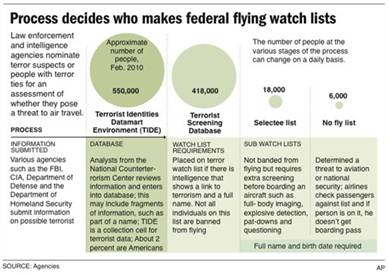
I am (or maybe now I can say was) among only two percent of people on the list who are US citizens. And I am (or was) one of 418,000 people in the Terrorist Screening Database and only one of 18,000 people selected for extra screening. This seems like an elite club of sorts. 18,000 people is not that many in the scheme of things. I was never denied a boarding pass or kept from flying which means I am not actually one of the 6,000 people on the No-Fly List. These people are not allowed to board planes. They are the super elite in the No-Fly Watch List community. Kind of like reverse Platinum Status.
Everything was looking good until I tried to plan ahead for my Spring travel. I may be able to print boarding passes, but I cannot seem to book flights anymore. Now why didn’t they think of this sooner? Forget about the No-Fly Watch List. If you’re on the list, they should just cut you off before the boarding pass and not even let you book a flight.  The No-Book Flight List.

I kept getting an error message when I tried booking my flight. When I called JetBlue to speak to an operator, she said, “I’ll have to charge you $15 to book it over the phone.”

“Umm, excuse me?” This was not going to work for me. “Since I can’t book it on the website, can you waive the fee?” I thought this was a reasonable request.

“No,” she said. “We haven’t had any complaints about the website.”I guess my problem did not rank as complaint status.

“So can you tell me what I’m supposed to do? You’re website doesn’t let me book the flight, so you’re going to charge me extra to do it over the phone?” I needed to speak to her leader. When I got the leader on the phone she was finally able to help me, but it sure did take a while.

Did I say JetBlue was my preferred airline? I may need to update that status.

Dear Diary

I sent Puchi a message on Facebook the other day. The message was titled “Memories,” and in it I wrote that I had been reading some of my old diaries. “Do you remember Johnny and Ronnie Afridi?” I asked her.

“You kept diaries?” she responded. “No wonder you remember all this stuff.” I think I made her nervous, because a few minutes later she wrote again, “I can’t believe you kept diaries all those years.”

One of my many diaries. 

The diary I was reading was written in late 1986 and early 1987 when I was back in Pakistan for an extended visit. Puchi and I used to go out to parties quite a lot back then, and I was struck by how all the same people, usually married, were carrying on affairs with each other.

At 19, I found myself hanging around a lot of middle-aged people. They would ask me what I did. “Are you a travel agent?” I gather they said this, because they considered it a respectable career for a young woman.

So I started answering, “No, I’m a writer.” And I began a novella (in my diary) titled the “The Young and the Eligible,” mostly about the dramas that were  unfolding all around me in the Islamabad social circles we were frequenting. For example, Johnny’s wife left him for Ronnie, his identical twin brother. Johnny shifted his affections to Puchi. Tina was taken by Johnny. Puchi had a thing for a man we called Beau. Beau was in love with a Sri Lankan woman.  And then there were a whole lot of Frenchmen who may have been gays.

The one story that may be in an earlier  diary that I would like to tell is when Puchi met David Bowie. I asked her, “Can I tell your David Bowie story? If so, please dilate on some details. I know you were fourteen, because I have my diaries.” But it is her story, so I feel I need permission to tell the full version.  She said she is thinking about it and will get back to me. I have not heard from her since.

Fish Freak Me Out

I have an irrational fear of fish. I like eating fish, I just don’t like swimming with them. This means I am most comfortable in a swimming pool, and most uncomfortable in any kind of water that is home to living creatures. Ponds and lakes are the worst in my opinion, followed by rivers and oceans.

I like to swim, and I like the ocean but swimming in the ocean can stress me out. For years I tried to hide this fact from most people. “Let’s go swimming!” my friends would say running into the ocean.

“I’m right behind you!” I’d yell. “I just want to get a little more sun.” This would buy me some time and if I was lucky, they’d be back before I would have to go in.  Otherwise, I would reluctantly go into the ocean, but I was always twitching and turning. “Was that a fish that just brushed up against my leg?”

With my family, I was more transparent about my fear of swimming in the ocean. We would often take our winter holidays near the beach. In early December of 1983 I wrote my father a letter from boarding school in Connecticut. He was in Pakistan. “I think we’re going to Panama for Christmas break. I’m not too keen on it, but it will be okay.”

One of our cousins was living in Panama City with her husband and children, and my mother arranged a trip for us to visit them and other parts of Panama over the winter holiday. Puchi, Mimo, and I packed our bathing suits and beachwear and left for Panama with our mother in late December. Our friends Peter and Joel joined us for parts of the trip.

Earlier that year, in August of 1983,  Manuel Noriega had assumed power of Panama,  promoting himself to General and becoming the military dictator until 1989 when the US invaded Panama, removed him from power, and tried him for drug trafficking, racketeering, and money-laundering.

While he was in power, Noriega was on the CIA payroll, and for much of the 1980s, he extended new rights to the US. Despite the canal treaties, he allowed the US government to set up listening posts in Panama which allowed the US to monitor sensitive communications in all of Central America and beyond. Noriega also aided the US-backed guerrillas in Nicaragua by acting as a conduit for US money, and according to some accounts, weapons. Noriega had been on the CIA’s payroll off and on since the 1950s, but towards the late 1980s, the US viewed him as a double agent believing that he was providing information not only to the US and its allies Taiwan and Israel, but also to communist Cuba.

The 1988 Senate Subcommittee on Terrorism, Narcotics and International Operations concluded that “the saga of Panama’s General Manuel Antonio Noriega represents one of the most serious foreign policy failures for the United States. Throughout the 1970s and the 1980s, Noriega was able to manipulate US policy toward his country, while skillfully accumulating near-absolute power in Panama. It is clear that each US government agency which had a relationship with Noriega turned a blind eye to his corruption and drug dealing, even as he was emerging as a key player on behalf of the Medellin Cartel.”

The Panama Canal, 1983 

“Didn’t you say one of your classmates lives in Panama City?” my mother said after we arrived. “Ring her up.” My mother loved meeting new people and she’d rather have a local perspective than a tourist one. I didn’t want to impose on my friend’s winter holiday, but it was impossible to say no to my mother, so I reluctantly called my friend.

As it turned out, my friend’s mother was Noriega’s personal secretary and my cousin’s husband was a branch officer for BCCI, the Bank of Credit and Commerce International, providing personal banking services for Noriega. He later became embroiled in the BCCI scandal and would later be convicted for the money-laundering services he provided for Noriega. I wasn’t aware of the nuances of these political connections back then, I just remember we had a pretty good vacation, later realizing these ties to Noriega probably were partly the reason for the decadence we experienced.

For instance, in passing, we mentioned we might like to visit the San Blas Islands, an archipelago of 365 islands off the north coast of the Isthmus, the narrow strip of land that lies between the Caribbean Sea and the Pacific Ocean linking North and South America, east of the Panama Canal. The next thing we knew, a private plane was arranged. When we got to the small airport, there were seven of us and only six seats on the plane. Within moments, a new plane that could accommodate our party of seven arrived on the tarmac.

The San Blas islands were beautiful. For lunch we ordered fish, and the restaurant staff asked us to select one to our liking, pointing to a netted part of the sea where the fish identified for the restaurant kitchen were swimming in isolation. I was glad not to be swimming with the fish, especially since I was about to eat one of them.

 
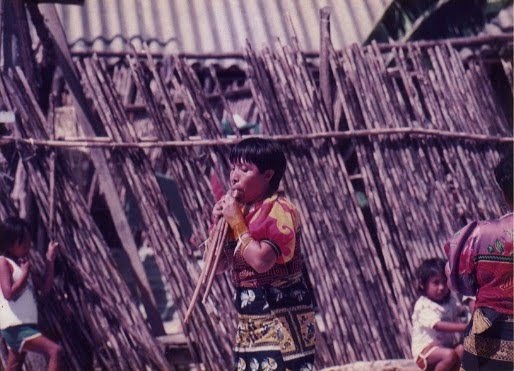
The Kuna Indians of the San Blas Islands

We also went to Taboga, a small beach resort, as well as the Panama Canal,  and after Joel and Peter left, the four of us went to Conta Dora. My friend’s mother said they would be visiting the same resort and invited us to lunch. We arrived at the hotel restaurant and thought we must have the wrong day or the wrong restaurant. “The restaurant is reserved for a private party,” the Maitre D’ informed us. There was one long, elaborate, U-shaped table set up in the middle of the outdoor veranda.

“We must have the days mixed up,” one of us said. “There must be some important people coming for this luncheon,” we predicted. It turned out, we were the guests of honor.  My friend’s mother had arranged the luncheon for us.

 
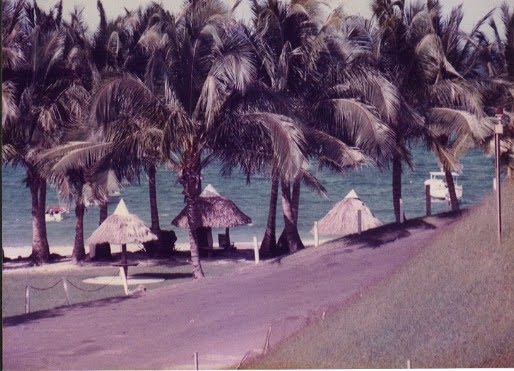
The view from the hotel restaurant in Conta Dora.

When we arrived at the resort a day or two earlier, I went to the room I shared with my mother, changed into my bathing suit, and announced that I was going to be spending the rest of  the day by the pool.

“Have you seen the water?” one of my sister’s said. “It’s beautiful. Clear and blue. Why would you want to go to the pool?”

“She doesn’t like to swim with the fish,” my mother reminded them.

 
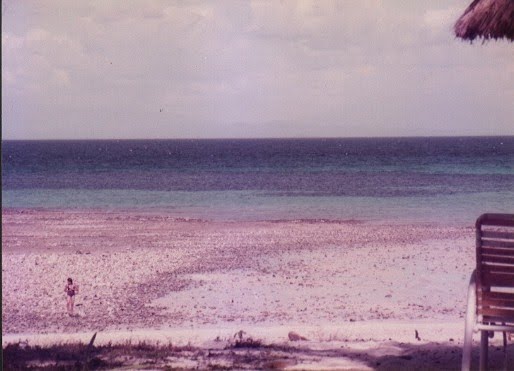
The beautiful Sea, in which I did not swim. 


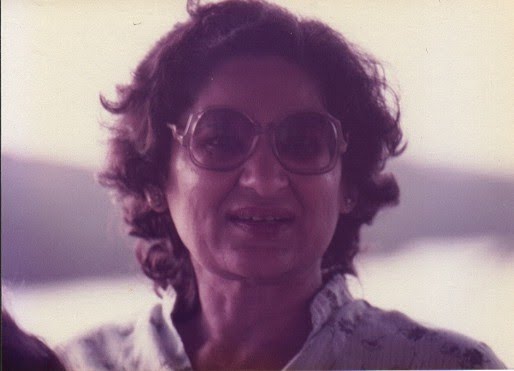
My mother looking relaxed in Taboga.

Sunny & Afzal Go to Washington

My mother and I were in my parent’s bedroom surveying her closet. She was selecting a sari to wear to Ronald Reagan’s inauguration in 1981.

“Will you take one of those tours of the White House?” I asked.

“I’ll only go to the White House if I’m invited,” she replied. “I’m not going on any public tours,” she said haughtily, her nose up in the air.

She selected a red and gold brocade sari, a pair of black evening shoes, and a matching hand bag. “Fold the sari nicely and put it in the suitcase with the other things,” she directed me.

My parents voted for Ronald Reagan in the 1980 election, the first US presidential election in which they could vote. They had been naturalized as US citizens the year before in 1979, the same year as the Iranian Revolution which deposed the Shah. Later that same year, 53 Americans were taken hostage for 444 days, from November 4, 1979 to January 20, 1981, symbolically released the same day Reagan was inaugurated into office.

When the hostages were taken, Puchi and I were living in Pakistan, attending the International School of Islamabad. The superintendent of our school, a man by the name of William Keough, had previously been the superintendent of the American School in Tehran. After the Iranian Revolution, he was posted to the International School in Islamabad. That November, Mr. Keough returned to Tehran to finish up business and pack the last of his things, and was taken hostage with the other Americans on November 4.

Anti-Americanism was spreading through Central and South Asia, and the American embassy in Islamabad was also attacked later that November, the same day that Puchi and I were to fly to Karachi on our way to Connecticut for the Thanksgiving holiday. The previous month, in October, we received a telex, to my great joy, “You are cordially invited to 112 Stoner Drive for Thanksgiving Dinner.” I thought my parents were responding to the misery I often expressed about having to live in Pakistan during my junior high school years, but in actuality, our names had come up for US citizenship and we returned to Connecticut for the Naturalization Oath Ceremony just as the Americans were being evacuated from Pakistan.

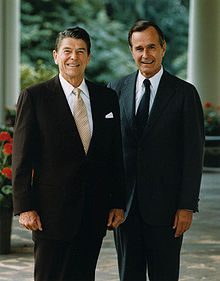
Before Reagan won the Republican presidential primary, my mother was keen on George H. W. Bush. She supported the elder Bush in the primaries and even hosted a fundraiser for him at our home in Connecticut. She was active in the West Hartford Republican Women’s Club.

I wasn’t home the day George Bush came over for the fundraiser, but I remember a photo of Mimo, dressed in a blue shalwar kameez, shaking his hand.

My mother never received a formal invitation to the White House, but I know she enjoyed the inauguration.

Eight years later in 1988, I cast my ballot for George H. W. Bush in the first presidential election in which I could vote. My family was Republican and I was comfortably following in their foot steps. I was towing the party line. As I became more politicized in later years, I changed my party affiliation, but I always like to tell people that I voted for Bush in 1988. It just goes to show you, a person really can change.

Wedding Blues

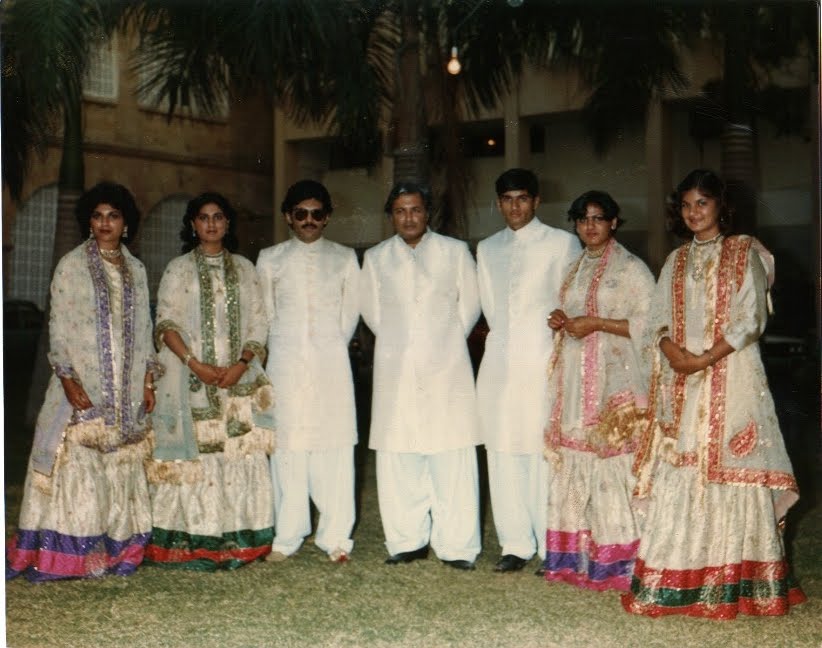
My mother was in a bad mood. “What do you mean it’s too long?” she said when I told her I didn’t think my Gharara fit.  I wanted to know why it was so long and billowing. And what was it anyway, pants or a skirt? Why were they so wide legged? Were they coulots? And the Kurta, or shirt, seemed too short. We were in Karachi for Baba’s wedding, which was quite a production. Pakistani weddings are generally a big deal. Especially in my extended family.

“Put on the Gharara and go find a pair of high heels if it’s too long.” She said about to raise her voice. I was twelve and feeling uncomfortable in the fancy wedding outfits which seemed foreign to me. And I thought I was too young to be wearing high heels, but given her worsening mood, I decided to keep this to myself.

 The six of us at Baba’s wedding photographed with our father. 
From the left: Puchi, Muna, Baba, Aba, Tito, Mimo, and me. 
My sisters and I are wearing Ghararas. At twelve, I am almost as tall as Tito, thanks to the three inch heels I was wearing.

Typically there are seven days and nights of functions involving custom-made ornate outfits, hair and make-up, jewelry, and a myriad of other details including outdoor tents, catering  and seating for hundreds of guests as well as several gifts for the new bride including multiple sets of jewels. There’s the Mehndi, which takes place the day before the actual wedding, a ceremony of mostly women who apply Mehndi, or Henna as it is known in the West, to the bride’s hands and feet, and then all the ladies sing, dance, and bless the bride as they hop around her.

There’s also usually a musical evening, and for Baba’s wedding this included a private concert by the Sabri Brothers, a well-known musical group trained  in Qawwali and North Indian classical music. There’s the Nikah, a small private ceremony for the bride and groom to sign their marriage contract. And then the actual wedding celebration which is typically hosted by the bride’s family. On the final night of festivities is the Walima, or reception for the bride and groom as their first full public event together.

 
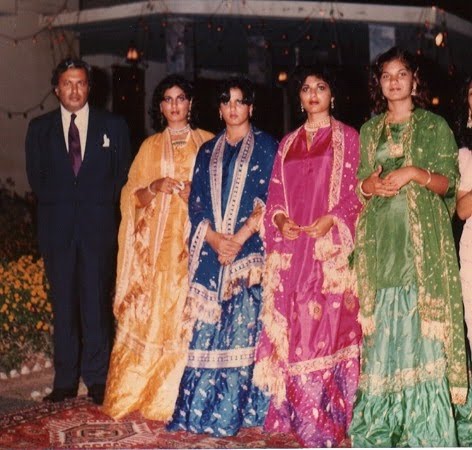
Another function, another Gharara. The Khan sisters with our father on the night of the musical evening.
From the left: Aba, Muna, Mimo, Puchi, and me.

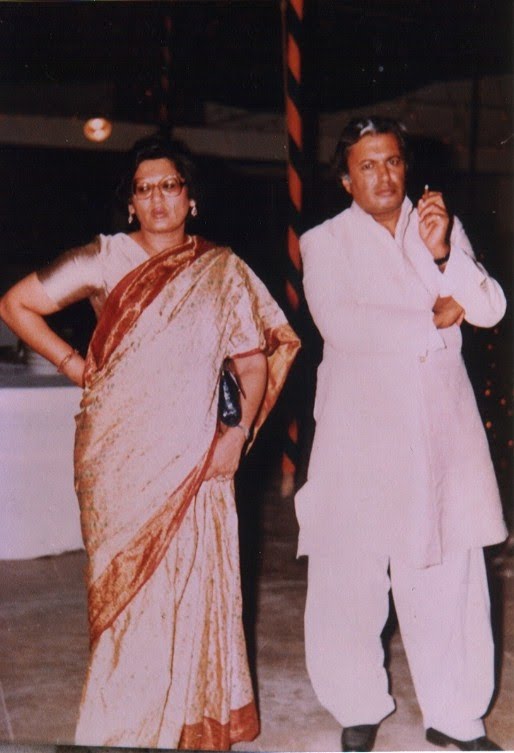
At the time, the Pakistani wedding custom was new to me. For the several years prior to the wedding, we had been mostly living in Connecticut. I was becoming increasingly Americanized and I thought these Pakistani wedding traditions were too elaborate. I think my parents may have thought so too. Towards the end of the week of festivities they did not look very festive.

This picture is among my favorite photos of my parents. They are both scowling in a way that is so authentic and unfiltered. It wasn’t the first time I had seen these expressions on their faces, nor was it the last. It’s clearly a look that got passed down to their children. Here I am trying it out early.

Piddles and Bits

Have I mentioned that I sometimes work from home? Generally this works out well, except when the dog barks in the middle of a conference call. Then I just say, “Pay no attention to the barking dog.” Fortunately this does not happen that often.

We’ve had Rosie for about six months. Jenny had been angling for a dog for sometime and I was warm to the idea too.

About a year ago, I was getting ready to go on a work trip, and Jenny said, “When you get back, there’s something I want to tell you.”

“When I get back? No way. Tell me now.”

“I’ve decided,” Jenny started to say, “That I’m getting a dog.”

You’re getting a dog?” I asked. “What about we’re getting a dog?” I mean, we do live in the same house.

I liked the idea of  getting a dog. We had already ruled out children, deciding that we are selfish and have too many bad habits. And we both wanted to keep it that way. But a dog is a different story. It’s possible to be selfish and have bad habits with a dog. My main issue with getting a dog was that both Jenny and I are so busy, I wondered if we’d be able to care for a dog.

“Do we really have time to take care of a dog?” I asked. Jenny reminded me that she was on sabbatical from her job at the University and it might be the perfect time to get a dog. And, with my travel schedule being what it is, Jenny would have some companionship when I am away.

But still, I was not convinced. I did not want Jenny to get distracted by the dog since she was supposed to be writing a book during  her sabbatical. So I decided to take a page from the Obama’s.

“When you finish your book, you can get a dog.” I said matter-of-factly. This was good motivation for writing, even Jenny thought so. But then, my situation changed slightly, and I started working from home more. Plus we almost got broken into, and both Jenny and I liked the idea of  a dog for extra security.

Jenny found Rosie on the internet, and we met her at a local shelter, fell in love, and brought her home. She looked to be a cross between a Border Collie and a Basenji. A sweet six-month old, red-headed, short-haired, medium-sized puppy named Rosie. She had been spayed earlier in the day and was groggy from the drugs and had a belly full of stitches when we brought her home. The next night, Jenny got on a plane to Korea for a week to attend a conference.

I was left alone with the new dog. We had various dogs in my family when I was growing up, but I have never had to care for one, so I was a little nervous. 

I asked some friends if they were available during the time that Jenny was away. “Why? Do you need a dog sitter?” One friend asked.

“No,” I said, “I’m the one who needs a sitter.” I wasn’t sure I really knew how to take care of a dog.

 
Rosie

Various friends came over and kept us company during the week Jenny was away, and I got a lot of good advice. For instance, I did not know that it is customary to name the function of urinating and pooping. Most people might call this pee pee or  poopie or potty, but I didn’t think that was going to work for us. So I considered, “Out.” I tried this for a day or two but it sounded strange.

“Go out, go out,” I would say when we were already outside. Plus my experienced dog-loving friends made a  good point. What if she came to recognize “out” as a command for pee and we happened to be sitting around watching TV and one of us said, “Let’s go out for dinner.” Would Rosie, hearing the word “out,” squat and do her business right there on the carpet? Not happening. I needed a new word.

I considered business. “Go do your business, Rosie,” I would direct. Or I might ask, “Did you do all your business, Rosie?” I thought this was going to work well, but then I remembered how often I work from home, mostly on the phone using all kinds of words, including business.  I might say, “We really need a new business model.” Or “I don’t really think it’s our business to worry about that.” This could get problematic, me sitting at my desk saying “business” a lot would just confuse Rosie or make her do her business on the carpet, since I tend not to be outside when I am conducting my business from home.

I needed another word. I gave this more thought and decided on Piddles and Bits. Piddles for Number 1 and Bits for Number 2.

What I really liked about this new combination is that Piddles and Bits, besides the obvious reference to Kibbles ‘n Bits, had the added benefit of a little jingle.

“Piddle in the Middle, Poop Poop-a-Diddle.”

I often sing this little ditty for Rosie when she needs to go outside and do her business. Jenny gets a good laugh, and I even catch Rosie smiling sometimes.

 
Rosie, basking in the glow and doing what she does best, lounging.

Let’s Do the Numbers

My shameless effort at self-promotion has yielded a twenty-five percent increase in my “followers.” This is good and bad. A twenty five percent increase is respectable for a twenty-four hour period.  In the last day, I increased my followers from fifteen to twenty. Twenty is a good number. A group of twenty is often referred to as a score, so you could say I scored.

But analyzed a different way, it is not so impressive. I know that 116 people have viewed my Blog since I posted Follow the Leader yesterday. Those 116 people loaded 241 pages, which is neither here nor there, but provides good context and 241 sounds good. Now just to complicate things a bit further, since I started this Blog, it has been visited a total of 4,347 times. Also an impressive number considering I started this little hobby just over six weeks ago. But 4,347 in relation to 20 followers somehow does not seem good. It’s less than .5 percent. That’s point five percent, also known as less than one percent.

Analyzed yet another way, of  the 116 people who viewed my blog in the last day only five joined up as followers. Which is less than 5 percent, which is better than .5 percent. But see how fast twenty five percent can turn into five percent? I was up twenty five percent, and now I’m down twenty percent, just like that.

That’s what some people would call small potatoes. But me? I’m just grateful that five more people are willing to be publicly identified about the fact that they read my Blog. The rest of the people reading may not want to be so open about it, which I can totally understand.

I also appreciate the effort that went into clicking the “Follow” button. My sister, Puchi had a hard time with it.

“I have pressed that button on the top right a few times in order to follow you,” she commented. “However, nothing happens and I felt that I had been rejected as a follower…so now I am looking for having another purpose in your life since I failed as a follower.” I know she was being all ultra-sensitive because I wrote about how sometimes I reject the comments she leaves on my Blog. (See Puchi Calling, posted February 20, 2010).

I told Puchi that I refused to accept that she had failed as a follower. “Consider doing the POP or PUP Analysis,” I suggested. “Or maybe you need a google account?”  It’s really not that complicated I told her. “After all, there are 19 others who have figured it out.”

Puchi is no quitter, so she kept at it. She wrote later today, “Oops, it seems that when I decided to follow you I chose to do it anonymously…that’s why it never showed up. Well here I am, all accounted for.” Now that is what I call sisterhood.

Now if  I could just get Jenny to start following me.

Follow the Leader

I thought Jenny should know that I was bar-hopping on the Wednesday night of last week’s work trip. After all, she was keeping the household running and managing the care and feeding of the dog while I was away. “I’m at a dive gay bar with Rockwood folks in Penngrove,” I texted her from the Black Cat Cafe.

Jenny responded that this was probably where one of our former tenants worked. “Oh, really?” I asked. “Was she from around these parts?”

Jenny, who has very good listening skills wrote back, “Were you not listening all those hours?” She raised a good point, we did have long conversations in the backyard with our former tenant and she probably did mention something about working at a dive bar in Penngrove when I was not listening.

I assured Jenny, “I guess not, but I have been practicing my active listening skills this week.” I was at the Rockwood Leadership Institute where we learned a lot about the importance of active listening.

I told Jenny, that the dive gay bar in Penngrove was not all that we had hoped it would be. It was open mic night and the presentations, in our opinion, were not of the highest quality. Jenny, who is a quick study, was getting the Rockwood groove. “What’s your vision?” she asked.

I told her our immediate vision involved a hoochie bar in downtown Petaluma. One of the members of our small (bar hopping) group found it on Yelp and it looked promising.

“That does not sound good,” Jenny responded. “So the visioning piece, as they call it, involves free-ranging on hump day?”

“Yes,” I said. “We have found our purpose and our vision, and tomorrow we will be having essential conversations.”

But first, there was the hoochie bar. We drove back to Petaluma and decided we would appoint a subcommittee to investigate the hoochie bar while the rest of us went into the Pub across the street and ordered some drinks. The subcommittee reported back from their site visit to the hoochie bar, and informed us that there was only one lonely hoochie mama dancing by herself which was depressing, so we stayed put and got a head start on having some essential conversations.

Roz and I decided that we needed to have an essential conversation about movement building. So we began to plan our essential conversation. This was on the next day’s agenda,  where different groupings of us would be hosting conversations.

The next day we had to give our essential conversation a title. I would have been fine with calling our conversation Funders’ Role in Movement Building, or some such boring title, but then Vini and Todd raised the bar when they titled their conversation a catchy, “What’s Love Got to Do With It?” They were hosting a conversation about supporting community leaders.

So Roz and I decided to call our conversation, “Who Let the DAWGS Out?” We felt this was more than appropriate since after finalizing the PUP Analysis (Purpose Unleashing Power), DAWG now stands for Doing a World of Good. (See: Pass the Talking Stick, posted February 28, 2010).

Another group decided to call their session. “Pump It!” They were discussing strategies for turning up the dial on leadership development. That group said they were a little anal retentive in planning their session. To which our trainer, who I will call LaWanda, said, “With a name like ‘Pump It!’ you might not want to be anal retentive.”And then Todd started forming the Ass Slander committee to raise awareness about all the ways in which the anus is used in a derogatory way.

That night we had to split up into groups and come up with a skit. We had very clear guidelines and were told that we could use any items lying around as props as long as we returned them. By now I had really improved my active listening skills and heard one of the participants asking LaWanda a question. “Do you have a special dong?” Not that it was immediately apparent to us, but my Institute colleague was referring to the device that LaWanda used to ring her Tibetan Bell when she wanted us to stop doing something or start doing something.

I looked at LaWanda and answered for her since she still looked surprised by the question, “Well, maybe at home,” I offered. I didn’t think bringing a dong to a training was very professional and I knew LaWanda to be on the up and up.

 
LaWanda’s bell (or more accurately, singing bowl) looked something like this.

My experience at Rockwood was good for a number of reasons. I laughed a lot, I made new friends, I furthered my skills as a leader, and I came closer to realizing my vision and purpose. Part of my vision involves transformative change, and I think to do that we need to reach a lot more people. Which is where this blog comes into relevance. You may think this is frivolous, but I have a larger purpose. I am hoping that the spirit of levity which I bring to this blog (and hopefully to the subsequent book project) will have wide appeal which might help us build a broader-based movement for social change. Are you still with me?

Ok, so this finally brings me to my point. I have a modest number of followers on this blog, fifteen to be exact. I know more people than that are reading the blog and I am hoping they will also make it official by “following” me. I think I will look more favorable to potential publishers if I have more followers, which will also serve my vision of movement building and transformative change. So if you are reading this, won’t you give me your vote of confidence, or khanfidence, and follow this leader?

Just click the button on the top right hand side of this page where it Says “Follow.” I can assure you it really does not mean much in the way of daily alerts or anything. I follow a couple of blogs and nothing happens when you click the button, except that it will help build my confidence if I can grow my readership into the triple digits. In my line of work, we call this measurable outcomes.

Pass the Talking Stick

I was texting Jenny, “Having found my purpose, I am now going to work on my vision.” Since I travel so much for work, I try to keep her informed about the kinds of things I am up to.

“Umm, What?” She texted back.

Jenny is in a different line of work than me.  She is a humanities professor, so when I say things like, “I really need to see measurable outcomes,” she looks at me quizzically.

Last year we had a dinner party and I noticed all our friends were interrupting each other so I told them about the Talking Stick.

“The what?” everyone responded almost in unison. I explained the concept of the Talking Stick, which has been used for centuries by Native American Tribes as a means of just and impartial hearing.

“You are all interrupting each other. In my line of work, we are very intentional about giving everyone the space to talk, so sometimes, we pass around a Talking Stick, which can come in just about any form. When you are holding the Talking Stick, you are the one speaking and the others have to listen actively to what you are saying. Let’s try it!” I said passing around a fork to symbolize the Talking Stick.

They humored me. Though I think they rather liked the concept of the Talking Stick, because now I notice sometimes at parties, when someone is dominating the conversation, another person will say, “We need the Talking Stick.”

 
The talking stick might look something like this.

Last week I was at a Rockwood Leadership Institute training called the Art of Leadership. I applied last fall for it and was excited when I was accepted.

We learned quite a lot in the Institute. Active listening. Staying centered on our purpose,  thinking carefully about our outcomes and process. This is called a POP analysis: Purpose, Outcomes, Process.

One of the nights we had a free night so some of us went out for cocktails. Around the third or fourth cocktail, we  started talking about how outcomes-focused philanthropy can be. So we made a friendly addition to the POP analysis. We came up with the PUP Analysis: Purpose Unleashing Power. What we liked about PUP is that it it can be a PUPPY that grows into a DAWG. If an idea or concept is in its infancy or if it is geared towards young people it can be a PUPPY: Process Unleashing Progressive Power for Youth. When it grows into a DAWG it is Doing a World of Good.

The other thing I learned is that it is really important to pay attention to how you say things, because it’s easy to misinterpret what gets said. For instance, at the training, my friend Todd said, “We should look for some far out liars.” And I said, “Why would we want to look for liars?” What he meant to say was, “Far outliers.”

Later, Todd was getting a little unnerved by all the negative comments people were making about the anus. He thinks when people say things like, “that’s so anal retentive,” it’s derogatory because he believes retaining things in one’s anus can be a source of pleasure.

He asked me if I would join his Ass Lander committee. And I said, “Why would I want to join an Ass Lander committee?” I have nothing against people landing on each others asses, but I am on enough committees and I wasn’t sure I wanted to join this one. “No, not the Ass Lander Committee, the Ass Slander Committee,” explained Todd.

“Oh, well in that case,” I said, “I’m in.” I wanted to be supportive of him and his efforts to reclaim the ass as a source of pleasure.

I told Jenny about the Ass Slander Committee when I got home, and she’s considering joining too. I love it when our activist and academic worlds come closer together.

No-Fly Watch List: Part 6

I think the Department of Homeland Security is reading my blog. Checking-in at the ticket counter on my way home from San Francisco this week was much faster. I didn’t even try printing my boarding pass in advance this time. What’s the point, really? I know I’m on the No-Fly Watch List so why bother?

The nice woman at the ticket counter checked me in. She didn’t fill out the No-Fly Watch List clearance form and handed me back my license. So I said, “No, No-Fly Watch List this time?”

And she said, “Oh yes, you’re on it.”

“But I didn’t see you filling out the form,” I responded.

“I’m doing it right now,” she said as she continued typing on the computer. Wow, that was fast, it was only last week that I suggested that it would be much more efficient, cost-effective, and environmentally friendly if they coordinated the No-Fly Watch List Clearance form information in a centralized database at the Department of Homeland Security. Were they reading my blog? And acting on my suggestions? Maybe I have a future consulting for the Department of Homeland Security, I thought to myself.

But no, the ticket agent was just being efficient. “Oh, I still have to fill out the form,” she informed me. “But I’ll just use the information on the computer and do it later so I don’t have to keep you waiting. So thoughtful.

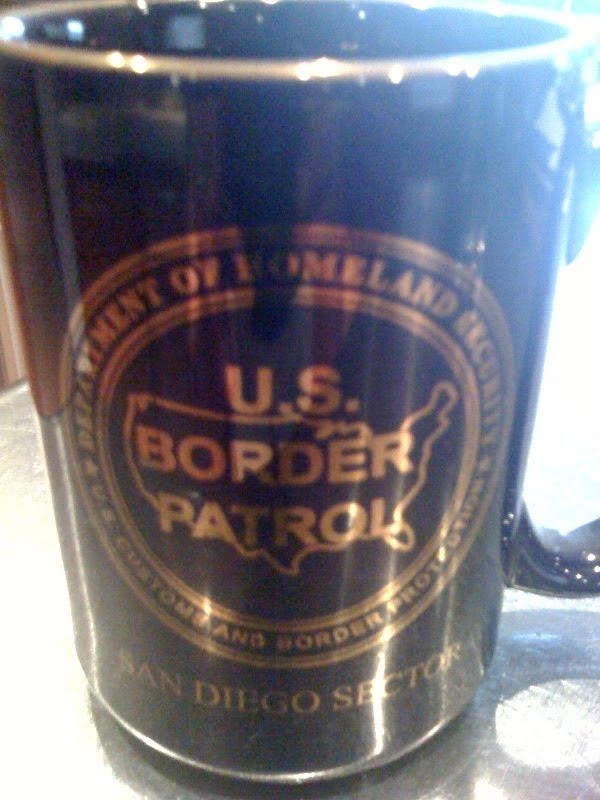
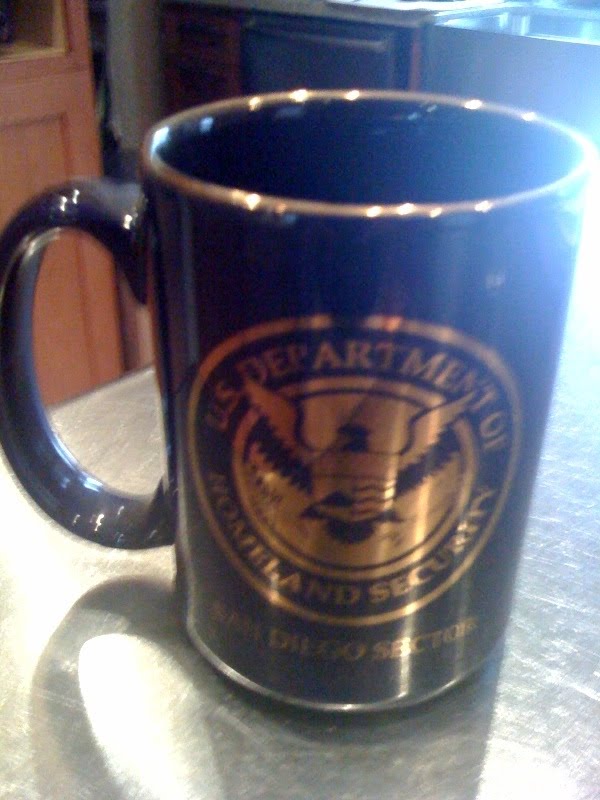
I’ve interacted with the Department of Homeland Security before. I even have a special Department of Homeland Security mug, given to me by a US Border Patrol agent.


A few years ago I organized a tour of the California Mexico border for the staff and board of the Women’s Foundation of California, where I am employed.  We decided to coordinate the tour through the US Border Patrol to get the full inside scoop. My liaison at the Border Patrol was a woman named Wendi, a Senior Patrol Agent. Wendi was very friendly and guided us  along the double fence that separates Mexico from California. She gave us an overview of how the Border Patrol is protecting our security by keeping out the vulnerable people who come to the US seeking work, cleaning our houses, caring for our children, and working the farms so we all have fresh produce whenever we want.

I didn’t fault Wendi for the flaws in US immigration policy. She was just doing her job. Wendi became interested in working for the US Border Patrol because her father, a Mexican, used to help people who would get injured trying to cross the border. He did this work from Mexico, where Wendi grew up. She herself is an immigrant too, which made it harder for me to understand why she wanted to keep other immigrants out. She told me that her father was not happy when she decided to pursue a career with the US Border Patrol.

About a week after I returned home, I got a package in the mail from Wendi. She sent me a thank you note for taking interest in her work, and enclosed a Department of Homeland Security mug, which I feature prominently in my office.