The house burned to the ground in July of 2012 just a few days shy of my mother’s birthday. If she had been alive, my mother, Sunny Afzal Khan, would have turned 77 that year and like many of the birthdays that came before, she would have celebrated it surrounded by family and friends at her beloved summer retreat in Nathiagali, one of the many hill stations in the Pakistani Himalayas where our family had been going since the 1960s. But on that day in July, fire engulfed the house, the flames burst out of the roof and stood as tall as some of the hundred year old pine trees on top of the hillside. Within hours, the fire reduced the house to a pile of rubble.


Our house was named Miranjani House because it looked onto Miranjani Mountain. Miranjani House was a historic landmark that my parents purchased through a lease to own agreement in 1969 from a man named Shiekh Iqbal– a tender old man who indulged me when I was a young girl with Laddus, my favorite sweet treat.
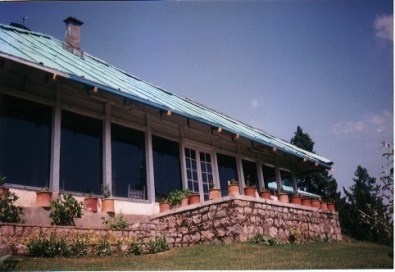
The original Miranjani House
My earliest memories are of Miranjani House. It was among my favorite places in the world. A large rustic cabin with a blue tin roof, wood floors and a square stone fireplace with a copper chimney in the living room that we would all gather around in the evenings. The bedrooms were full of bunk beds, and in the summer months the house was teeming with children. The dining table was long and easily sat thirty or forty people. There are six children in our family and I am the youngest. I have three older sisters and two older brothers. In addition to us we would be joined by friends, aunts and uncles, and cousins. My mother loved sharing our home and welcomed many guests over the years.
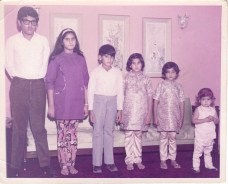
The six kids. From L to R: Samad, Gulfiza, Asad, Fazilet, Chanel, and Surina.
In the summer when the house was full of kids, my father, M. Afzal Khan, a retired Navy Commander who went on to found a successful poultry breeding business, would crave peace and quiet. We would tumble out of bed in search of breakfast which would usually be laid out on the kids dining table.
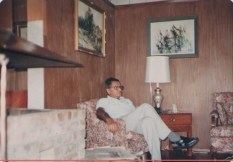
My father enjoying his solitude at Miranjani House in the 1980s.
“Breakfast is up there this morning,” my father said on more than one occasion, pointing to Miranjani Mountain. Picnic baskets were packed in advance and we kids would go off hiking up the mountain munching on fruit and snacks until we got to the top, a beautiful open meadow where we would have our picnic.
When they entered into the lease to purchase agreement with Shiekh Iqbal, my mother did not like the layout. “The kitchen had the best views,” she would say. So she hired a carpenter, and the two of them went about remodeling the house so that the living room had the best views of Miranjani Mountain.
“Architects always marvel,” my mother would say, “that the house is standing on three beams.”
The house sat atop a seven or eight thousand foot high mountainside. We would be short of breath when we first arrived, needing to adjust to the altitude. We would sit in the garden looking out at the forests of cedar and pine trees. In July and August the fog would roll in.
“Come,” my father would beckon me. “It’s time to sweep the clouds out of the house.” We would each take a broom and sweep the fog that would make its way into the house. It was our little ritual. One I will never forget, even if the house is long gone, and even amidst a family property dispute that began after my parents death and continues to this day.
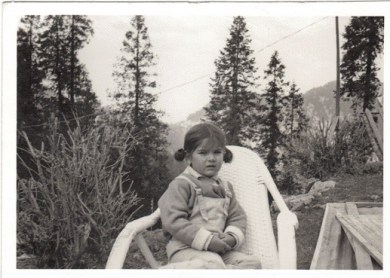
Surina as a young girl at Miranjani House.
When my mother was sick with cancer in the 1990s, my oldest brother, Samad Afzal Khan, convinced her that after the final payment was made on the house, she should put it in his wife, Lalarukh Samad Khan’s name to safeguard it against business debts that Samad alleges our father left behind when he died in 1989.
“I have the power of attorney on the house,” my mother told me in 1998. “I’ll make sure it reverts back to all of you kids.” She died before that happened and since then Samad has insisted that the house never belonged to our parents and has always belonged to his wife. But he can’t erase the memories or the reality that many people are witness to, that the house did in fact belong to our parents.
In November of 2011, through the Abbottabad courts, Samad and Lalarukh filed an ex parte decree, which is a decree passed against the defendants in absentia. By this time, the rest of us were living outside of Pakistan. As required by law, Samad and Lalarukh sent notice of the ex parte decree to all of us, but they sent it to old or fraudulent addresses and none of us received the notice. Once we learned of the decree, we challenged it in the courts in order to reclaim what rightfully belongs to us.
Meanwhile, less than one year later, the house burned to the ground–we don’t know what caused the fire, but we do know that it allowed Samad to realize a long-held dream of developing the property into a hotel and cottages. Now called “Miranjani Properties” the website for the development notes, “The management is constructing multiple luxury villas on the property which are available for sale or lease.”

After the house burned to the ground, construction began swiftly. Trees that were more than a hundred years old, were cut down. The hillside was carved up, creating environmental damage that may not be reparable. “The gated community will offer state of the art estates with a contemporary look,” notes the website. The problem is, the development is illegal.
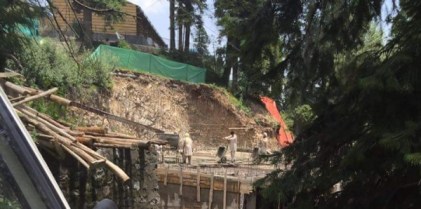
Samad and Lalarukh carved up the pristine hillside in order to develop the property.
My siblings and I are pursing justice through the courts which is a long process. We’ve been standing on the right side of history since our father’s death in 1989 and our mother’s death in 1999. For almost 30 years, our brother, Samad Afzal Khan, has tried to keep our parents’ estate from us. But we are not deterred. We are appalled at the environmental damage they have caused. We are repulsed by Samad and Lalarukh’s greed.
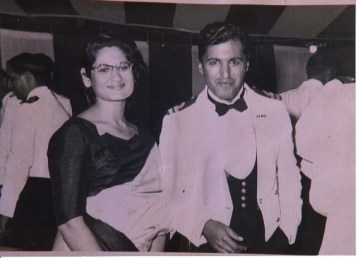
Sunny and Afzal Khan shortly after their wedding in the 1950s.
And we are determined to seek justice so that we might preserve the legacy of our parents.
In January of 2017, we won an important legal victory. A civil Judge in the Abbottabad Court ruled in our favor, setting aside the ex parte decree and allowing us to present the evidence that shows that we are the rightful heirs of Miranjani Property. Our legal efforts are sure to take many more years and we will be patient and resolute in seeking justice. We may not be able to restore the property to its early glory. We may not be able to repair the environmental damage. But we will continue to seek resolution so that the truth may prevail.
 Leaving Pakistan