No-Fly Watch List: Part 9

The mail came early this morning. “Looks like I got a response from the Department of Homeland Security,” I told Jenny as I opened the envelope.

I had submitted a Traveler Redress Inquiry Form to the Department of Homeland Security’s Traveler Redress Inquiry Program back in February when I learned I had been placed on the No-Fly Watch List. (See No Fly Watch List: Part 3, posted February 15, 2010).

For most of February and March, traveling was a hassle. I couldn’t print my boarding pass in advance. I waited in lines at the airport while the airline staff completed the No-Fly Watch List paperwork. I’d often get stopped for extra screening. I generally tried to have a good attitude about it, but flying as often as I do, I needed a long-term solution so I filed my paperwork with the Department of Homeland Security to try to get my name off the list. Sometime around late March I was able to print my boarding pass from home, which made me think the system was working. I filed my paperwork, and I am off the list. Hooray. But according to the letter I received, that may or may not be the case.

“What does the letter say?” Jenny asked.

“It says they have researched and completed review of my case.”

And then the letter goes on to say, “Security procedures and legal concerns mandate that we can neither confirm nor deny any information about you which may be within federal watchlists or reveal any law enforcement sensitive information.” That is so not helpful.

They also suggest I provide my redress control number when booking travel. “This information will assist new technologies being introduced in 2009-10 to help prevent misidentifications.”

And after all these not so helpful explanations, the letter concludes, “Despite these positive efforts, we cannot ensure your travel will be delay-free.” Thanks a lot.

I can only hope that the Department of Homeland Security may or may not have communicated this information to the Transportation Security Administration because for the past couple of months I have been able to print boarding passes out in advance and breeze through security. Have I triggered a new watch list status? Or did filing my paperwork actually help? Hard to tell.

Lost Luggage

We were sitting in the back of the plane. “Make sure your father is on the plane,” Ami said to Tito.

Aba had died a few days earlier in London where he was being treated for a rare illness. Mimo, Tito, and I flew to London as soon as we got the news, to accompany Ami back to Pakistan with our father’s body. His body was placed in a coffin which had a square piece of glass over his head so that we could see his face, which seemed to be turning bluer with every passing day. “Why do they have a piece of glass there?” I asked Mimo when we went to view his body at the mortuary. “Probably because he died here and the family will want to view the body when we get back to Pakistan,” she responded.

Tito went to the front of the plane to speak with the airline staff to make sure Aba’s coffin was in the cargo section.

“They can’t find him,” he said when he returned.

“Oh good God,” Ami said. “We’ve lost your father.” For some reason this seemed funny to us and we all started giggling.

The coffin was located several minutes later. “He’s still up to his tricks,” Ami said about Aba as if, even in death, he was still playing pranks by making his own coffin disappear.

When we landed in Islamabad we were met at the airport by Puchi, Muna and Baba and my father’s brothers and sisters who took us to our family home in Abbottabad for the funeral services. Hundreds of family and friends gathered at our house to mourn the loss of our father. The men and women were segregated with the men sitting outside and the women, many of them on the floor, sitting around the coffin. Some of them held prayer beads as they wailed in grief.

“Who are all these people?” I asked my sisters. I didn’t know most of the people who had gathered, so I went up to my old bedroom. Puchi and Mimo joined me a few minutes later and we sat there sneaking cigarettes. Occasionally one of our young nephews would burst into the room.

“Where’s Dada?” Ali, the three-year old asked about Aba, calling him the Urdu term for grandfather.

We sisters looked at each other, not knowing how to respond. How do you tell a three-year old that his grandfather is dead?

“Where do you think he is?” we asked, thinking the question might buy us some time as we figured out how to tell him the truth.

Distracted by his older brother, Asif, the two boys went running from the room, continuing to play their games. They probably thought we were having a party, not realizing it was a funeral.

A few minutes later, they came back in the room. “We know where Dada is!” they said excitedly.

“You do?” we asked. “Where is he?”

“He’s in that box in the room with all the old biddies! We saw him! Through the glass.” And sure enough, that was the truth.

Aba with his first grandchild, Asif, about seven years before he died.

London Calling

When I landed at Heathrow, I took the Tube to Hyde Park Corner Station. “It’s not far from the station,” Mimo instructed me on the phone before I left. “It may shock you to see him in this state,” she said about Aba, describing the feeding tube that went through his nose to his stomach. “So prepare yourself, and try not to act stunned when you see him.”

We were taking turns helping Ami take care of Aba. His health had declined rapidly after we sold the Stoner house. His muscles were deteriorating slowly. He could still walk, but had lost the ability to speak. And eventually he lost the ability to swallow, so he stopped eating, which is when he went to London for medical care. Ami and Aba were staying in a small two bedroom flat near Hyde Park that one of their friends had generously offered them.

Mimo came to the door when I arrived. Everyone seemed cheerful, despite the fact that Aba looked like a walking skeleton. “Foosie!” Ami greeted me. Aba was sitting on a chair in the living room with a blanket over his legs.

“Come,” Mimo said just as I was sitting down on the sofa. “I’ll show you how I do the laundry.There isn’t a washer dryer in the flat, so we have to go to the laundromat.”

She led me out of the building and straight to a pub where we both ordered a lager. “Are you okay?” Mimo asked. “It’s shocking at first,” she said. “But he’s in good spirits.”

We finished our beer, and headed to the laundry while Mimo explained the routine. She was leaving to go back to Connecticut the next day. The laundry needed to be done daily since he soiled himself and the bedding at night.

In the morning we’d bathe him. Towel him dry and put lotion on his body. He always put powder between his toes when he was healthy, so we continued that ritual. But we didn’t bother to dress him fully. It was too complicated. Instead we’d pull a t-shirt over his head and a makeshift diaper under his underwear and lead him to the chair in the living room where he sat happily most of the day. A blanket would cover his bare legs.

We fed him through the tube in his nose, keeping up with his rituals like afternoon tea. He had lost so much weight that we tried to load him down with calories, hoping he’d put on a few pounds. “Let’s put condensed milk in his tea,” I suggested to my mother.

“Good idea,” she said. I loaded his afternoon tea down with sugar and condensed milk. “It’s not like he can taste it,” I said to Ami.

When Akhter Aunty came to visit, Aba got out a piece of paper and a pen and wrote her a note. “They think I don’t know that they are putting condensed milk and sugar in my tea,” he wrote. “Please tell them to stop. All I want is a simple cup of Earl Grey tea.” He was serious, but the note made me smile.

“Too bad,” I teased him. “I’m the decision-maker now.”

He still had his sense of humor, too. On occasion, he’d get up from his chair, walk down the hall to the kitchen where Ami and I might be preparing food and motion for me. “What is it?” I’d ask. “Do you need something?”

I’d follow him down the hallway, marveling at how he seemed so comfortable walking around in a diaper. His whole life he never came down in the morning unless he was impeccably dressed. But that vanity disappeared with his illness.

He’d walk back into the living room and sit in his chair pointing to the blanket, which I would pick up and put back on his legs. About the third time this happened I figured out his trick.

“Wait just a minute,” I said. “You’ve been getting up from the chair for no reason, so the blanket falls to the ground and then you walk down the hallway, interrupt what I’m doing to make me come and put the blanket on you?” Well, I’m on to you now.” Aba smiled. That twinkle in his eye glistening.

Aba, before he got sick.

Haunted House

My father refused to sell the Stoner house, even though there was an interested buyer. “I wont sell to that man,” Aba said about Gary Blonder, a high-profile, flamboyant Hartford business man who made his fortune in used auto parts. “He’s a creep,” Mimo would say. And sure enough, Blonder was later convicted for tax evasion, fraud, and lying to federal authorities, the last of which was in 2005 for trying to conceal a $100,000 bond investment from federal bank regulators. He was sentenced to 28 months in prison for that crime.

Blonder was a shady character, but he had money and we needed to sell the house. “No,” was all my father would say when we broached the subject. His stubbornness caused the house to go into foreclosure (See Walk of Shame posted May 31, 2010).

The Stoner Mansion was a former estate of the Stoner Family. It was completed in 1928 for Louis Stoner, a manufacturer who became wealthy from the Jacobs Chuck company, which produces holding devices for stationary equipment and portable power tools. The property was sold off into single lots starting in the 1950s after Louis Stoner committed suicide and his widow, Clara Stoner, faced financial hardship. (See 112 Stoner Drive, posted January 26, 2010).

Before the land was sold, the estate encompassed the entire street and contained a small 9-hole golf course as well as a stable and a rose garden. The mansion remains at the top of the hill overlooking what used to be the golf course. My parents purchased the house in 1974 for a mere $180,000. I’m sure they must have refinanced or taken a second mortgage on the house in later years and were not able to keep up with the payments, especially after my father’s head injury in 1987, which among other things, led to financial troubles.

On the day of the public auction, we got the house ready and prepared ourselves for the indignity. Mr. and Mrs. Large, our close family friends came with a cashier’s check for $50,000 in hand, the amount required to bid on the house. They didn’t want the house, but thought that bidding on it would help drive the sale price up so that at least my father would be able to pay what he owed his multiple creditors.

An hour or so before the auction was set to start, we were all looking glum. “I can’t believe this is happening,” I said to Mimo. “Why wont he agree to sell it and spare us the embarrassment of a foreclosure?”

In the final hour, my father changed his mind. “Tell the bank I’ll agree to sell to Blonder,” he said quietly, keeping the house from going into foreclosure. The public auction was called off and the sale negotiations began in earnest. He sold the house to Blonder for $1.1 million, and even that didn’t cover all his debts.

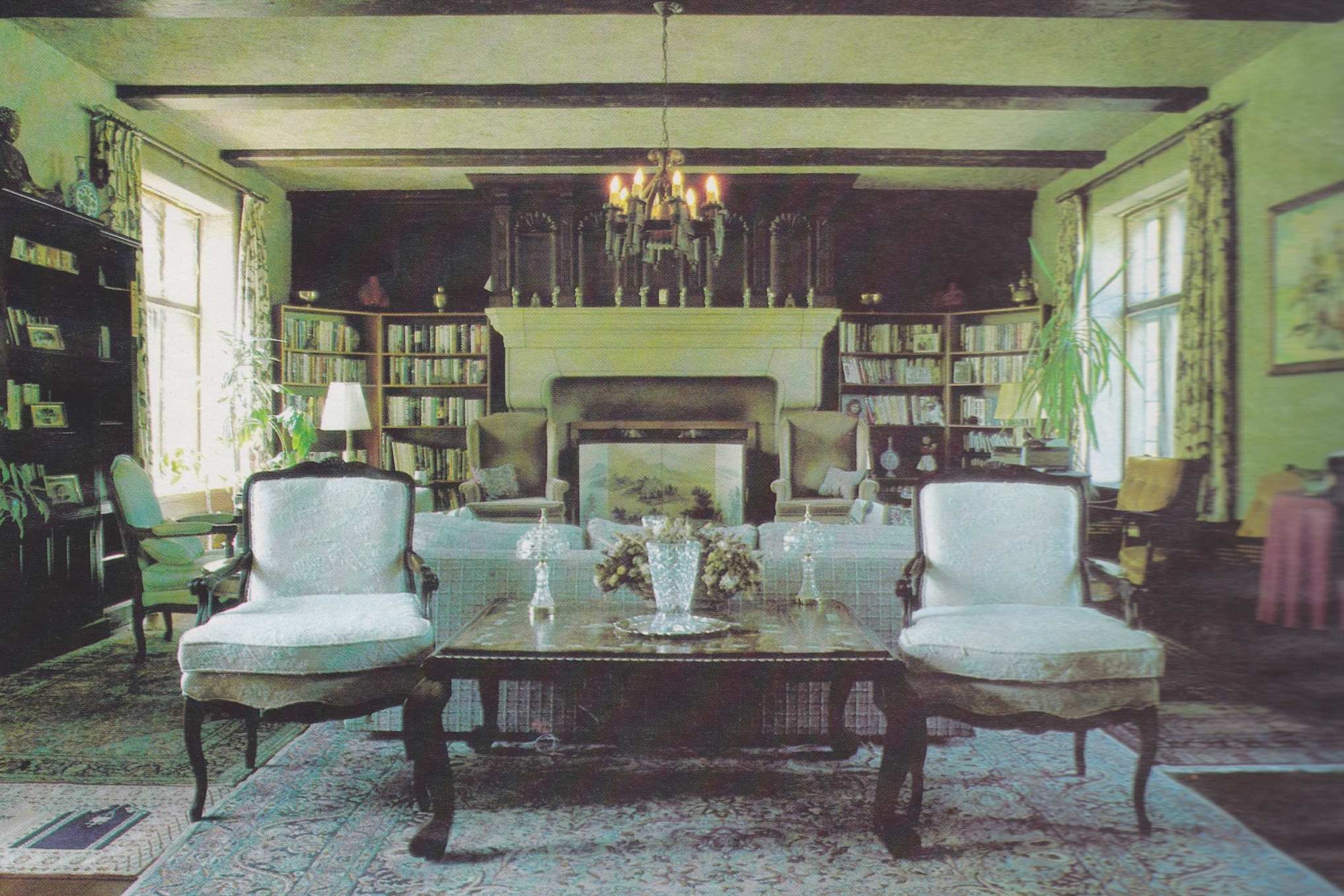
As we we packed up the house over the following weeks before the closing, my father would sit in the same chair in the Billiard Room, which we called the Big Room since we didn’t have a billiard table. There was plenty to pack up, fifteen years of memories tucked away in drawers and cabinets. A full attic and basement and piles and piles of stuff. We sold what we could and moved the rest into a friend’s storage facility. The Big Room was the last room to be packed, but eventually we had to pack it. And my father just sat there as we packed up around him. Boxes of his books and other artifacts. Until all that was left was the chair he sat on. We moved the chair after Aba walked out of the house for the last time.

My father hated leaving that house, and he hated that he had to sell it to Gary Blonder. Blonder didn’t last long in the house, which has had a series of owners after we moved out, most of whom I don’t think have really inhabited it for long.

When we lived in the house, I felt the presence of Clara Stoner’s ghost at various times. I think she mostly liked us and the hustle and bustle we brought to the house, but maybe she didn’t like Blonder and the other owners that resided in the house after him. Or maybe my father’s ghost lives there now too. He and Clara must have pretty high standards, because the house is for sale again.

The Big Room