When I saw the foreclosure sign, I panicked. The sign at the bottom of the driveway, for everyone to see, had big black letters painted on it that read, “Notice of Public Auction.” As I kept reading in stunned silence I saw the warning, “Do not remove: violation subject to punishment by court.”
I continued driving up to the house, engulfed in shame and embarrassment that my family’s financial troubles were so public, with what seemed like a slightly smaller version of a billboard. I had just returned from my shift at the Keg restaurant, where I was waiting tables. The money I earned from tips contributed to the household bills. My sister Mimo paid for most of the bills out of her own salary as the Manager of the Edelweiss Restaurant, a small popular German restaurant in West Hartford Center. I was responsible for the weekly groceries and for paying for the classes I was taking at the University of Connecticut, trying to finish my college education.
As soon as I got inside the house, I called Mimo who was working at the Edelweiss. “There’s a foreclosure sign at the end of the driveway,” I said. “Anyone who drives by can see it. All the neighbors.”
When Mimo got home, I suggested we take the sign down. “We have to get rid of it.” We drove down to the end of the driveway so we could make a quick exit once we got the sign out of the ground, avoiding a walk of shame up the driveway. Pulling the sign out was not easy. “How far did they push these stakes in?” we both grumbled, hoping no one would drive by to see us removing the foreclosure sign. The sign was bad enough, but to be caught removing it would have been in its own category of shame.
Our determination was strength enough to pull it out, and when we finally got it out of the ground, we threw it in the back of Mimo’s red Chevrolet Cavalier and drove it up the driveway.
“Now what are we supposed to do with it?” we both wondered.
“We have to hide it,” I said. “It’s illegal to pull it out of the ground.”
“Where should we put it?” Mimo pondered. “Maybe in the attic?” The house was plenty big enough. A full basement and attic the entire length of the house which had twenty-three rooms. Known as the Stoner Mansion, this had been our home in Connecticut for the last fifteen years, since 1974.
“That’s the first place someone would look,” I said. “We need a better hiding place.”
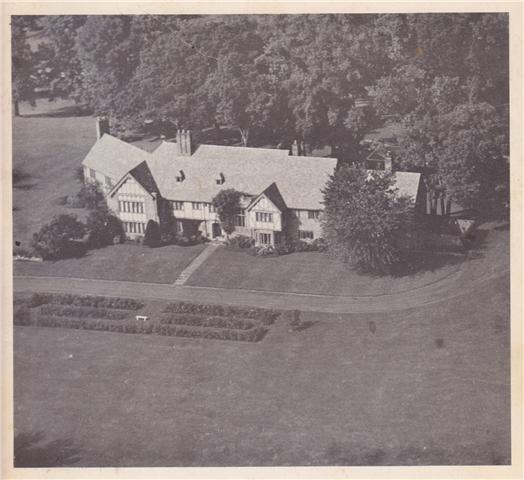
The Stoner Mansion circa 1973 when my parents purchased it.
When we first moved into the house, it was bustling, home to us six kids, my parents, and any number of guests who were welcome to stay as long as they liked. By the mid eighties my father’s chicken business was not doing well, and after he got sick in 1987 things went from bad to worse. But my father refused to sell the Stoner house, even though it was a shell of its former self. There were just three of us living there in 1988, the year the foreclosure sign went up– Mimo, me, and Aba when he was not in Pakistan trying to revive the chick business. Amin, our cook, was also with us. Mimo put him to work at the Edelweiss so he could earn money to send home to his family in Pakistan. And he continued to cook and clean for us, though with only three of us in the house there wasn’t much to do. Ami, Baba, Muna and Puchi had moved back to Pakistan, one by one. Tito was an officer in the US Marine Corps, living in San Diego with his wife and son, and Mimo and I stayed in Connecticut and kept the house running.
Aba would sit in the same chair in the Big Room at one end of the house, reading or watching television most of the day. Mimo and I generally hung out near the kitchen, usually late at night after our restaurant shifts. The rooms were mostly uninhabited and dark. The pool hadn’t been used in years.
“Let’s put it in the swimming pool,” I suggested. “No one will look there.”
“Good idea,” Mimo said. “Let’s go. You pick up that end of the sign.” We walked around to the back of the house and threw it in the deep end.
When the bank called inquiring about the missing sign, we responded with proud condescension, “What sign? I’m sure we haven’t any idea what you’re referring to.”
 Leaving Pakistan