I’m not a fan of the egg. I especially don’t like boiled eggs or fried eggs. If I’m going to eat an egg, the yolk and the whites have to be mixed together as in a scrambled egg. Or an omelet or fritatta is even better because it is more likely to have other things to mask the actual egg. The worst is a soft boiled egg, a poached egg or a fried egg over easy with the yolk all runny.
Given that my father was in the poultry breeding business, this was not a popular position in my family. We always had eggs. Often the eggs had double yolks, a great source of family pride since they came from my father’s chicken farms. In addition to grossing me out, the double-yolked eggs were also confusing to me, especially when it came to baking. If a recipe called for three eggs, how many was I supposed to put in if each egg had two yolks? One and a half? Or three? And how do you halve a raw egg anyway? I’m surprised I didn’t lose interest in baking at an early age.
As a child I was made to eat a concoction of eggs and milk. The egg would be dropped in a pot of boiling water for thirty seconds and then cracked open into a glass of milk and mixed together. “Nashta,” which means breakfast in English, one or another servant would say to me, following my mother’s instructions. I didn’t understand why I was being tortured like this. None of my other siblings was made to drink this horrific concoction.
As I grew up, I stayed away from anything to do with eggs and dairy which for some reason began to equal all white foods. Milk and mayonnaise were, and still are, the worst in my opinion. I can hardly watch someone eat a sandwich if it has mayonnaise creeping out the sides. Sometimes my friends will order fries and ask for a side of mayonnaise. This causes me anxiety since the thought of having to watch people willingly dip things in mayonnaise and then consume it is too much for me so I might say, “You’re going to dip your fries in mayonnaise? Why not try the ketchup? I hear it’s very good here.” And they might respond, “Oh no, it’s aioli,” as if I don’t know that aioli is just a fancy word for mayonnaise.
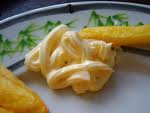
French fries served with mayonnaise is a problem in my world.
Milk is also in my “avoid white foods” category. I can’t drink it. I’ll take milk or cream in my coffee, but by the time it makes it into my coffee it turns a creamy chocolate brown, so that works for me. I like yogurt, but not plain (read: white) yogurt. If it’s berry flavored, preferably strawberry, I’ll eat it. I sometimes put coriander chutney in plain yogurt which causes it to turn green and then I am fine to eat it, usually with a samosa.
I like ice cream, but not vanilla. Chocolate is my favorite, but I’ll eat just about any kind as long as it is not white. I also don’t like whipped cream, unless it has been whipped with something to cause it to turn slightly off white, like chocolate or a little espresso. Malai, the clotted cream that rises to the top of milk, is in it’s on special category of disgusting as are all things related to it like Russ Malai. And no Kulfi or Lassi for me, please.
Rice is the exception. I’ll eat basmati rice, or jasmine rice and since it’s usually served with a masala of some kind or dal, it doesn’t stay white long anyway.
When I tell people about this strange behavior of mine related to white foods, they ask, “So you don’t like mashed potatoes?” And I say, “Oh, mashed potatoes are fine. Potatoes are off white, not white.” This causes them to look at me quizzically.
When Jenny and I first got together, she made one of her specialties, deviled eggs, which just about did me in. I looked at the platter of eggs, the hard boiled whites with a mixture of yolk and mayonnaise in the middle, and decided I had to tell her the truth. “I can’t eat that.”
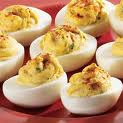
I can't eat deviled eggs.
 Leaving Pakistan