My father suggested we write letters to each other every week since we were often apart. He was in Pakistan running his poultry breeding business, and I was in Connecticut attending boarding school, and then New Orleans for college. We wrote to each other on aerogrammes, the thin blue paper with postage included that functioned as letter-writing paper and an envelope when folded into thirds.
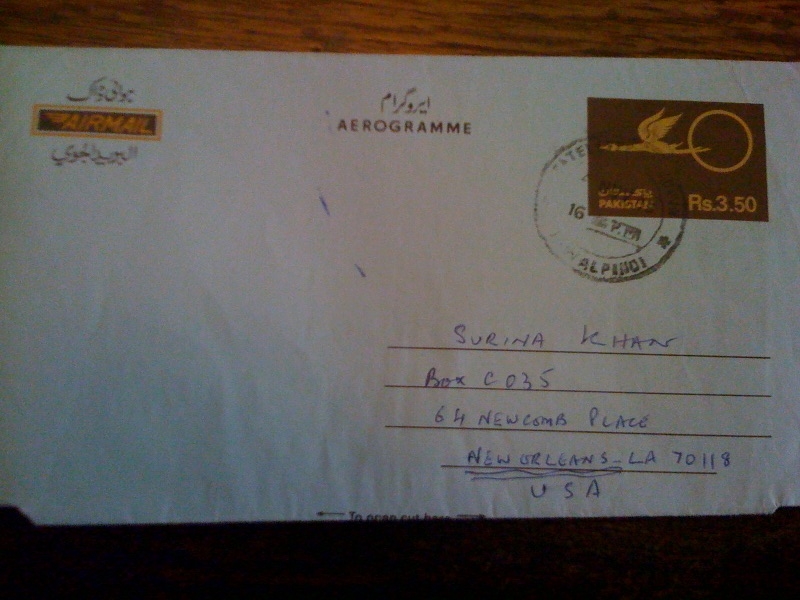
letters from my father
We mainly corresponded about grades, money and weight. “Things are going pretty well here,” I wrote from college, in October of 1985. “I’m working hard, but my grades aren’t where I want them to be yet, so I guess I’ll just keep working until my brain falls out.”
The letters are mostly boring. In November of 1985 I wrote, “There really isn’t much going on here. I’m keeping up with my studies. I really don’t have much more to say. I’m going to continue this tomorrow.” The next day I wrote, “Nothing happened since last night. So you get a pretty boring weekly letter. But don’t blame me it was your idea.” I think the weekly letter writing was getting on my nerves.
My father was very focused on my weight which seemed odd since he had not seen me in more than a year. I was a healthy size 10 and could sometimes even fit into an 8, which seemed respectable, especially now since I would love to be a size 10 again. Nevertheless a size 10 could easily become a 12 or (gasp!) a 14. Dieting was encouraged from the time you could understand language in my family. I went on my first diet at the age of eight. It didn’t help that my nickname was Fatty. Which thankfully turned into Fatty Foo, and eventually I had the courage to insist that everyone drop the Fatty and just call me Foo.
“I understand from Nafisa and Lalarukh that you are making every effort to put on more weight. This is the time in life you have to be careful and watch what you eat. Best way is to write down everything you eat and convert it to calories. At your age you have to watch it now otherwise you will become like Mimo. Basically everything is 100 calories like a cookie, an apple, or another fruit.”
I responded, “As for my weight, let’s not be sarcastic. It’s a pretty touchy subject.”
That didn’t stop him. “Dear Fatty,” my father wrote later that same November. “Received your letter and I’m glad your grades are going up and your weight (?) going down. I am confident that you will do well in your grades once you get used to the system.” This was encouraging, but then came the dieting diatribe.
“For your weight, the main problem is mental attitude and will power. If you make up your mind to bring it down, it is then easy, but lot of will power is needed to keep it down at the right level.” I was beginning to think this was more about his weight than mine.
“You should go on a zero carbohydrate diet to bring it down and then keep track of the total calories you consume. About 1500 calories a day should keep you trim. Write down what you eat daily and add up the calories. This way the stomach also shrinks and one does not feel hungry.” Really? Writing down what you eat makes your stomach shrink? I should have listened to him years ago.
“If it is any help,” he continued, offering me his daily regimen. “Breakfast: 1/2 glass of juice (anar) these days.” Anar is Pomegranate which I gather was in season in November. For breakfast, he also had green tea. “No sugar,” he was careful to emphasize any chance he got. And he had “one toast with malai and honey.” Malai is the clotted cream that rises to the surface of milk before it is skimmed off. It looks like a thick yellowish layer of fat. The sight of it made me gag. I already had a deep aversion to milk, and in my world malai was in its own special category of disgusting, right next to mayonnaise. Sometimes, a little speck of the malai would make its way into my tea, not having been skimmed properly from the milk. “Eeew!” I would shriek dropping my tea cup. “There’s malai in the milk!”
My father’s diet tips were not making sense. Malai is full of fat. So basically he was telling me he put a layer of fat on his toast and then covered it with honey. I wonder how many calories he allotted to this coveted morning ritual?
“Lunch,” he continued, “is meat cooked without any oil and also vegetable or daal without any oil. And one chapati.” I’m pretty sure chapati, which is made with wheat flour, is full of carbohydrates, but I didn’t want to point out this contradiction either.
For evening tea he had, “Two cups of green tea without sugar and no cookies or biscuits.” In case I was not paying attention, in the following week’s letter he wrote, “I lost two pounds in the last two weeks by cutting out United Bakery cookies at evening tea time and switching to green tea without sugar.”
His advice for dinner was not helpful. “Dinner,” he wrote, followed by all caps. “NO dinner. At night I have some fruit, an apple, or grapes and that’s it.” I was beginning to think the man had an eating disorder.
 Leaving Pakistan