I had only planned on staying in Pakistan for a few months. “I’m only staying two months,” I said to my mother the day I arrived in Islamabad from Connecticut. It was October of 1986. “I want to be back in Connecticut by New Year’s Eve,” I added.
Shortly after that I fractured my vertebrae in three places when Puchi insisted we go horse back riding. It took me several months to recover. (See Back in the Saddle, posted January 14, 2010 and Khanvalescense, posted February 8, 2010).
A month or two after my cast was removed, my father got sick. He started losing movement on the left side of his body during the course of one day, and we all thought he was having a stroke. There were no MRI machines in Islamabad so we flew him immediately to Karachi where the doctors discovered a collection of blood on the right side of his brain.
“They need to drill into his skull,” my mother told us. “To get the blood out.”
Ami, Puchi and I moved temporarily to Karachi and took up residence at our apartment at the Sind Club while Aba was hospitalized. Though I wasn’t too happy about extending my stay in Pakistan by what was sure to be another several months, I did love the Sind Club. Started as an exclusive European men’s residential club, the Sind Club was deluxe. In its early years though, women were not allowed in except to attend a ladies’ dinner held every two months and the celebrated Sind Club Ball organized once a year. Until 1950 when the Prime Minister of Pakistan lived across the road, the Sind Club was still used almost exclusively by Europeans.
The sign “Natives and dogs not allowed” was removed only a day after Mohammad Ali Jinnah took his oath as Governor-General of Pakistan on August 14th, 1947. I gather my mother’s family became members shortly after that because she always talked of going there as a young girl. After my parents married in 1955, they too became members and began maintaining an apartment there in the late 1960s.
For me, not knowing the history of the place until recently, it was a small slice of heaven. I learned to swim as a baby with my arm band floaties in the swimming pool. I ordered chicken patties and lemon tarts from the full service on-site bakery. I ordered Mulligatawny Soup in the fancy restaurant. At the snack bar by the swimming pool I would order fresh lime sodas or chicken masala or ice cream bars known to us as choc bars. The bearers or waiters all knew me by name and seemed never to move on to other jobs. They grew old as I grew up. There were lush gardens to be strolled around, as well as tennis courts, and room service in case I wanted to stay in. While my father was hospitalized, I took up tennis lessons.
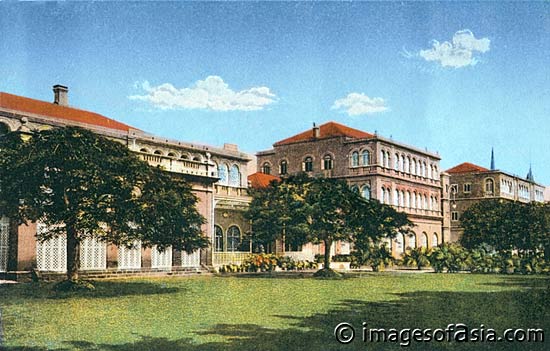
The Southern Italian-style sandstone buildings of the Sind Club.
After Aba recovered from the first surgery, they discovered more blood, so they had to drill for a second time. And after that they discovered a blood clot on his brain, which meant they had to open up his skull and remove the clot.
“He needs a blood donor,” my mother informed us. “I don’t want him getting just anyone’s blood so we’ll have to see whether one of you can give him blood since I’m not a match.”
My blood was a match as was Puchi’s and we both went to the Blood Bank at P.N.S. Shifa, the Naval hospital where my father was being treated, to donate our blood.
The Blood Donation certificate, dated 10-5-87 or 10 May 1987, notes that my Blood Group and Type is “Bee Positive,” which did not give me much confidence in the hospital. “They can’t even spell it correctly,” I said to Puchi. “And they also spelled my name wrong,” I added for emphasis.
The certificate also notes, “Blood donation does not entitle a donor to any extra ration, nor is such recommended on Medical Grounds.” What ration, I wondered? I did get a stale cookie after donating my blood. I wondered if people asked for seconds claiming they felt dizzy from all the bloodletting just so they could get an “extra ration?”
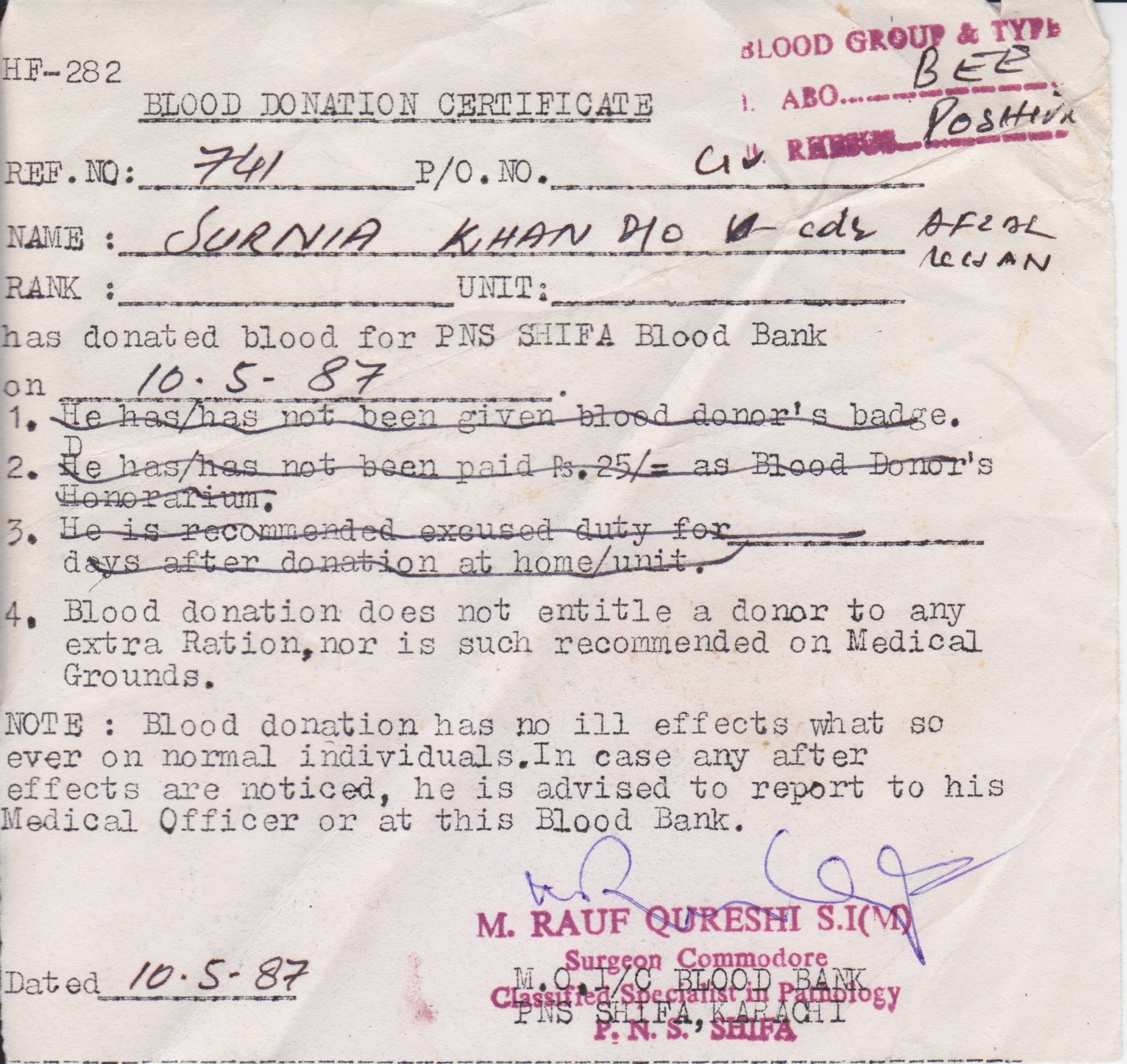
My Blood Donation Certificate
In case I felt woozy afterward, the certificate assured me, “Blood donation has no ill effects what so ever on normal individuals. In case any after effects are noticed, he is advised to report to his Medical Officer or at this Blood Bank.” I pointed this out to Puchi as well, “What is a normal individual? Am I normal?”
Doesn’t matter, at least I am Bee Positive, which according to some medical professionals makes me “carry the genetic potential for great malleability and the ability to thrive in changeable conditions.”
 Leaving Pakistan