Ami must have told Aba that I didn’t think he had a job (See Hold the Phone, posted on January 27, 2010). Shortly after our conversation, Puchi and I became Aba’s personal secretaries, and we became painfully aware of the details of the poultry breeding business. The daily fluctuations in the price per chick, for instance, or the production levels for each of the hatcheries.
Aba had an office set up in the basement with two desks and a typewriter. Why the basement when there were 23 rooms in the main house, I have yet to figure out. Maybe because he did not really spend much time in the office, his secretarial staff did. He would say, “Take dictation, I have a letter I need typed.” And I’d have to be sure to type it on a carbon copy and then file the copy.
The secretarial task I dreaded most was being asked to “get such and such person on the phone.” I was basically a shy kid, so the typing I could handle since it was a solitary task, but calling someone on the phone was nerve-racking. For one thing, my nickname in the family is Foo. So when I would place a phone call, I’d have to identify myself. “Hello, may I speak to such and such person?”
“Who’s calling?”
“This is Foo, calling for my father.” The response would almost always be, “Who?”
“Foo.”
“Sue? Sue who?” And it would go on and on like this.
Often he’d hand me a piece of paper with his poor penmanship, which I struggled to read, and would say, “Send this message over the Telex machine.” We got Telex machines for instant communication between Connecticut and Pakistan in the late seventies. In the Stoner house the Telex machine was in the TV room, and in the Islamabad house it was under the staircase on the first floor. My father was always using the latest technology. The Telex is a communications system consisting of teletypewriters connected to a telephonic network to send and receive signals.
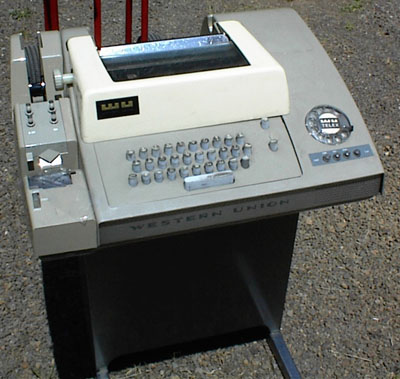
I don’t have a picture of our Telex machine, but I found a similar one on the internet.
A major advantage of the Telex is that the receipt of the message by the recipient could be confirmed with a high degree of certainty by the “answerback.” At the beginning of the message, we would transmit a WRU (Who aRe yoU) code, and the recipient machine would automatically initiate a response which was usually encoded in a rotating drum with pegs, much like a music box. The WRU code would also be sent at the end of the message, so a correct response would confirm that the connection had remained unbroken during the message transmission. This gave Telex a major advantage over less verifiable forms of communications such as telephone and fax. In order to send a Telex, we would have to prepare the message off-line, using a yellow paper tape. All common Telex machines incorporated a 5-hole paper-tape punch and reader. Once the paper tape had been prepared, the message could be transmitted quickly. Telex billing was always by connected duration, so minimizing the connected time saved us money. But, it was also possible to connect in “real time,” where I could type something standing at the Telex machine in Connecticut and the person standing in front of the Telex machine in the Islamabad house would immediately see my message. Now we call this instant messaging.
This early secretarial training has served me well. I have good phone etiquette and initiating phone conversations became so much easier when I started using my given name, Surina, instead of Foo. This early training also taught me to be more assertive, self-confident, and outgoing. Now, I have no problem calling people on the phone. And my typing skills have improved a little, too. I type faster now, but still with two fingers like I did back then. I never did learn the QWERTY way.
 Leaving Pakistan